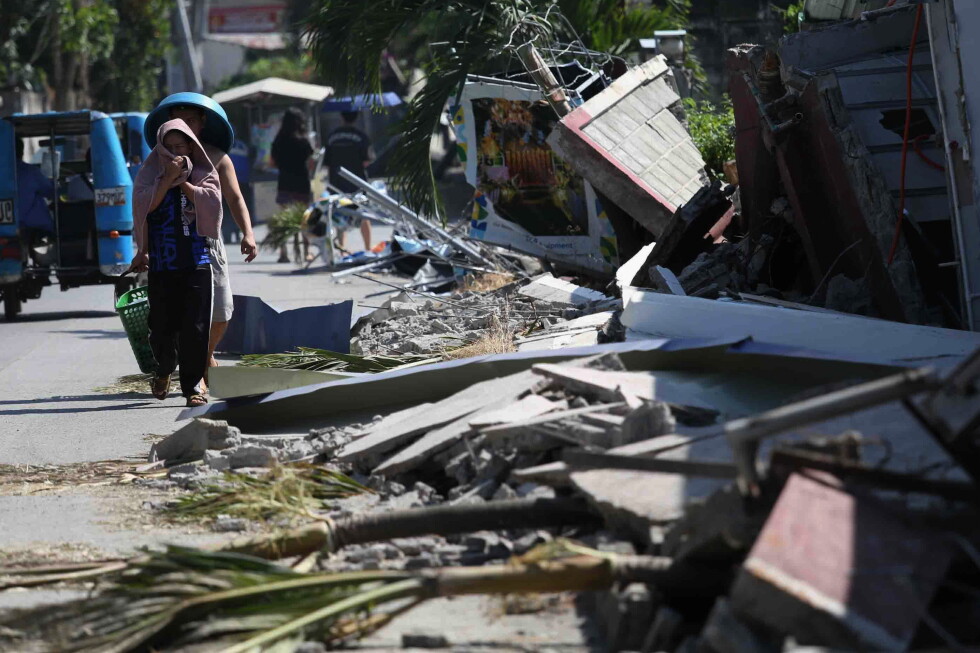
Four days after a catastrophic 7.8-magnitude offshore earthquake struck the southern Philippines, leaving dozens dead and thousands displaced, a local mayor has issued an urgent appeal for military helicopters to deliver life-saving food supplies to communities cut off by widespread landslides.
The powerful quake, which hit Monday off the coast of Sarangani province, ranks among the strongest seismic events to shake the Philippine archipelago in 50 years. As of Thursday, official disaster data puts the death toll at no less than 47, with 688 people injured and 31 others still unaccounted for. More than 12,600 residential structures across rural farming communities and urban centers were damaged in the disaster, forcing more than 45,000 residents to leave their homes. Roughly half of these displaced people are now sheltering in emergency evacuation facilities, and provincial officials note that many survivors remain too fearful of ongoing aftershocks to return to their properties even if their homes survived intact.
According to the Philippines’ Office of Civil Defense, the national agency tasked with managing major disasters, Sarangani province has recorded the highest number of fatalities at 20, most of which stemmed from a single landslide that buried multiple homes in the coastal town of Glan.
Glan Mayor Victor James Yap, speaking to Philippines-based DZMM radio, outlined the dire conditions facing his town of more than 100,000 residents. Ten of the town’s 31 barangays (villages) remain completely cut off from overland access, blocked by landslide debris, and power has yet to be restored across the area. “We need food and water but it’s difficult to transport them to some of our villages which remain isolated,” Yap said. “Choppers are needed to transport food because people there are already very hungry.”
While a key access highway leading into Glan has been cleared and reopened to traffic, allowing fuel deliveries to resume as early as Thursday, the town still remains without grid electricity, and mobile phone connectivity remains spotty at best across most affected areas.
Most fatalities across the disaster zone were caused by falling debris from collapsed buildings or landslides across Sarangani, the nearby coastal city of General Santos, and the adjacent provinces of South Cotabato and Davao Occidental. In a separate, quake-related tragedy, two swimmers drowned off the coast of General Santos after being swept out to sea by sudden abnormal waves immediately after the quake struck, with one additional swimmer still missing. Seismic sea surges reaching up to 1.4 meters above normal tide levels were recorded in southern Philippines, with smaller wave activity detected as far away as Indonesia, Palau, and southern Japan.
Geographically, the Philippines sits along the Pacific “Ring of Fire”, a seismically active arc of fault lines encircling the Pacific Ocean that leaves the country regularly vulnerable to major earthquakes and volcanic eruptions. This recent quake is the strongest to hit the nation since an 8.1-magnitude quake and subsequent tsunami in August 1976 killed an estimated 8,000 people across the archipelago.