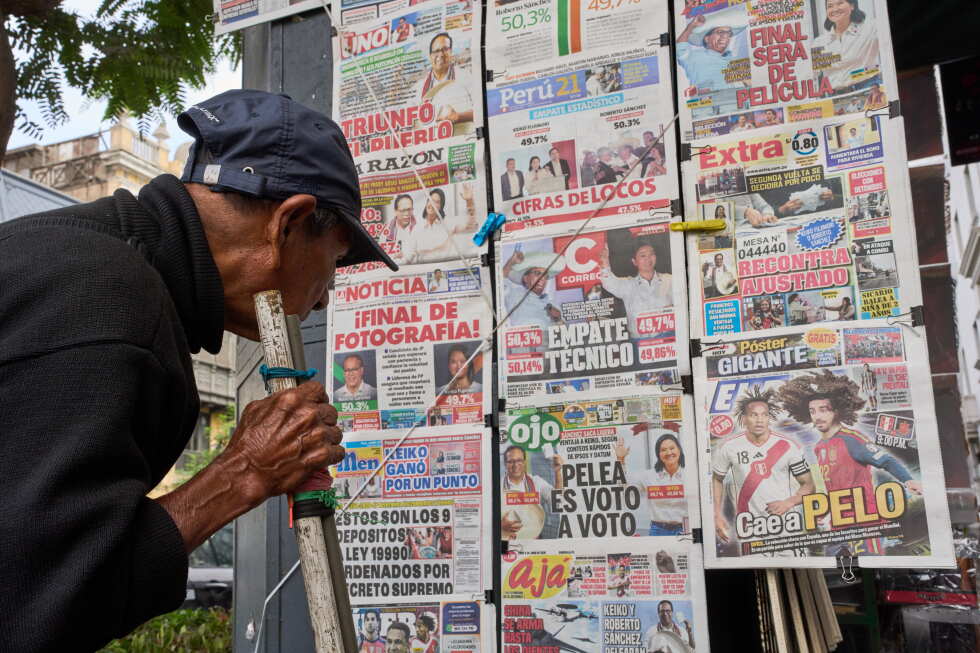
LIMA, Peru — Nearly three days after Peru held its tightly contested presidential runoff election on Sunday, the race between the two remaining candidates has shrunk to a margin of fewer than 20,000 votes, with 96% of all ballots now processed by national electoral authorities. As it stands, the South American nation is set to swear in its ninth head of state in just a decade when the winner takes office.
Official electoral data released Tuesday puts nationalist congressman Roberto Sánchez at 50.055% of the total valid vote, while his conservative challenger Keiko Fujimori trails narrowly at 49.945%. To date, electoral workers have counted more than 17.8 million ballots across the country and from overseas polling locations.
The runoff marks the final stage of a months-long electoral process that began with an initial 35-candidate field in April’s general election. Both Sánchez and Fujimori advanced to the second round, but neither candidate managed to break the 20% support threshold in the first round of voting. It took electoral officials more than four weeks to officially confirm the two candidates’ advancement to the runoff, amid delays in processing results.
Peru’s top electoral official Roberto Burneo has confirmed that the final official result of Sunday’s runoff will not be announced for up to 30 days. Burneo has issued a public call for both voters and affiliated political groups to uphold democratic responsibility amid the ongoing counting process.
The extended timeline for finalizing results stems from two key structural factors laid out in Peruvian electoral law. First, national rules require every individual ballot and polling station vote tally sheet to be transported to one of more than 100 regional processing offices for manual verification. Second, all ballots and tallies from citizens voting abroad must be shipped back to the capital Lima for counting, with overseas polling locations spread across 63 different countries.
Voting is a legal requirement for all Peruvian citizens between the ages of 18 and 70, with non-participation carrying a maximum fine of $32. In total, more than 27 million Peruvians are registered to vote in the election, with roughly 1.2 million of those registered voters residing outside the country, the majority based in the United States and Argentina.
For most voters heading to the polls on Sunday, the top issue driving their decision was the country’s rapidly surging violent crime, particularly a sharp rise in extortion cases across the nation. Political analysts and security experts broadly link the growing influence of organized criminal groups in Peru to expanding profits from unregulated illegal gold mining operations across the Andes mountain range and Amazon basin.
Once the final result is confirmed, the winning candidate will be inaugurated for a full five-year presidential term on July 28. Notably, neither candidate entered the runoff with broad popular support, as both are closely tied to controversial former Peruvian presidents whose legacies remain divisive among the electorate.
Fujimori is the daughter of late former president Alberto Fujimori, whose 1990s administration was marked by authoritarian rule and widespread proven corruption. After her parents separated in 1994, she served as Peru’s official first lady during the remainder of her father’s term. On the other side of the race, Sánchez is one of the closest political allies of imprisoned former president Pedro Castillo, who was removed from office over corruption allegations and widespread perceptions of mismanagement. Castillo’s 16-month tenure saw unprecedented political instability, with more than 70 changes to his presidential cabinet.