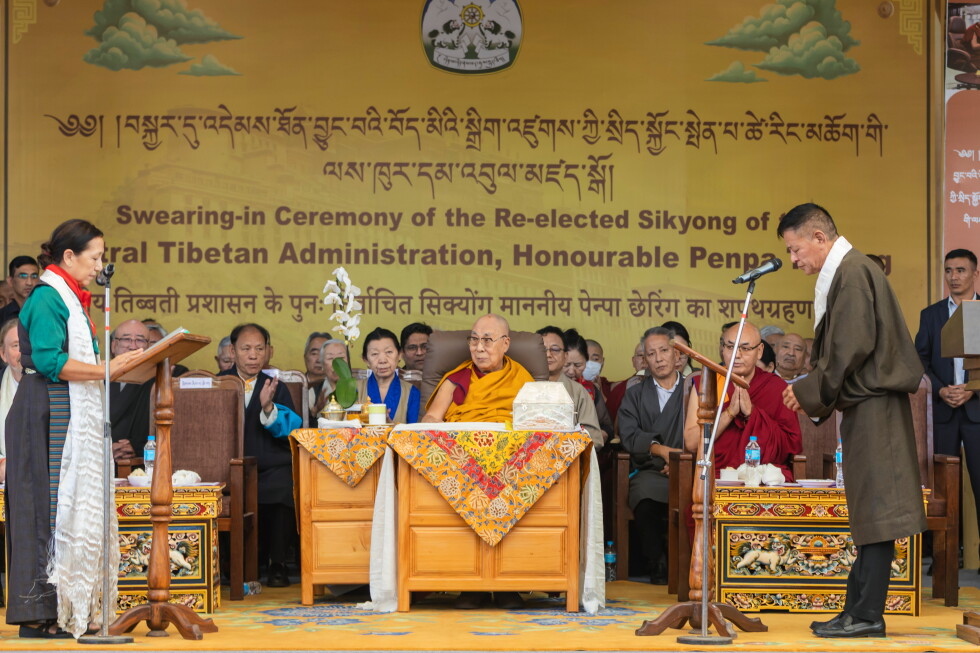
DHARAMSHALA, India – On Wednesday, Penpa Tsering formally took the oath of office for his second consecutive five-year term as the elected president of the Central Tibetan Administration, the body that functions as Tibet’s government-in-exile based in the northern Indian hill town of Dharamshala. The 58-year-old leader first assumed the top executive post in 2021, after securing an initial victory in exile community elections, and won re-election in February’s vote that was open to Tibetans residing across India and other countries around the globe. Tsering’s long career in Tibetan exile governance stretches back to 1996, when he won his first seat in the Tibetan Parliament-in-Exile, and he went on to serve as the body’s speaker from 2008 until his election to the presidency.
Founded in 1959 after the 14th Dalai Lama fled into exile, the Central Tibetan Administration – formerly known as the Tibetan government-in-exile – operates as a full decentralized governance structure with separate executive, judicial, and legislative branches to serve the global Tibetan exile community, which numbers roughly 150,000 people around the world. This year’s February election marked the fourth direct vote for the exile leadership, a milestone that comes 13 years after the Dalai Lama, Tibet’s revered spiritual leader, formally devolved all governing authority to the elected leadership and stepped back from any formal role in the administration.
The swearing-in ceremony unfolded with traditional Tibetan Buddhist ritual, with the 89-year-old Dalai Lama escorted to the event venue by a procession of red-robed monks, accompanied by the sound of ceremonial drums and chanted prayers. In front of an audience of hundreds of monks, community leaders, and ordinary Tibetans, Yeshi Wangmo, Chief Justice Commissioner of the Tibetan Supreme Justice Commission, administered the oath of office to Tsering.
In his first public remarks after taking office, Tsering reaffirmed the exile administration’s longstanding commitment to the Middle Way Policy, a framework first articulated by the Dalai Lama that seeks a negotiated resolution of the Tibet issue through nonviolent means and bilateral dialogue with Beijing, with the goal of achieving a lasting mutually beneficial outcome for all parties. “Until a resolution is achieved, we will continue the back-channel communications with caution and steadiness with the Chinese government,” Tsering stated in his address.
The inauguration comes against a backdrop of long-running geopolitical and diplomatic tensions surrounding the status of Tibet. China maintains that Tibet has been an inalienable part of its sovereign territory since the mid-13th century, and that the Chinese Communist Party has administered the Himalayan region since 1951. However, a large share of the global Tibetan community rejects this claim, arguing that Tibet functioned as an effectively independent state for most of its modern history, and that Beijing has systematically exploited the region’s rich natural resources while eroding and suppressing its distinct cultural and religious identity.
The Chinese government does not recognize the legitimacy of the Central Tibetan Administration, and has not held formal dialogue with envoys representing the Dalai Lama since 2010. While India officially recognizes Chinese sovereignty over Tibet, it has allowed the Tibetan exile administration to maintain its headquarters in Dharamshala since the 1950s. Beijing has long accused the Dalai Lama of pursuing a secret agenda to separate Tibet from China, a claim the spiritual leader has repeatedly denied, noting that the Middle Way Policy does not seek full independence but rather genuine autonomy for Tibet within the Chinese constitutional framework. Still, a growing number of radical Tibetan community groups have pushed for full independence in recent years, as the lack of progress in talks with Beijing has left many exiles frustrated with the existing policy framework.
In the lead-up to this week’s inauguration, Yu Jing, a spokesperson for the Chinese Embassy in New Delhi, issued a formal rejection of the exile body’s legitimacy, claiming that “it is not recognized by any sovereign country in the world” and has no authority to speak on behalf of the Tibetan people or oversee the future reincarnation process of the Dalai Lama. The question of the Dalai Lama’s succession has emerged as a major point of tension in recent years: on his 90th birthday last year, the spiritual leader publicly asserted that Chinese authorities would have no legitimate role in selecting his successor after his death, and that the centuries-old institution of the Dalai Lama would continue regardless of Beijing’s objections.