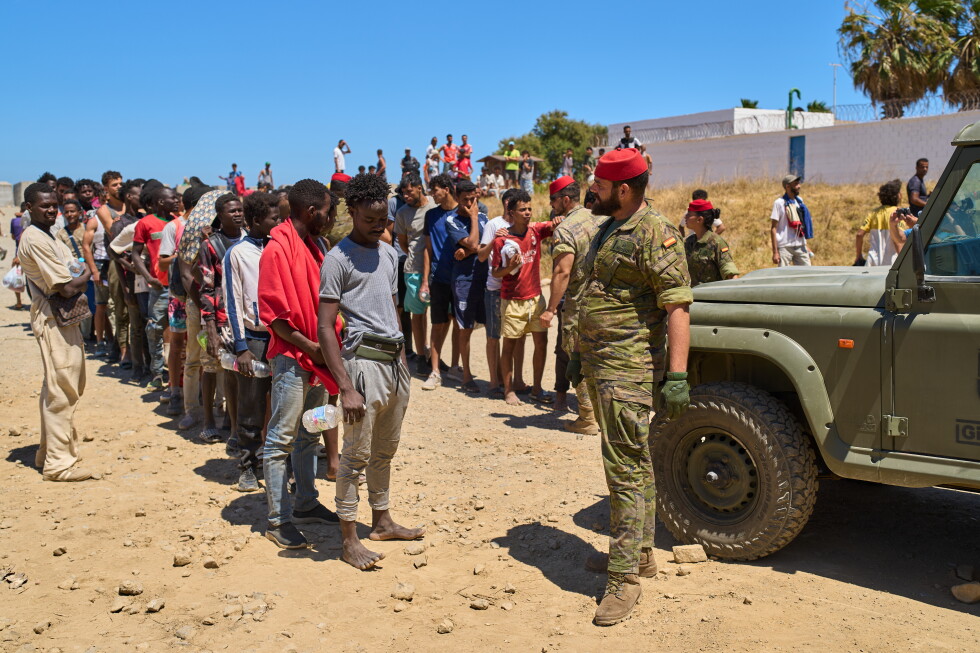
In the wake of a chaotic mass migration surge through the Moroccan-Spanish border last week that left dozens dead, a key junior partner in Spain’s ruling government is pushing for the country to re-examine its plan to co-host the 2030 FIFA World Cup alongside Morocco and Portugal.
Sumar, a small left-wing party that holds cabinet positions in Socialist Prime Minister Pedro Sánchez’s governing coalition, tabled a non-binding parliamentary motion Wednesday calling on Spanish sports governing bodies to revisit the 2030 co-hosting agreement finalized with Morocco and Portugal. While Sumar only controls 26 of 350 seats in Spain’s national parliament, its position carries outsize political weight as a member of Sánchez’s ruling administration — a government that has already drawn sharp criticism from other European Union members over its handling of the Ceuta crisis. Party leaders have acknowledged that beyond backing from other small left-wing blocs, additional parliamentary support for the motion remains unlikely at this stage.
Last week, more than 72,000 migrants crossed the border from Morocco into Ceuta, a small Spanish autonomous territory located on the North African coast. By the time the initial surge calmed, Moroccan authorities helped Spanish officials repatriate nearly all of the arrivals, with roughly 2,000 people — 1,000 of them minors — remaining in the enclave as of the latest figures from Spain’s Interior Ministry. At least 84 migrants died while attempting to cross by swimming around the breakwater and border fence separating the two territories, a surge that was largely coordinated and fueled by viral social media posts encouraging mass crossings.
Prime Minister Sánchez has publicly defended Moroccan authorities’ response, crediting them with acting quickly to facilitate the repatriation process. But his stance has drawn backlash from opposition figures and even within his own cabinet: Spain’s defense minister has joined calls for Morocco to issue a more detailed public explanation of the events that led to the crisis.
Nahuel González, a Sumar lawmaker and one of the co-authors of the motion, has gone further, accusing the Moroccan government of deliberately weaponizing migration to gain political leverage. “The Moroccan state, the Moroccan monarchy, does not respect human rights, it uses migrants to exercise political pressure,” González told Spanish public broadcaster TVE. When pressed to clarify whether Sumar was calling for Morocco to be stripped of its co-hosting status or for Spain to exit the joint hosting plan entirely, González declined to specify, saying only that the motion asks for “Spain’s sports institutions [to] reconsider this World Cup that is to be shared with Morocco because we believe that we must defend human rights.”
Concern over the joint hosting plan has spread to co-host Portugal, where a small parliamentary party Livre has echoed Sumar’s calls. The party sent an official letter to Portuguese Prime Minister Luís Montenegro and the president of the Portuguese Football Federation calling for a full reassessment, arguing that continuing with the current co-hosting arrangement is “unsustainable” in the wake of the Ceuta crisis.
The 2030 FIFA World Cup is structured as a joint project that will see most matches hosted across Spain, Morocco and Portugal. To mark the 100-year anniversary of the first World Cup hosted by Uruguay in 1930, three South American nations — Argentina, Paraguay and Uruguay — will each host one opening round match as part of the centenary celebration.
Videojournalist Helena Alves contributed reporting from Lisbon, Portugal.