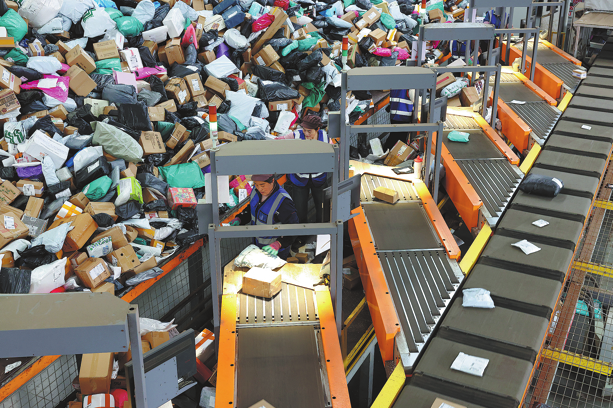
China’s express delivery industry achieved an unprecedented milestone this week, with annual parcel volume exceeding 180 billion items for the first time in history. The State Post Bureau announced Monday that this record-breaking figure was reached on Sunday, highlighting the sector’s extraordinary growth trajectory and its increasing importance to the national economy.
The landmark parcel—a smart learning device ordered by Shenzhen resident Li Xiaojun—underwent a fully automated journey representative of China’s advanced logistics infrastructure. Processed at JD.com’s automated warehouse, the package was transported via unmanned vehicle before final doorstep delivery, demonstrating the sophisticated integration of technology throughout the supply chain.
At JD’s Pineshan grid warehouse station in Shenzhen, automation has become fundamental to operations. Station manager An Jixing reported handling approximately 15,000 parcels daily with five unmanned vehicles that manage over 1,000 orders. “These vehicles significantly reduce staff travel time, alleviate workload pressures, and enable longer community service hours, resulting in markedly improved customer experiences,” An explained.
Recipient Li Xiaojun expressed surprise at his accidental role in the national milestone. “I placed the order yesterday and received it today—incredible efficiency for my child’s educational device,” he remarked. “Both my family’s shopping and factory business depend heavily on courier services, though I never realized annual volumes reached such astronomical levels.”
Courier Zhang Fan, who delivered the historic package, described how automation has transformed his profession. Serving over 2,000 households, he noted that unmanned vehicles now bring parcels within hundreds of meters rather than requiring 6-kilometer trips for package retrieval. “This allows greater focus on delivery quality, customer interaction, and collection services,” Zhang emphasized.
The industry’s technological transformation extends throughout the logistics chain: warehouse robots manage inventory operations, AI-powered vision systems scan parcels within milliseconds at sorting centers, and large language models optimize transportation routing. Drones and unmanned vehicles are expanding through pilot programs to further reduce operational costs.
With monthly averages exceeding 16 billion parcels and peak daily volumes reaching 777 million items (over 6,200 parcels per second), China’s courier sector demonstrates extraordinary scale. Liu Jiang of the State Post Bureau’s research center attributed this growth to macroeconomic policies and national market integration. “The industry’s scale effect has made it crucial for driving consumption, domestic demand, and economic stability,” Liu stated, noting technology’s role as “a powerful engine injecting lasting vitality.”
Shenzhen has emerged as an innovation leader within the sector, deploying 180 unmanned vehicles capable of handling 100,000+ daily parcels. According to Liu Xiaoqing of Shenzhen Municipal Postal Administration, the city has invested over 150 million yuan ($21 million) in equipment upgrades this year alone. Their drone delivery system now operates eight bases with 500+ routes, achieving two-hour intra-city delivery and three-hour service throughout the Guangdong-Hong Kong-Macao Greater Bay Area.
The industry appears poised to exceed official 2025 targets of 190 billion parcels and 1.5 trillion yuan in revenue, having already surpassed the 180 billion mark within the first eleven months of 2025. This performance underscores the resilience and continued expansion of the world’s largest express delivery market.