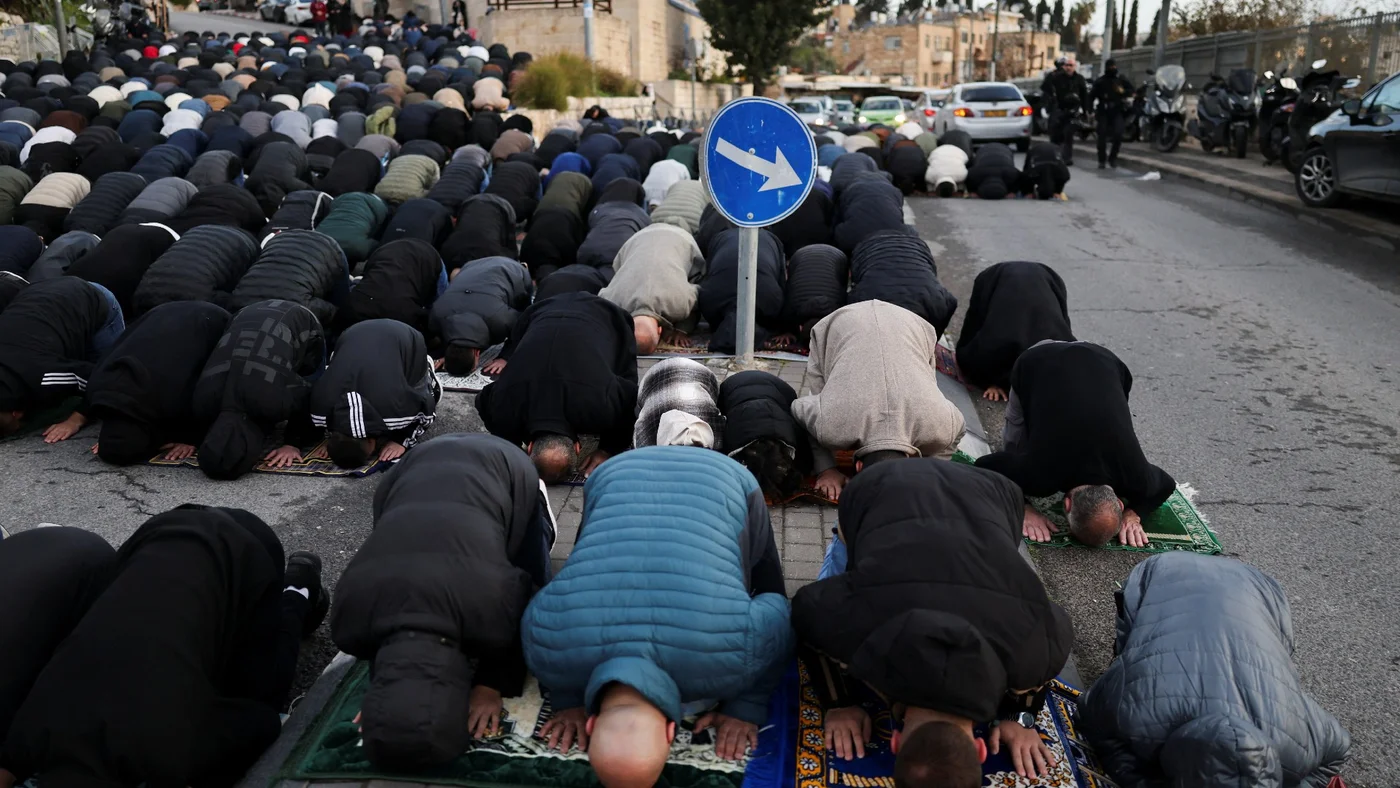
In a historic departure from decades of protocol, Israeli authorities implemented a comprehensive closure of Jerusalem’s Al-Aqsa Mosque and Old City during Eid al-Fitr celebrations, marking the first such restriction since Israel’s 1967 seizure of East Jerusalem. The unprecedented measures prevented Palestinian worshippers from accessing Islam’s third holiest site for traditional holiday prayers.
Security forces erected barricades at all complex entrances early Friday, redirecting thousands of devotees to alternative prayer locations outside the ancient walls. The normally vibrant Old City, typically adorned with Ramadan decorations and bustling with religious activity, stood eerily silent under strict lockdown protocols that limited access exclusively to registered residents.
Eyewitness accounts describe extraordinary scenes as Palestinian worshippers gathered along Salah al-Din Street, chanting Eid praises while attempting to approach secondary gates. Photojournalist Faiz Abu Rmeleh documented Israeli security personnel deploying stun grenades and tear gas to disperse crowds attempting to pray near Bab al-Zahra entrance. Ultimately, congregants performed Eid prayers outside the local post office under substantial police surveillance, only to be forcibly dispersed immediately following religious observances.
The restrictions extended beyond religious access, severing traditional family gatherings during the holiday period. Journalist Latifeh Abdellatif reported difficulty re-entering her own neighborhood despite resident status, while family visitors faced complete denial of entry. Simultaneously, security incidents intensified as Iranian missile debris landed near the Old City walls, creating impact craters adjacent to the Jewish and Armenian quarters.
This closure represents the culmination of months of escalating restrictions on Palestinian access to the holy site. Since October, Israeli authorities have limited Waqf staff to merely 25 personnel per shift within the massive complex and arrested prominent religious figures including Sheikh Ekrima Sabri, the mosque’s senior imam. Analysts interpret these measures as fundamentally altering the delicate status quo governing interfaith access established after the 1967 Six-Day War.
The Al-Aqsa compound, known to Jews as Temple Mount, constitutes one of the most religiously significant and politically sensitive locations in the ongoing Israeli-Palestinian conflict. Palestinian leadership perceives the closure as strategic implementation of heightened control measures, potentially mirroring the transformation previously enacted at Hebron’s Ibrahimi Mosque where Jewish worshippers now control two-thirds of the partitioned holy site.