In a breakthrough diplomatic development announced by Pakistani Prime Minister Shehbaz Sharif, the United States and Iran have reached agreement on a two-week ceasefire that came into effect in the early hours of April 8. Negotiators from both adversarial nations are scheduled to convene for follow-up peace talks this Friday in Islamabad, the Pakistani capital, marking the first formal direct engagement between the two sides in months.
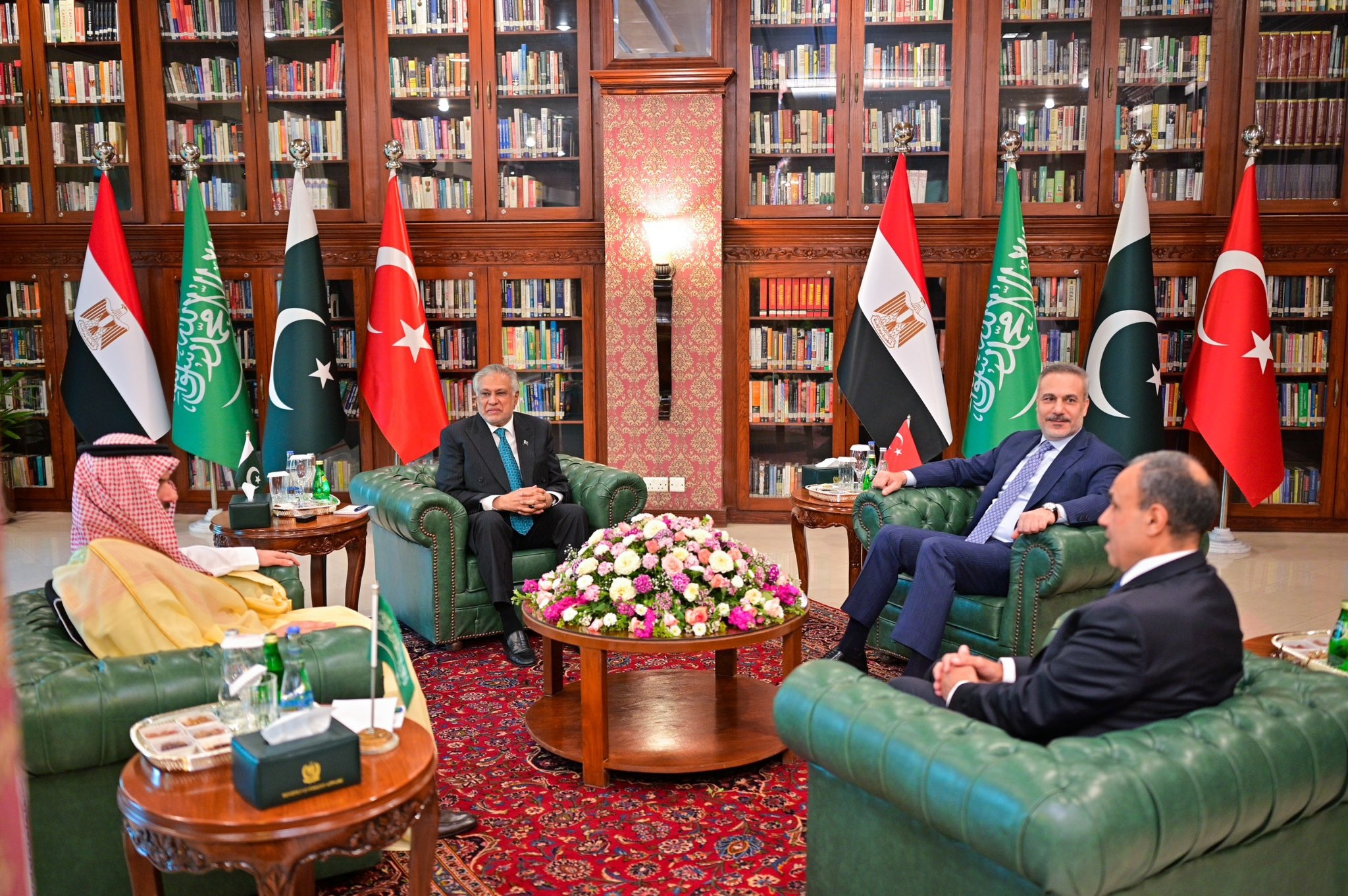
This ceasefire announcement arrives less than two weeks after Islamabad hosted a high-profile summit bringing together Pakistan, Saudi Arabia, Egypt, and Turkey. At that gathering, the four nations issued a unified call for an immediate end to hostilities across the Persian Gulf, and formalized their grouping — now dubbed the Middle East Quartet — as the primary mediating channel between Tehran and Washington. Analysts view this collective effort as the foundation of an emerging regional order aimed at reducing the influence of both Iran and Israel, whose escalating confrontations have plunged the Middle East into chaos since the outbreak of full-scale conflict in late February 2026.
Long before the current war ignited, both Iran and Israel faced growing regional isolation, a shift that has completely upended decades of Western-led diplomatic strategy in the region. The 2020 Abraham Accords, spearheaded by the United States to normalize relations between Israel and Arab states, have effectively collapsed. The accords’ core strategic goal — securing normalization between Israel and Saudi Arabia — is now completely out of reach. While the United Arab Emirates and Bahrain signed normalization deals under the accords, Saudi Arabia has repeatedly maintained it will never formalize ties with Israel without the establishment of an independent Palestinian state. That prospect was formally ruled out by the Israeli parliament in a 2024 vote, and recent reporting indicates Saudi Arabia is already moving forward with plans to reroute a key fiber-optic cable connecting the kingdom to Europe, replacing Israel with Syria as the transit hub.
Regional alienation of Israel has deepened across the Muslim world. Turkey suspended all formal diplomatic and economic ties with Israel in 2024 in protest of the Gaza conflict, while relations between Doha and Tel Aviv broke down completely in September 2025 following an Israeli targeted strike on Hamas leaders in the Qatari capital, an attack that drew unanimous condemnation from the United Nations Security Council.
For its part, Iran finds itself even more isolated than it was at the start of the conflict. Once counting Russia, and to a far lesser degree China and Yemen’s Houthi movement, as its only core allies, Iran has seen its fragile regional partnerships crumble in recent months. China has deliberately distanced itself from Tehran since the outbreak of full-scale hostilities, while the Houthis, who entered the conflict in support of Iran, have been severely weakened by years of targeted Israeli airstrikes. The long-standing close alliance between Iran and Qatar was severed entirely after Iranian missiles struck Qatar’s critical Ras Laffan natural gas facility on March 18. Even Iran’s 2023 detente with Saudi Arabia, a breakthrough agreement brokered by China after years of open hostility, has collapsed completely following Iranian missile attacks on Saudi energy infrastructure earlier this year.
It is against this backdrop of mutual pariah status for both Iran and Israel that the four-nation quartet of Pakistan, Saudi Arabia, Egypt, and Turkey has stepped up to fill the diplomatic vacuum, prioritizing regional stability after months of destructive conflict.
The quartet’s shared strategic and economic interests have aligned to drive their push for a restructured regional order. All four states maintain robust political and economic ties with the United States, and are active members of U.S. President Donald Trump’s 2026-established Board of Peace, an international body tasked with resolving global conflicts and overseeing long-term reconstruction in Gaza. Each member also brings unique, critical assets to the alliance: Pakistan is a recognized nuclear-armed state with advanced defense capabilities; Saudi Arabia controls the world’s second-largest proven crude oil reserves, giving it unmatched global energy influence; Egypt holds strategic control over the Suez Canal, one of the world’s most vital commercial waterways; and Turkey is a longstanding NATO member with a powerful regional military. Combined, the four nations boast a total population of 500 million, making them the most politically and militarily influential bloc of Muslim-majority countries on the global stage.
While the quartet’s collective influence is undeniable, the alliance is not without historical friction. For decades, the four nations have endured periods of tense relations, requiring deliberate diplomacy to overcome long-standing divides. Egypt and Saudi Arabia’s relationship has long been described as a “difficult marriage”: Egypt’s mid-20th century leadership of pan-Arab secular nationalism was historically viewed as a direct threat to the Saudi monarchy, but since Abdel Fattah el-Sisi took power in Cairo in 2014, the two sides have resolved their core differences. Sisi offered critical political and military support to Saudi Arabia’s 2015 military operation against the Houthis in Yemen, and the pair have since deepened their defense cooperation significantly.
Turkey, under the long leadership of Recep Tayyip Erdoğan, has positioned itself as a regional power broker and conflict mediator, but it too has a history of frosty relations with other quartet members. Ankara’s ties with Cairo collapsed after the 2013 military coup that ousted Turkish ally Mohammed Morsi, while relations between Turkey and Saudi Arabia plunged to a historic low following the 2018 assassination of Saudi journalist Jamal Khashoggi inside the Saudi consulate in Istanbul. A 2021 U.S. intelligence assessment concluded that Saudi Crown Prince Mohammed bin Salman approved the killing, a claim he has consistently denied.
In recent years, however, the quartet has worked through these historical divides. A formal rapprochement between Turkey and Saudi Arabia was completed in 2022, followed by a normalization of ties between Turkey and Egypt in 2025. Erdoğan toured both Cairo and Riyadh in February 2026, where he proposed multiple cross-regional geoeconomic projects to connect Asian and European markets, including the proposed Middle East Corridor designed to foster economic integration across Asia, the Persian Gulf, and Europe. Even amid recent tensions — where Pakistan has declined to intervene militarily to support Saudi Arabia against Iranian attacks, despite a 2025 strategic mutual defense pact between the two nations — the bloc has maintained its unified diplomatic push.
As the US-Iran ceasefire holds and follow-up talks approach, the quartet’s ad hoc alliance of convenience has solidified into a transformative force in the Middle East, filling the power vacuum left by the mutual isolation of Iran and Israel and paving the way for a fundamentally restructured regional order.
This analysis is by Natasha Lindstaedt, Professor in the Department of Government at the University of Essex, republished with permission under Creative Commons license.