博客

  • A third of Holocaust survivors in Israel living in poverty, study finds

    A third of Holocaust survivors in Israel living in poverty, study finds

    A groundbreaking joint study conducted by two leading Israeli welfare organizations has exposed a devastating humanitarian crisis: more than one in three Holocaust survivors residing in Israel are currently living below the poverty line, with their economic insecurity and mental health trauma dramatically exacerbated by the ongoing US-Israeli military conflict against Iran.

    The findings, released publicly on Monday by the Eran Association — Israel’s largest non-profit organization dedicated to providing mental and emotional health support — and the Foundation for the Welfare of Holocaust Victims, paint a grim portrait of neglect and crisis for a population that already carries generations of trauma from the Nazi genocide. The conflict, which began on February 28 when US and Israeli forces launched a large-scale offensive against Iranian targets, has prompted a surge in urgent need among the elderly survivor community. Eran’s data confirms that the organization has received more than 11,600 calls for help from survivors since the outbreak of hostilities — a staggering increase compared to just 3,200 calls received across the entire year of 2026, before the war began.

    Physical danger has compounded the economic and emotional pressure: Eran confirms that the homes of at least 50 Holocaust survivors across Israel have sustained damage from Iranian retaliatory strikes, which targeted Israeli territory and Gulf Arab states following the initial US-Israeli attack. For survivors already in fragile health and unstable financial situations, the war has rapidly worsened living conditions over the past month. Thirty-six percent of survivors surveyed now report they depend entirely on charitable aid to afford basic food staples, while 27 percent have been forced to skip meals entirely, either due to unaffordable costs or limited mobility that prevents them from accessing grocery stores.

    Pre-existing structural vulnerabilities have been laid bare by the conflict. More than 65 percent of Israel’s estimated 70,000 Holocaust survivors live alone, struggling with chronic loneliness that has been amplified by wartime disruption to care services. Many survivors shared harrowing accounts of helplessness during air raid sirens, including one bedridden woman who was left stranded alone above ground when her caregiver fled to an underground bomb shelter without assistance for her. In another troubling incident shared with Eran, an 87-year-old survivor contacted her local municipal government for guidance on reaching a bomb shelter located hundreds of meters from her home, only to be told she “needed to run” to the shelter with no additional support offered.

    “These calls are heartbreaking. It’s very difficult,” said David Koren, chief executive officer of Eran Association, in an interview following the report’s release. Beyond immediate wartime fear, survivors contacting the hotline described reactivated trauma from their experiences during the Holocaust, alongside persistent anxiety, grief, and unmet needs related to age-related disability and chronic illness.

    This crisis is not new: it is the culmination of years of systemic neglect, pre-dating the current conflict. Back in December 2026, Israel’s public broadcaster Kan released an investigation revealing that some 5,000 Holocaust survivors were on waiting lists for public housing assistance. The investigation found that 2,500 survivors had died over the preceding five years while waiting for state-supported housing support to materialize. Most of these waiting list survivors were immigrants from the former Soviet Union, who do not qualify for state pensions in Israel.

    Speaking after the Kan investigation was published, Yasmin Sachs Friedman, chair of the Israeli parliament’s special committee on Holocaust survivor welfare, acknowledged the state’s failure to address the crisis. “The data is very, very difficult, and what are we waiting for? The average age is 87,” Friedman said. “I understand that the state has failed and will not be able to create immediate housing solutions for Holocaust survivors.” The new study from Eran and the Foundation for the Welfare of Holocaust Victims puts renewed pressure on the Israeli government to address the unmet needs of the last generation of Holocaust survivors, even as the country remains absorbed by the ongoing conflict with Iran.


  • Blooming Heze, more than blooms

    Blooming Heze, more than blooms

    Nestled in eastern China’s Shandong Province, the city of Heze has long been known as China’s peony capital, where sprawling fields of layered, fragrant blooms draw visitors every spring. But in mid-April 2026, the city proved it offers far more than just picturesque floral displays, when it played host to the 2026 Heze Peony International Communication Forum on April 11.

    The event drew a diverse crowd of guests from every corner of the globe, who traveled to Heze not just to admire the peonies in full spring bloom, but to engage in open, people-to-people cross-cultural exchange rooted in the shared connection of the city’s iconic flower. Attendees spanned multiple sectors and backgrounds: from international journalists and media professionals covering China’s cultural development, to foreign students and educators studying at Chinese institutions, all united by a curiosity to deepen their understanding of Chinese culture and people-to-people ties.

    Organized around the central theme of peony as a cultural bond, the forum created intentional space for informal dialogue and firsthand connection, allowing global guests to move beyond secondhand narratives and experience Heze’s unique cultural heritage directly. What began as a celebration of one of China’s most beloved traditional flowers has grown into a platform for building global mutual understanding, proving that floral culture can serve as a soft, accessible entry point for cross-border friendship and collaboration. For Heze, the forum marks another step in positioning the city as a welcoming hub for international exchange, where ancient cultural traditions meet modern global dialogue.

  • ‘Ping-pong diplomacy’ carries forward friendship

    ‘Ping-pong diplomacy’ carries forward friendship

    Fifty-five years after the groundbreaking exchange that opened the door to formal China-US relations, a special commemorative event honoring the historic “Ping-Pong Diplomacy” initiative was convened Sunday, April 13, at Shanghai University of Sport. The gathering brought together a rare group of individuals who witnessed the landmark 1971 exchange firsthand alongside young delegates from both China and the United States, with a shared goal of revitalizing and sustaining the people-to-people friendship that defined the original diplomatic breakthrough.

    Held more than half a century after a chance encounter between Chinese and American ping-pong players at the 1971 World Table Tennis Championships sparked the unorthodox diplomatic overture, the event marked a key moment to reflect on the legacy of people-to-people exchange in bridging geopolitical divides. Chinese President Xi Jinping sent a congratulatory message to the commemorative event, underscoring the enduring significance of the 1971 breakthrough for bilateral relations.

    The 1971 exchange, which saw American table tennis players invited to visit China for a series of friendly matches, became a defining example of “sports diplomacy” that set the stage for then-US President Richard Nixon’s historic official visit to China the following year, and eventually the formal establishment of diplomatic ties between the two nations. Today, as bilateral relations face new complexities, organizers and attendees of the 55th anniversary event emphasized that the core spirit of Ping-Pong Diplomacy — building mutual understanding through informal, people-centered exchange — remains as relevant as ever.

    By bringing together the generations who witnessed the original moment and young leaders who will shape the future of China-US ties, the event aims to carry forward the legacy of friendship laid out 55 years ago, reinforcing the idea that shared cultural and people-to-people connections can serve as a stable foundation for bilateral cooperation even amid political tension.

  • Witnesses reunite at 55th anniversary of China-US Ping-Pong Diplomacy

    Witnesses reunite at 55th anniversary of China-US Ping-Pong Diplomacy

    Fifty-five years after a groundbreaking people-to-people exchange that altered the course of China-US relations, key witnesses from both nations gathered in Shanghai on April 13 to celebrate the anniversary of the iconic China-US Ping-Pong Diplomacy. Hosted at Shanghai University of Sport, the opening of the Shanghai leg of the anniversary event featured an official welcome ceremony followed by friendly exhibition table tennis matches, reviving the spirit of the historic 1971 exchange.

    Shanghai holds a special place in the legacy of Ping-Pong Diplomacy. When the US table tennis team made their landmark trip to China in 1971 — the first group of American athletes to visit the country in decades — Shanghai served as one of the most memorable stops on their itinerary. The team competed in friendly matches at Jiangwan Stadium, and was greeted by warm, enthusiastic crowds on the city’s streets, laying the early groundwork for the eventual normalization of relations between the two countries through people-to-people connection.

    This year’s gathering brought surviving original witnesses from both sides back to the city where they once helped make history. Among the American attendees were Judy Louise Hoarfrost, Jan Carol Berris, Connie Mae Sweeris and her husband Dell Arthur Sweeris, who joined Chinese table tennis veterans Yao Zhenxu and Xu Yinsheng, alongside a contemporary US table tennis delegation. Over the course of the event, participants shared personal anecdotes from the 1971 visit, reflecting on how the small, informal exchange of the 1970s grew into a 55-year tapestry of cultural and people-to-people ties between China and the United States.

    For Hoarfrost, who was just 15 years old and the youngest member of the 1971 American team, the 1971 trip left an unerasable mark on her life, with Shanghai holding a particularly lasting impression. Now on her 10th visit to China, she noted that the city has undergone dramatic, transformative change over the past five and a half decades — but the warm hospitality that the Chinese people showed her in 1971 remains just as heartfelt and unchanged today.

  • Philippines accuses Chinese fishermen of dumping cyanide in South China Sea

    Philippines accuses Chinese fishermen of dumping cyanide in South China Sea

    Long-running territorial friction in the South China Sea has entered a new phase of escalation after Manila formally accused Chinese fishermen of deliberately dumping cyanide in waters around the Spratly Islands, a contested archipelago at the heart of competing regional sovereignty claims.

    In an official press briefing Monday, Philippine National Security Council (NSC) Assistant Director-General Cornelio Valencia framed the alleged activity as a deliberate act of sabotage targeting Filipino military personnel stationed at Second Thomas Shoal. According to Valencia, the cyanide poisoning first began last year, with the explicit goal of wiping out local fish populations to cut off a critical food supply for troops based in the area. Beyond threatening food access, he added, the toxic contamination poses direct health risks to military personnel and could damage the coral reef ecosystems that provide structural support to the BRP Sierra Madre, the World War II-era vessel intentionally grounded at the shoal in 1999 to assert the Philippines’ territorial claim.

    Philippine Navy Spokesperson Rear Admiral Roy Vincent Trinidad laid out what Manila says is evidence backing the accusation: Filipino forces seized 10 bottles of cyanide from small sampan boats linked to larger Chinese fishing vessels in three separate incidents across February, July, and October 2024. He also confirmed that last month, troops observed another sampan crew dumping substances near the shoal, and follow-up laboratory testing of water samples confirmed the presence of cyanide.

    Cyanide fishing is a banned practice across most of Southeast Asia, including under Philippine law. The technique, historically used to stun fish for the lucrative live reef trade, causes irreversible harm to coral reefs and marine ecosystems, making it illegal in most international and regional fishing frameworks.

    China has immediately and forcefully rejected the accusation, dismissing it as a baseless fabrication. Chinese Foreign Ministry spokesperson Guo Jiakin called the claim “completely unbelievable and not even worth refuting”, countering that the Philippines has a long record of illegal harassment against Chinese vessels engaged in legitimate, routine fishing activity in the area.

    Valencia confirmed that Philippine officials raised the allegation during a recent diplomatic meeting with Beijing but have yet to receive a formal response. The NSC is preparing a full report for the Philippine Department of Foreign Affairs, which could serve as the foundation for an official diplomatic protest. In the meantime, the Philippine Navy and Coast Guard have been ordered to ramp up patrols across the disputed Second Thomas Shoal region.

    The latest exchange of accusations comes amid years of steadily escalating tensions between the two countries in the South China Sea, a strategically critical waterway that holds some of the world’s richest fishing grounds and untapped offshore energy reserves. More than half of the world’s global fishing fleet operates in the South China Sea, and the waterway carries an estimated $3 trillion in annual international trade. Sovereignty over the sea is disputed by six parties: China, the Philippines, Vietnam, Malaysia, Brunei, and Taiwan. China claims nearly the entirety of the South China Sea as its sovereign territory, a claim that was ruled to have no legal basis under international law by a 2016 tribunal ruling under the United Nations Convention on the Law of the Sea (UNCLOS) — a decision Beijing has repeatedly refused to recognize.

    Tensions around Second Thomas Shoal, in particular, have spiked repeatedly in recent years. China’s coast guard has made repeated attempts to block Philippine resupply missions to the small outpost on the BRP Sierra Madre, and a violent confrontation in June 2024 saw Chinese coast guard personnel armed with melee weapons board Philippine navy vessels near the shoal, leaving multiple Filipino sailors injured.

    In recent months, the Philippines has deepened military cooperation with extra-regional powers in response to growing tensions with Beijing. Last week, Manila held joint maritime exercises with the United States and Australia in the disputed South China Sea, leading into the annual Balikatan military exercises, which will include Japan as a full participating member for the first time this year. Beijing has repeatedly condemned these multinational drills, arguing they unnecessarily raise geopolitical tensions in the region. In a further sign of expanding defense ties, the Philippines signed a military agreement with France in March that will see a 15 to 20-person French contingent deploy to participate in the upcoming April 20 Balikatan exercises.

  • US drivers head to Native American lands for cheaper gas

    US drivers head to Native American lands for cheaper gas

    Across the United States, as retail gasoline prices continue to fluctuate and strain household budgets, a growing number of motorists are changing their refueling routines to seek out significant savings: they are traveling to Native American tribal territories to fill up their tanks.

    The core draw behind this trend lies in the unique legal status of federally recognized tribal lands, which grants these sovereign nations exemptions from most state and federal fuel taxes. Unlike standard public gas stations operating off-reservation, retail outlets on tribal land do not pass these accumulated tax costs down to consumers, resulting in per-gallon prices that are often 10 to 50 cents lower than the national average, and in some high-tax states, the gap can stretch even wider.

    For budget-strapped drivers, even a small per-gallon discount adds up to meaningful savings over time, especially for those who commute long distances or rely on their vehicles for work. Many motorists now plan regular trips around stops at tribal gas stations, sometimes driving several miles off their regular routes to lock in lower prices.

    This trend also highlights the economic role that tax exemptions play for tribal communities, where gas retailing has become a key revenue stream that funds local public services and infrastructure development. At the same time, it has sparked ongoing discussions about tax policy equity across different jurisdictions in the US, though for now, cost-conscious drivers show no signs of slowing their visits to tribal fuel outlets.

  • Woman dies more than three weeks after assault

    Woman dies more than three weeks after assault

    Nearly three weeks after a brutal assault left her fighting for her life in Birdhill, a small village in Ireland’s County Tipperary, 20-something-year-old Scarlett Faulkner has succumbed to her injuries at Cork University Hospital, authorities confirmed this week. The 21 March attack left Faulkner in critical condition immediately after the incident, prompting an urgent investigation from local law enforcement. Just seven days following the violent assault, two suspects — a teenage girl and a woman in her 40s — were taken into custody and appeared before a local court to face charges connected to the attack on Faulkner. The case remains ongoing as the community comes to terms with the tragic outcome of the violence that shocked the small rural village.

  • Unitree’s H1 robot runs 10 meters per second

    Unitree’s H1 robot runs 10 meters per second

    Chinese robotics firm Unitree Robotics has hit a historic milestone in legged humanoid robotics, with its flagship H1 model achieving a peak running speed of 10 meters per second — a new benchmark that pushes the limits of bipedal robotic mobility. The breakthrough comes just months after the company’s founder publicly predicted that humanoid robots would soon outpace legendary sprinter Usain Bolt’s world record 100-meter dash speed.

    In demonstration footage published by Unitree this past Saturday, the H1 robot — which stands on 0.8-meter legs and has a total mass of 62 kilograms — was modified to remove non-essential head and arm components to reduce aerodynamic drag and excess weight, enabling it to hit the unprecedented 10 m/s mark. For context, this speed is just 0.44 m/s slower than the average speed Usain Bolt maintained when he set his still-unbroken 100-meter world record of 9.58 seconds in 2009.

    The H1 robot is set to make its competitive public debut this Sunday at the 2026 Beijing E-Town Half Marathon, where it will compete in the event’s inaugural Humanoid Robot Half Marathon. To prepare for the challenging multi-kilometer course, which features uneven terrain, elevation changes, and sharp curves, Unitree’s engineering team has prioritized two key upgrades: boosting the robot’s long-distance endurance and refining its foot structure to handle complex real-world running conditions. The team has said it aims to achieve a new breakthrough in humanoid robot endurance racing with the event.

    The 10 m/s milestone aligns with a prediction Unitree founder Wang Xingxing made during a public address on March 17. Wang noted that as of early 2026, humanoid robots had not yet matched top human sprinting speeds, but he claimed that by mid-2026, a transformative speed breakthrough would be achieved both globally and within China’s domestic robotics sector — one that would leave even Usain Bolt’s record-setting pace in the dust. This latest achievement puts the company well on track to deliver on that bold promise, marking a major step forward in the global race to develop high-mobility humanoid robots capable of operating in human-centric environments.

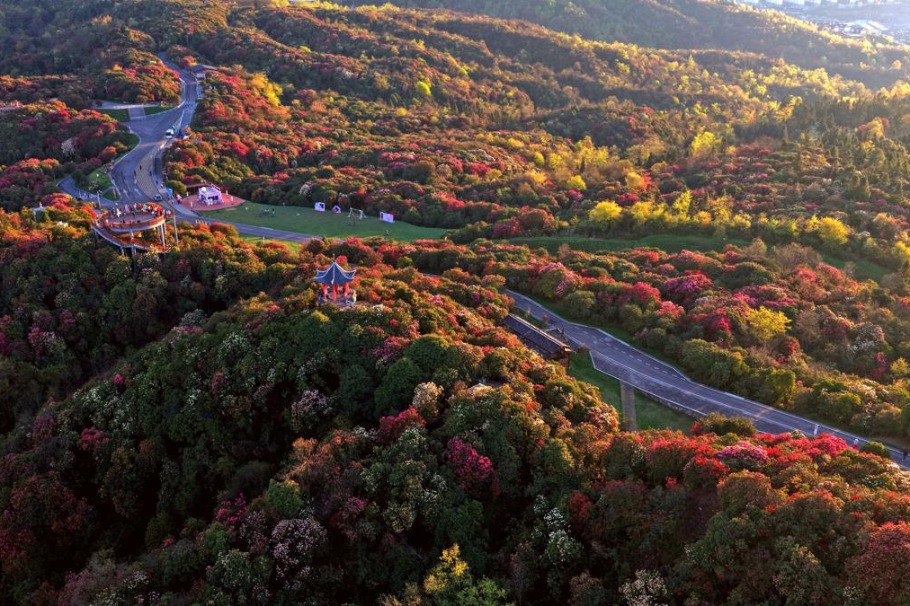
  • Vast rhododendron forests bloom in Guizhou’s Bijie

    Vast rhododendron forests bloom in Guizhou’s Bijie

    Every spring, the hills and valleys of Bijie, in southwest China’s Guizhou province, transform into a dreamlike floral panorama, as the region’s famous vast native rhododendron forests burst into full bloom. Spanning nearly 125 square kilometers, the rolling landscape is dotted with soft pink blossoms stretching to the horizon, creating one of the most striking natural displays in the country.

    The heart of this floral region is the Baili Dujuan Scenic Area, a protected reserve that takes its name directly from the iconic flowering tree. Recognized globally as the largest and most biologically diverse natural rhododendron habitat on Earth, the site is home to more than 10 unique rhododendron species that cannot be found growing wild anywhere else in the world. Unlike smaller common rhododendron shrubs, the varieties growing here grow into tall, tree-like specimens, producing dense, vivid clusters of blooms that attract visitors from across the globe each year. The natural blooming window runs annually from mid-March to early May, drawing hundreds of thousands of tourists to the region during the spring season.

    In recent years, local managers and horticultural teams have developed specialized cultivation techniques that extend the availability of these prized rhododendrons far beyond their traditional spring blooming period. This innovation has allowed the scenic area to establish a commercial rhododendron production base, making the iconic flowers available to commercial markets year-round, turning a unique natural resource into a sustainable driver of local economic growth.

  • Team Wuxi crushes Team Zhenjiang 3-1 in Suchao opener

    Team Wuxi crushes Team Zhenjiang 3-1 in Suchao opener

    The 2026 edition of the Jiangsu Football City League, widely known by its regional nickname “Suchao,” kicked off on April 11 at the Yixing Sports Center, located in the county-level city of Yixing under the administration of Wuxi, Jiangsu Province. In the tournament’s highly anticipated opening fixture, Team Wuxi put on a dominant attacking display to defeat neighboring rival Team Zhenjiang by a final score of 3-1.

    The opening match of the annual inter-city football competition drew a lively crowd of local football fans to the Yixing venue, who filled the stands with passionate cheers and chants throughout the 90-minute contest. Host Douglas Dueno is set to guide audiences through a full recap of the game’s most electrifying moments, from game-changing goals to near misses, while also sharing firsthand reactions from cheering spectators who witnessed the clash in person.

    As the first major result of the 2026 Suchao season, the opening victory gives Team Wuxi an early boost in the league standings and sets a strong tone for their upcoming fixtures against other city-based teams from across Jiangsu province. The regional league has grown in popularity in recent years, becoming a beloved platform for grassroots football development and friendly cross-city competition in eastern China.