
Paris Saint-Germain (PSG) is undergoing a transformative shift, prioritizing homegrown talent over high-profile signings. This strategic pivot marks the end of the club’s ‘bling-bling’ era, characterized by extravagant acquisitions, and ushers in a new chapter focused on nurturing local players. The change has been accelerated by an early-season injury crisis, which has thrust several academy graduates into the spotlight. This season, as many as five Parisian-born players have featured in the first team, showcasing the club’s commitment to its youth development program. The move to the state-of-the-art PSG Campus, a sprawling 59-hectare facility, has been instrumental in this transition. The complex, inaugurated a year ago, houses the men’s and women’s teams, their youth sides, and includes 16 pitches, accommodation for 140 young players, and educational facilities. Sporting advisor Luis Campos emphasized the club’s long-term vision of integrating more Parisian players into the first team. ‘The idea is to have players in every age group who can climb the steps,’ Campos stated, referencing the literal staircase of the PSG Campus, where the senior team trains at the top. This approach aims to reduce reliance on the transfer market, with Campos likening frequent signings to ‘going to the supermarket often doesn’t make you a better cook.’ The strategy has already yielded success, with players like Senny Mayulu and Warren Zaire-Emery making significant contributions. Mayulu, a versatile 19-year-old, has become a key figure, scoring crucial goals, including in the Champions League final. Zaire-Emery, who made his debut at 16, has rediscovered his form and is captaining the injury-hit squad. Yohan Cabaye, the academy director, praised the resilience and character of these young players, particularly Mayulu, who overcame multiple injuries in his formative years. However, Cabaye cautioned against using Zaire-Emery as a benchmark, noting that not every 16-year-old can replicate his rapid rise. PSG’s focus on youth extends to fending off competition from other clubs, with a dedicated team of scouts monitoring local talent. The under-19 side’s recent league title retention and continental success have further validated the academy’s effectiveness. Despite challenges, including a recent labor inspection highlighting workload issues, PSG remains committed to its youth-centric strategy. As the club prepares for upcoming fixtures, the new generation of homegrown talent is poised to play a pivotal role in PSG’s continued success on the European stage.
博客
-

Bangkok court issues an arrest warrant for Thai co-owner of Miss Universe pageant
A Bangkok court has issued an arrest warrant for Jakkaphong “Anne” Jakrajutatip, co-owner of the Miss Universe Organization, following her failure to appear at a scheduled hearing on Tuesday. The court deemed her a flight risk after she did not notify them of her absence. Jakkaphong, who was previously charged with fraud in 2023 and released on bail, is now facing renewed legal scrutiny. The hearing has been rescheduled for December 26, 2024. The case stems from allegations that Jakkaphong and her company, JKN Global Group Public Co. Ltd., defrauded Raweewat Maschamadol by selling him corporate bonds in 2023, resulting in a loss of 30 million baht ($930,362). JKN, which has been financially troubled since 2023, defaulted on investor payments and initiated debt rehabilitation procedures in 2024, with reported debts totaling 3 billion baht ($93 million). The company acquired the Miss Universe pageant rights in 2022 and sold 50% of its shares to Legacy Holding Group USA in 2023. Jakkaphong, a prominent transgender celebrity in Thailand, resigned from all company positions in June 2024 after being accused by Thailand’s Securities and Exchange Commission of falsifying financial statements. Her current whereabouts are unknown, and she did not attend the 74th Miss Universe competition held in Bangkok earlier this month. The event itself faced controversies, including allegations of rigging and illegal promotion of online casinos. JKN has denied rumors of Jakkaphong liquidating assets and fleeing the country, but she remains unreachable for comment.
-
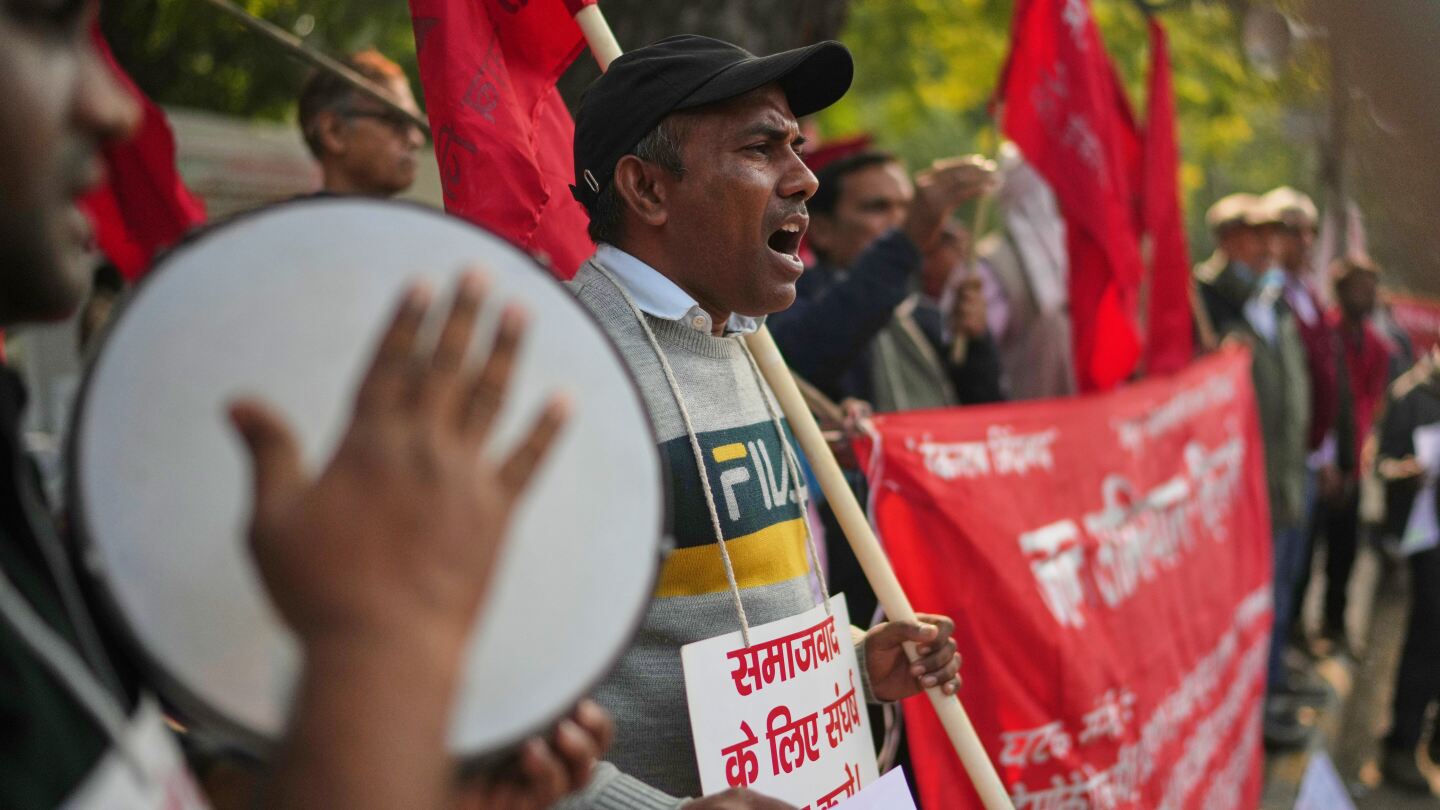
Trade unions in India stage nationwide protests against new labor codes
In a significant show of dissent, a coalition of 10 major Indian trade unions organized nationwide protests on Wednesday, vehemently opposing the government’s implementation of new labor codes. The unions labeled the reforms as a “deceptive fraud” against workers, arguing that the changes undermine job security, weaken collective bargaining, and increase employer control. Demonstrations erupted across various regions, with millions of laborers and farmers voicing their concerns over the sweeping overhaul. This marks the first coordinated labor action since the codes came into effect last week, highlighting the escalating tensions between unions and the government regarding economic reforms. While the government claims the new framework modernizes outdated laws, enhances efficiency, and expands social protections, unions contend that it strips essential safeguards and disproportionately favors employers amid rising job insecurity. Tapan Sen, general secretary of the Centre of Indian Trade Unions, accused the government of bulldozing workers’ rights and masking the move with misleading claims of benefits for laborers. The four new codes—covering wages, industrial relations, social security, and occupational safety—replace 29 existing labor laws. The government asserts that the consolidated structure simplifies compliance, reduces fragmentation, and improves access to social security and safety norms. However, unions argue that the reforms are skewed in favor of employers, citing provisions that facilitate layoffs, expand fixed-term employment, and impose stricter conditions for forming unions or organizing strikes. Amarjeet Kaur, general secretary of the All India Trade Union Congress, likened the reforms to a regression to the colonial era, where workers’ voices were suppressed. The government has yet to formally respond to the protests but maintains that the codes are essential to attract investment and create formal jobs in the long term.
-

India-China trade barbs after passenger detained at Shanghai airport
The detention of Pema Wangjom Thongdok, an Indian national residing in the UK, at Shanghai airport has escalated diplomatic tensions between India and China. Thongdok was held for 18 hours last Friday while transiting from London to Japan via Shanghai. The reason cited for her detention was her passport listing Arunachal Pradesh as her birthplace, a region China claims as its own, referring to it as ‘South Tibet’—a claim India vehemently denies.
-

TCM’s future is looking up down under
Traditional Chinese Medicine (TCM) is experiencing a significant surge in recognition and adoption across Australia and the Southern Hemisphere, driven by its holistic approach and growing integration with Western medical practices. Steven Wolfgang Sass, a Melbourne-based TCM practitioner, exemplifies this trend. His clinic, which opened nearly two years ago, has seen a steady increase in patients seeking relief from conditions ranging from chronic pain to stress-related ailments. Sass’s success stories, such as treating a neurologist with acupuncture, highlight TCM’s efficacy and its ability to complement conventional treatments.
-

Hong Kong, Macao to get more support
The central government has pledged to intensify its support for Hong Kong and Macao, ensuring their alignment with national strategies and the forthcoming 15th Five-Year Plan (2026-30). This commitment was underscored during a high-level seminar led by Zhu Weidong, deputy director of the Office of the Central Financial and Economic Affairs Commission and the Office of the Central Rural Work Leading Group. Zhu highlighted the remarkable achievements of the 14th Five-Year Plan (2021-25), including an average annual growth rate of 5.5 percent and significant technological advancements, such as producing over 60 percent of the world’s new energy vehicles and breakthroughs in semiconductors and quantum technology. The delegation, which included Hou Jianguo, president of the Chinese Academy of Sciences, conducted similar seminars in Macao and Hong Kong, emphasizing the regions’ strategic roles in national development. Hong Kong Chief Executive John Lee Ka-chiu and Zhou Ji, director of the Liaison Office of the Central People’s Government in Hong Kong, reiterated the central government’s unwavering support for Hong Kong’s prosperity and stability. The seminars also featured calls for enhanced infrastructure and institutional connectivity, leveraging Hong Kong’s unique position as an international hub. Participants, including Hong Kong deputies to the National People’s Congress and leaders of community associations, expressed confidence in the central government’s proactive role in fostering regional growth and stability.
-

Watch: Moment researcher finds rare flower after 13-year search
In a moment of profound triumph, researcher Septian Andriki broke down in tears after finally locating the elusive Rafflesia hasseltii flower in Indonesia, marking the culmination of a 13-year search. This rare botanical specimen, known for its striking appearance and ecological significance, had evaded discovery for over a decade. Andriki’s relentless pursuit of the flower underscores the dedication and perseverance required in scientific exploration. The discovery not only highlights the biodiversity of Indonesia but also emphasizes the importance of conservation efforts to protect such rare species. This breakthrough is expected to contribute significantly to botanical research and inspire future generations of scientists to explore the natural world with unwavering determination.
-

Moravian stars light up Germany’s Christmas season
In the quaint village of Herrnhut, nestled near the borders of Poland and the Czech Republic, a centuries-old tradition continues to illuminate the darkest days of winter. The Moravian stars, a symbol of the Star of Bethlehem, have become a cherished part of Christmas celebrations across Germany and beyond. These stars, handmade for over 180 years, adorn church steeples, apartment windows, and even the chancellery in Berlin during Advent. Katja Ruppert, managing director of the Herrnhuter Sterne manufacturing company, explains that the stars represent the guiding light that led the three wise men to the Christ Child. The tradition began in 1722 when refugees from the Moravian Church, fleeing persecution in Bohemia and Moravia, founded Herrnhut under the protection of Count Nikolaus von Zinzendorf. The stars were born out of a geometry lesson in one of the schools established by the church, where a math teacher tasked students with creating a complex geometric shape. This initial cardboard star was patented in 1925, allowing it to be dismantled for shipping and reassembled. Today, the stars come in various sizes, colors, and materials, ranging from 8 centimeters to 250 centimeters in diameter, with prices starting at 19 euros. The company has expanded its offerings to include monochrome, varicolored, and even ‘literary stars’ made from the pages of old books. A handicrafts workshop in Herrnhut allows visitors to create their own stars, while a showroom showcases the diverse range of designs. The Moravian star’s popularity has grown significantly in the past two decades, with over 820,000 stars produced annually by 230 employees. Despite their local fame, the stars have yet to be widely exported, though Moravian Church communities in places like Bethlehem, Pennsylvania, and Christiansfeld, Denmark, also feature them during Advent. For many, like hairdresser Silk Schmidt, the stars are a cherished part of their holiday traditions, bringing light and beauty to the winter season.
-

Teens launch High Court challenge to Australia’s social media ban
Australia’s pioneering social media ban for children under 16 is under legal scrutiny as two teenagers, supported by the Digital Freedom Project (DFP), challenge its constitutionality in the nation’s highest court. The law, set to take effect on December 10, mandates platforms like Meta, TikTok, and YouTube to prohibit accounts for users under 16, aiming to shield young people from harmful content and algorithms. However, 15-year-olds Noah Jones and Macy Neyland argue that the ban infringes on their right to free communication, likening it to the dystopian world of Orwell’s ‘1984.’
Communications Minister Anika Wells has reaffirmed the government’s commitment to the policy, stating it will not yield to legal challenges or pressure from tech giants. The DFP, led by New South Wales parliamentarian John Ruddick, contends that the ban disproportionately impacts vulnerable groups, including disabled youth, First Nations communities, and LGBTIQ+ teenagers, who rely on social media for information and connection. The group advocates for alternative measures such as digital literacy programs, age-appropriate platform features, and enhanced privacy protections.
Critics, including Jones, argue that the policy is ‘lazy’ and fails to address the root issues of online safety. Meanwhile, tech companies like Google, which owns YouTube, are reportedly considering their own constitutional challenges. While polls indicate broad public support for the ban, mental health advocates warn it could isolate children and push them toward unregulated online spaces. The case highlights the ongoing global debate over balancing child protection with digital freedoms.
-

What to know about French ex-President Sarkozy’s latest legal matters
Nicolas Sarkozy, the former President of France, awaits a pivotal ruling from the Court of Cassation on Wednesday regarding his conviction for illegal campaign financing during his 2012 reelection bid. The court will determine whether to uphold or overturn his one-year prison sentence, half of which is suspended, for exceeding the legal spending limit by nearly double the allowed €22.5 million ($25.5 million). This decision follows his recent release from a 20-day incarceration in Paris’ La Santé prison, stemming from a separate case involving alleged secret financing from Libya during his 2007 presidential campaign. Sarkozy, 70, has consistently denied any wrongdoing. If the Court of Cassation confirms the conviction, it will mark a definitive legal conclusion, barring further appeals. The court’s role is to ensure proper application of legal procedures rather than re-examining the case’s merits. Additionally, Sarkozy faces an upcoming appeal trial in the Libya case, scheduled from March 16 to June 3, where he was previously sentenced to five years for criminal association related to campaign financing. Amid these legal battles, Sarkozy is set to release a memoir titled “Diary of a Prisoner,” reflecting on his recent incarceration. The former president’s legal woes also include preliminary charges for alleged witness tampering in the Libya case, with his wife, Carla Bruni-Sarkozy, similarly implicated. Sarkozy’s legacy continues to be marred by these controversies, including a prior conviction for corruption and influence peddling, which led to the revocation of his Legion of Honor medal.