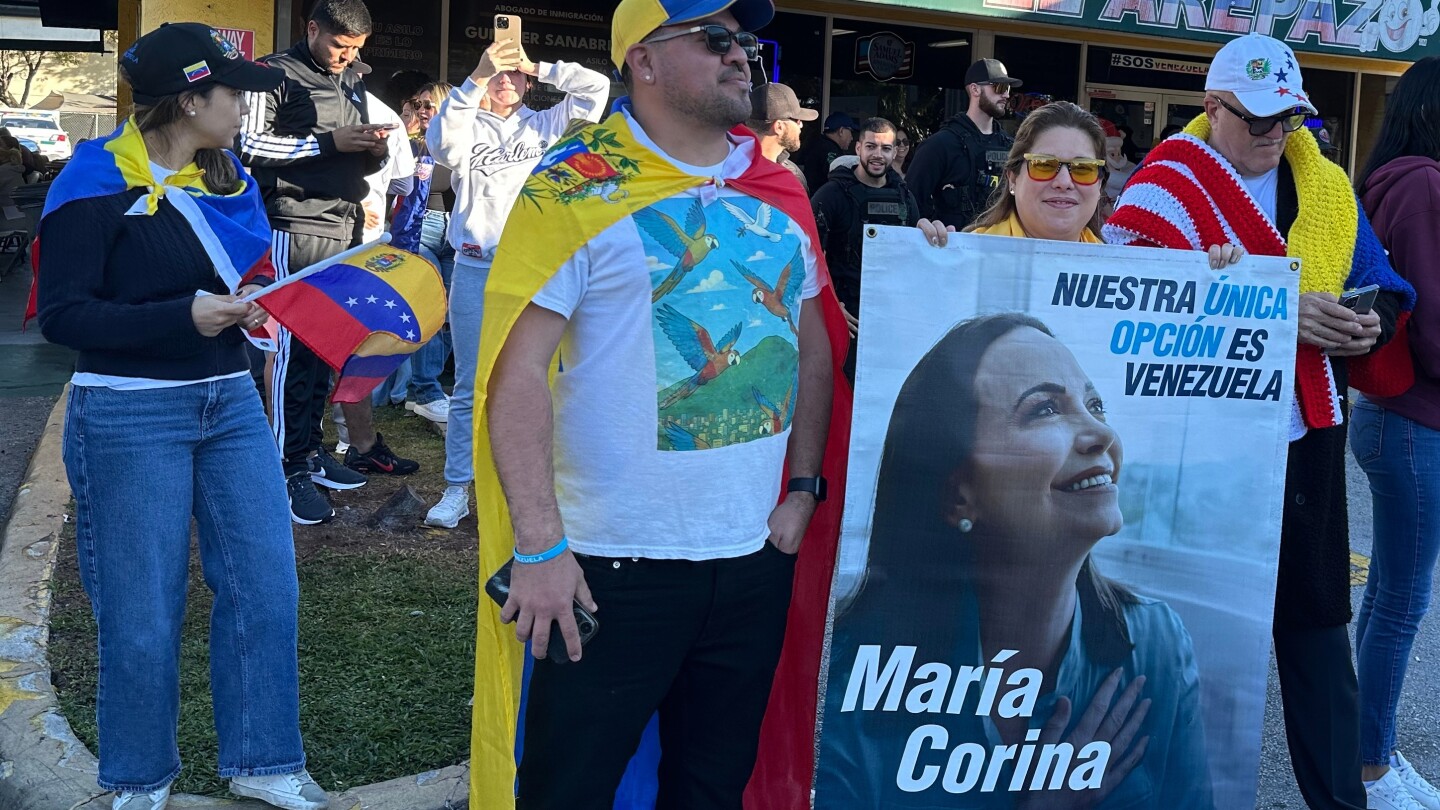
SOUTH FLORIDA — Venezuelan expatriates across South Florida erupted in emotional celebrations Saturday as news spread of Nicolás Maduro’s dramatic capture and removal from power through American military intervention. The atmosphere in Doral—a Miami suburb with deep Venezuelan ties and home to one of the largest exile communities—became a vibrant tapestry of national flags and cathartic chanting as decades of political anguish momentarily gave way to triumphant relief.
The gathering outside El Arepazo restaurant, a cultural hub for Venezuelans, embodied the complex emotional landscape of a diaspora witnessing unprecedented change. Participants held handmade signs bearing the word ‘Libertad’ (liberty) while voices united in repeated chants of ‘Liberty! Liberty! Liberty!’—a powerful expression of hope for their homeland’s future.
President Donald Trump confirmed the operation’s success, stating the U.S. government would temporarily administer Venezuela during the transition period. This development represents the culmination of an intensifying pressure campaign against Maduro’s regime and weeks of strategic planning targeting the leader’s behavioral patterns.
The Venezuelan diaspora in South Florida represents a microcosm of the broader exile experience. Initial waves of upper-middle-class professionals and entrepreneurs arrived following Hugo Chávez’s election in the late 1990s, followed by political dissidents and, more recently, lower-income refugees seeking economic stability. This community of approximately 8 million Venezuelans who have fled since 2014 includes naturalized citizens, asylum seekers, and undocumented immigrants with American-born children.
Niurka Meléndez, who fled Venezuela in 2015 and co-founded Venezuelans and Immigrants Aid in New York, characterized the intervention as ‘the start of the justice we need to see.’ She described her homeland as having reached a ‘breaking point’ due to systematic repression, humanitarian crises, and widespread fear, while emphasizing that Maduro’s removal creates ‘the possibility, not a guarantee, for recovery.’
The celebrations were tempered by underlying anxieties about Venezuela’s future trajectory. Alejandra Arrieta, a Venezuelan immigrant since 1997, captured the collective emotional complexity: ‘We’re like everybody—it’s a combination of feelings. There’s fears. There’s excitement. There’s so many years that we’ve been waiting for this.’