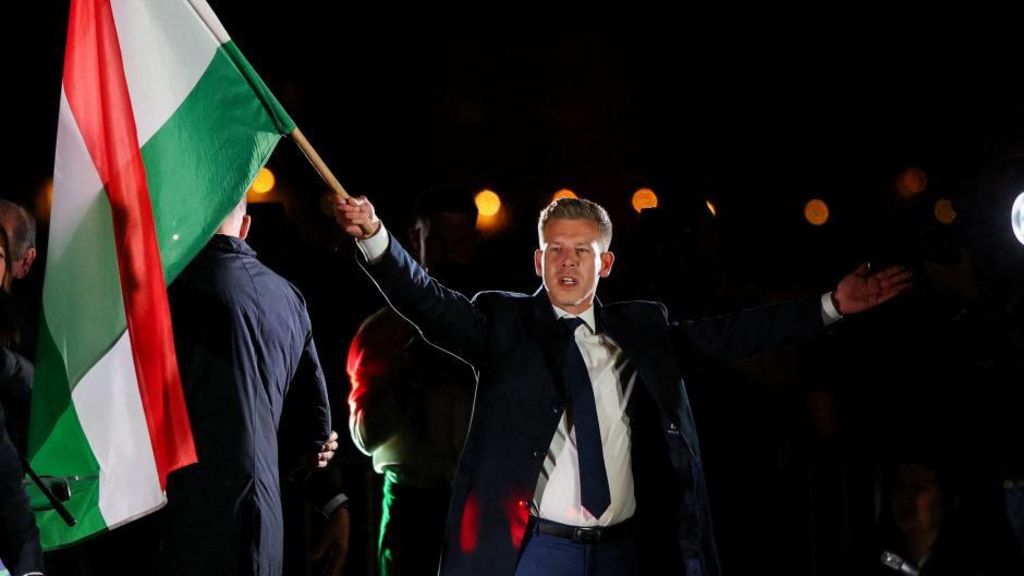
After 16 consecutive years holding power in Hungary, Prime Minister Viktor Orbán’s long tenure has come to an abrupt end, following a historic general election that saw a stunning political upheaval led by 45-year-old former ruling party insider Péter Magyar. His newly formed Tisza Party has secured what appears to be an overwhelming constitutional majority, bringing down the Orbán administration that critics had long labeled an “electoral autocracy.”
Preliminary vote counting, which has processed more than 98% of all ballots, projects Tisza will take 138 seats in Hungary’s parliament — five more than the 133 two-thirds supermajority required to amend the national constitution. Orbán’s long-ruling Fidesz party is on track to win just 55 seats, with the far-right Our Homeland movement claiming the remaining six seats. The election saw a historic 79% voter turnout, the highest participation rate in the democratic history of modern Hungary.
Shortly after the unofficial results began trending toward a Tisza victory, Orbán personally called Magyar to congratulate him on the win, a confirmation that Magyar shared publicly on his Facebook page. Speaking to thousands of jubilant supporters gathered on a Danube River square overlooking Budapest’s iconic parliament building, Magyar declared, “We did it. Together we overthrew the Hungarian regime.”
Minutes after Magyar’s announcement, a visibly somber Orbán addressed his dejected Fidesz supporters at a downtown conference center. “The result of the election is clear and painful,” he told the crowd, thanking the roughly 2.5 million voters who remained loyal to his party. “The days ahead of us are for us to heal our wounds.” Orbán, 62, has not stepped down as leader of Fidesz and will remain in office as a caretaker prime minister until a new government is formed.
Magyar built his anti-incumbent movement over two years, crisscrossing Hungary from small rural villages to major city squares, rallying voters frustrated by the systemic cronyism and corruption that became entrenched during Orbán’s four consecutive terms in office. Once a member of Fidesz himself, Magyar positioned himself as the voice of Hungarians ready for sweeping change. He has pledged an ambitious policy agenda: rolling back controversial Orbán-era reforms to education and healthcare, dismantling the widely unpopular National Unity Regime (NER) patronage system that enriched loyal Fidesz allies with state resources, restoring judicial independence, and cracking down on systemic public corruption.
The election result upended weeks of misleading polling from pollsters aligned with Fidesz, which continued to forecast a narrow Orbán victory as late as election night. For years, Hungarian society had existed as two parallel political worlds: one in which Orbán’s supporters and state media outlets maintained confidence in a fourth re-election, and another where Magyar drew massive, enthusiastic crowds and independent pollsters tracked his growing lead. On election night, those two worlds collided, with Magyar’s movement emerging as the clear will of the majority.
One of the first institutional changes Magyar’s administration is expected to pursue is overhauling Hungary’s pro-Orbán state media ecosystem, which for years had strictly toed the Fidesz party line. On election night, even state broadcaster M1 — long a mouthpiece for Fidesz — rebroadcast a pre-victory speech from Magyar, a sign of the immediate shift sweeping through the country’s media landscape.
Magyar’s victory also signals a major shift in Hungary’s foreign policy. For years, Orbán cultivated a close alliance with Russian President Vladimir Putin, justifying his reliance on cheap Russian energy and defying EU efforts to cut dependence on Russian fossil fuels. He also recently blocked a bloc-wide €90 billion aid package for Ukraine, straining Hungary’s relationships with other EU member states. As celebrations erupted on the streets of Budapest, Tisza supporters chanted “Russians go home,” and Magyar has pledged to reset Hungary’s relationship with the European Union.
European leaders were quick to welcome the historic election outcome. Polish Prime Minister Donald Tusk, one of the first regional leaders to issue a statement, praised Magyar’s “glorious victory” and echoed the crowd’s slogan in Hungarian: “Ruszkik Haza” — Russians go home. Magyar has announced his first foreign trip as prime minister will be to Warsaw, to reinforce the long-standing historical friendship between Hungary and Poland.
As the dust settles on the most dramatic political shift in Hungary’s post-communist history, the future of Fidesz remains uncertain. While Orbán retains his position as party leader, political analysts widely agree that the once-dominant right-wing party will face a period of major internal restructuring and soul-searching in the wake of its historic defeat. For Hungary and the broader European Union, the election marks the start of a new political era after nearly two decades of Orbán’s illiberal rule.