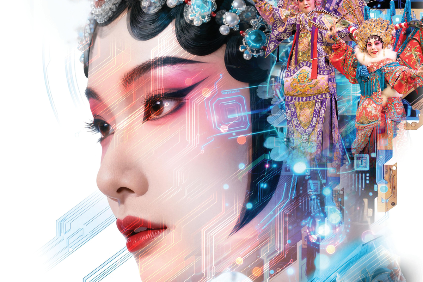
Amidst venue closures and an aging audience demographic threatening its survival, Cantonese opera is experiencing a remarkable transformation in Hong Kong through innovative fusion with contemporary culture and cutting-edge technology. This centuries-old performance art form is being reimagined by a new generation of artists, educators, and enthusiasts who are determined to secure its future.
The recently opened Xiqu Centre in 2019 set a global precedent as a purpose-built venue dedicated to Chinese traditional theater. This commitment continues with the December 19 inauguration of FutureScope, Hong Kong’s first large-scale art dome at Kai Tak Sports Park, which will feature Cantonese opera in its inaugural programming.
A groundbreaking collaboration titled ‘Waving Script’ exemplifies this new approach. Created by new-media artist Chris Cheung (h0nh1m), the immersive experience brings together Chinese calligrapher Xu Jing and Cantonese opera performer Leung Fei-tung within a 360-degree sensory environment. The production explores the artistic resonance between traditional brush strokes and the fluid movements of water-sleeve dancing intrinsic to Cantonese opera.
Leung Fei-tung describes the art form as ‘living, breathing’ and constantly evolving, noting how it ‘absorbs the characteristics of each generation and the spirit of each era.’ She draws surprising parallels between the symbolic language of Cantonese opera and modern programming codes, suggesting inherent compatibility with contemporary digital experiences.
Despite an overall audience decline, educational institutions report unprecedented interest. The Hong Kong Academy for Performing Arts (HKAPA) received record applications for its Bachelor of Fine Arts in Chinese Opera—the world’s only accredited program of its kind. Dean Martin Lau attributes this success to their ‘innovative, interdisciplinary, and globally focused’ approach that integrates advanced technologies to modernize pedagogy.
The challenge of audience development remains critical following the closure of the iconic Sunbeam Theatre in March. Professor Leung Bo-wah of the Education University of Hong Kong emphasizes that ‘audience-building is the first and most important issue,’ particularly among younger demographics.
Various initiatives are addressing this challenge. The Ina Ho Cantonese Opera Research Centre, led by Kelly Chan Kar-yue, is developing digital archives and general education courses that combine traditional knowledge with contemporary experiences. Their Cantonese Opera Repository digitizes memorabilia, scripts, and stage props while making them accessible through online applications.
Students and professionals are exploring creative innovations while respecting tradition. Performance major Cao Xiulin advocates for maintaining traditional instruments like the gaohu while incorporating electronic synthesizers for atmospheric enhancement. Music student Lam Wai-hung sees potential in incorporating magic elements to make performances more accessible to youth.
Technology plays a crucial role in preservation and innovation, from AI-assisted restoration of historical recordings to virtual reality recreations of historical scenes. As alumnus and lecturer Zhao Riwei observes, ‘Traditional culture is no longer remote; it is within reach. Through the fusion of tradition and technology, Cantonese Opera in Hong Kong will gain enduring vitality.’
This multifaceted revival effort represents a significant cultural moment where ancient art forms meet digital innovation, creating new possibilities for cultural preservation and contemporary relevance in an increasingly technological world.