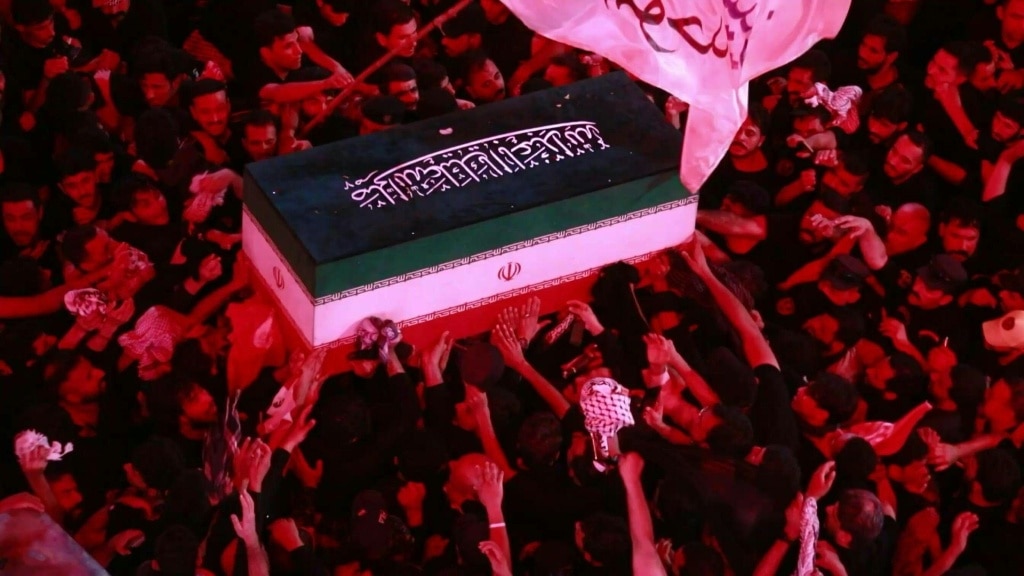
Battling sweltering temperatures that neared 40 degrees Celsius, thousands of loyalists to Iran’s Islamic Republic gathered in the northeastern holy city of Mashhad on Thursday for the burial of long-serving Supreme Leader Ali Khamenei, united by chants of vengeance and firm rejection of any compromise with Western powers. Khamenei was killed in an Israeli strike in late February, on the opening day of a major US-Israeli military campaign against Iran, cutting short a 35-year tenure leading the country.
The six-day series of national funeral ceremonies saw mourners pay tribute across Tehran, the key clerical center of Qom, and Iraq’s holy Shia cities of Najaf and Karbala, where massive crowds turned out to honor the late leader before his body was transported to Mashhad for the final interment. Per Khamenei’s will, he will be laid to rest at the Imam Reza shrine, Iran’s most sacred site for Shia Muslims, alongside close family members including his infant granddaughter, daughter, son-in-law, and daughter-in-law Zahra Haddad Adel — all of whom died in the same February 28 strike that killed Khamenei. His son and designated successor Mojtaba Khamenei, widely reported to have been injured in that attack, has not yet appeared in any public setting, a development that has drawn close scrutiny from global observers.
As crowds lined the processional route from early morning, local officials announced that a helicopter would carry Khamenei’s coffin over the final segment of the journey to the shrine, after projections showed the main avenue would be overwhelmed by attendees. At least one fighter jet escorted the aircraft carrying the casket to Mashhad, a security precaution that came as new hostilities have broken out between Iran and the United States, just one month after a preliminary accord was reached to end months of open conflict. Facing the extreme heat, fire trucks deployed water sprays to cool the massive gathering, while military fighter jets carried out low-altitude passes over the event to reinforce security.
Nearly all attendees wore black mourning garb: men in black shirts, and women in full black chadors, with many waving the red flags that carry traditional symbolic meaning of vengeance in Shia Islam. Slogans directed at US President Donald Trump, Israeli Prime Minister Benjamin Netanyahu, and any push for diplomatic compromise rang out across the crowd, led by official funeral eulogists. Large provocative banners placed near the procession drew a hardline line: one displayed a caricature of Trump with a bounty advertised for his head, while another bore a message in English directed at Netanyahu reading “There will be blood.”
“The loss of the leader is heavier than losing our parents,” said Hoda, a 35-year-old housewife who traveled to attend the burial. Echoing the widespread sentiment across the crowd, she told reporters, “Only the death of Trump and Netanyahu will soothe our pain. There should be no compromise at all,” referencing the mid-June peace deal that ended the initial phase of open hostilities.
Mohammad Afsharian, a 41-year-old local shop owner, noted that the unified call for revenge cut across any public divides over diplomatic policy. “I don’t know what’s the story with diplomacy and what’s the policy to continue diplomacy but all the people are carrying red flags in a sign of seeking revenge,” he said.
The public anger aligns with longstanding criticism from Iranian hardliners, who have repeatedly pushed back against President Masoud Pezeshkian’s administration for pursuing diplomatic talks with Washington following Khamenei’s assassination. Tahereh Rahmani, a 37-year-old school administrator, echoed the hardline consensus: “Only revenge, only revenge can soothe the pain. We are here with our red flags to call for the revenge of our leader.”
The ongoing outbreak of violence forced the closure of the 800-kilometer rail link connecting Tehran and Mashhad, Iran’s state railway company confirmed, adding that organizers had arranged alternative road transport for passengers left stranded by the closure. The funeral prayer ahead of the burial was set to be led by 101-year-old Ayatollah Hossein Noori Hamedani, a prominent conservative figure within the Islamic Republic’s leadership, capping a week of national mourning that has underscored the deep polarization and heightened tensions roiling the region in the wake of Khamenei’s death.