For four decades, Mark J. Terrill has built a legendary career capturing some of sports’ most unforgettable moments, and his work at the 2022 FIFA World Cup offered another example of how innovative camera work can redefine sports photography.
Terrill’s journey in photojournalism began unexpectedly early: at just 16 years old, 44 years ago, he started out as a freelance contributor primarily for the Associated Press. While studying photojournalism in college, he began experimenting with sports photography and remote-triggered camera setups, and quickly developed a lifelong passion for the craft. He went on to join AP as a full-time staff photographer in 1997.
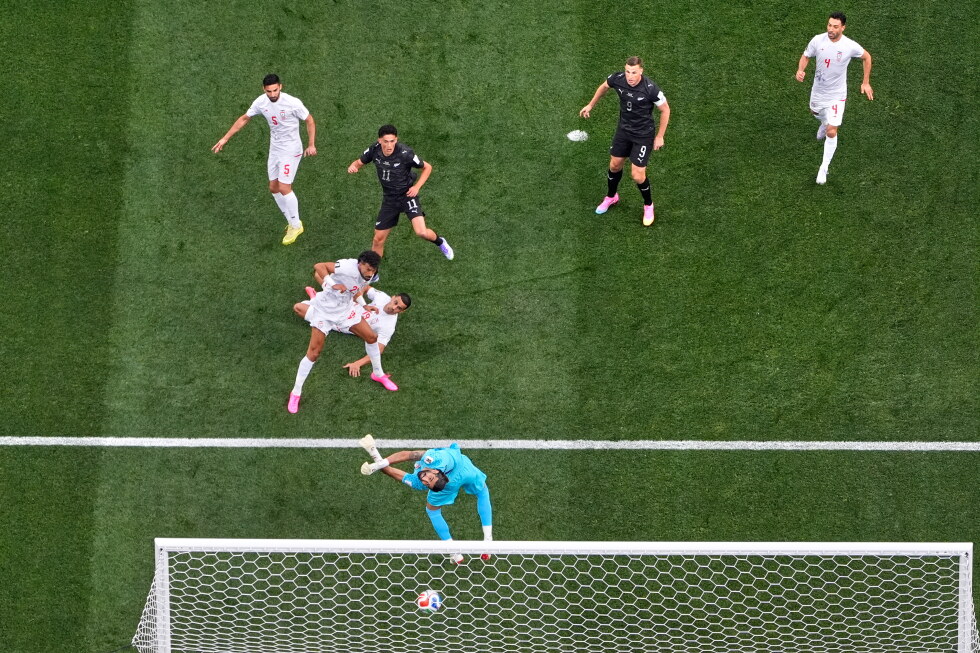
In a breakdown of one of his standout World Cup shots — capturing New Zealand forward Elijah Just scoring against Iran — Terrill explained the creative logic behind the image that sets it apart from typical match photography.
“One of the primary goals (no pun intended) of a photographer is to make a different photograph,” Terrill explained. “Different in the sense that your competition doesn’t have it and that the audience hasn’t seen it before. One of the ways to do this is with remotely triggered cameras. They not only allow you to be in more than one place at a time but it also allows you to be in positions where you can’t physically be.”
The unique vantage point of this shot, which gives viewers a one-of-a-kind overhead look at the goal-mouth action, would have been impossible for Terrill to capture in person from his spot on the pitch sideline. To pull off the shot, he installed a total of four remote cameras along the overhead catwalk of Los Angeles Stadium (now SoFi Stadium), where the match was held: one positioned behind each goal, and another angled toward each goal from the side. Two additional remote cameras were placed behind the goal where Just scored, all synced to radio transceivers that let Terrill trigger the shutters himself from his on-pitch press position.
Terrill noted that the finished image checks every box for a standout soccer photograph. It clearly captures all the key narrative elements of a goal: Just in the act of scoring, the Iran goalkeeper failing to make the save, and defending players reacting to the play in the background. It also benefits from a clean, uncluttered backdrop that keeps the focus firmly on the high-stakes action, rather than distracting from the moment.
This behind-the-scenes look at Terrill’s process offers a rare glimpse into the technical skill and creative planning that goes into capturing iconic sports imagery on the world’s biggest stage.