BEIJING – A groundbreaking naturally occurring insecticidal protein sourced from common plants is transitioning from lab discovery to large-scale agricultural application, marking a major milestone in China’s homegrown crop protection technology, according to a recent report from Science and Technology Daily.
Discovered and developed by the Institute of Cotton Research (ICR) under the Chinese Academy of Agricultural Sciences, the new protein, named iJAZ, offers a fully independent and controllable new pathway for breeding insect-resistant staple crops. To accelerate commercial rollout of the innovation, ICR has entered into a collaborative development agreement with Guangxi Tianyuan Biochemistry Co., Ltd. The partnership will focus on integrating the iJAZ technology into insect-resistant breeding programs for four high-value major crops: cotton, soybean, eucalyptus, and sugarcane, with the goal of making the novel insect-resistant approach widely accessible to global agriculture.
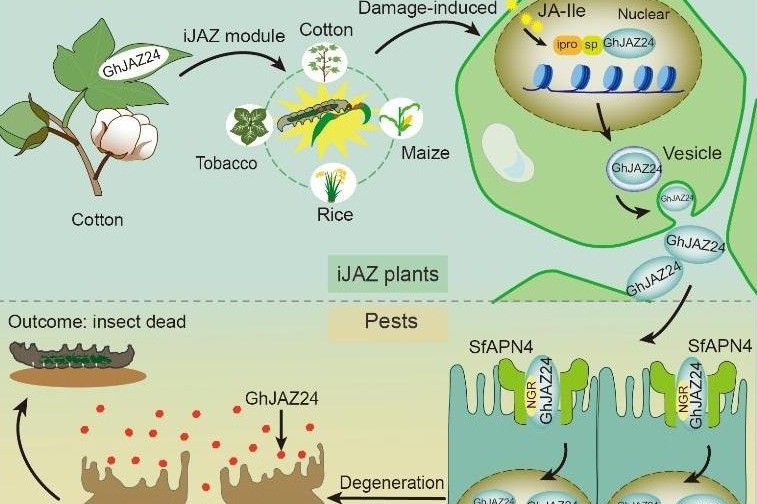
Unlike many synthetic or engineered insecticidal traits, iJAZ occurs naturally in a range of everyday plant species, including cotton, pumpkin, and durian. What sets the protein apart from the current industry standard, Bacillus thuringiensis (Bt) insecticidal protein, is its completely unique mechanism of action and structural characteristics. Unlike Bt proteins that are constitutively expressed in modified crop tissues, iJAZ remains inactive in plant cells under normal, undamaged conditions. Only when targeted chewing pests begin feeding on plant leaves and causing tissue damage does the protein activate: it then specifically identifies and binds tightly to unique receptor sites found only in the pests’ digestive tracts, triggering its potent lethal effect.
Independent research data from ICR’s trials confirms the protein’s extraordinary efficacy: it achieves a 99.33 percent resistance rate against cotton bollworm larvae, one of the most destructive and costly pests for global cotton production. Structurally, iJAZ is just one-tenth the molecular size of conventional Bt proteins, a key advantage that allows both iJAZ and Bt proteins to be stacked in the same crop variety. This combined application provides a long-sought solution to one of the most pressing challenges facing modern agricultural biotechnology: the widespread degradation of Bt protein efficacy as pests develop cross-resistance over decades of widespread use.
To complement the discovery of iJAZ, ICR researchers have also developed a cutting-edge high-efficiency genetic transformation system designed to streamline the integration of the iJAZ trait into elite commercial crop varieties. The new system leverages direct shoot regeneration from the apical stem cells of seeds, cutting the traditional transformation cycle dramatically: what previously took between 6 and 8 months to complete now only requires 2 to 3 months. Even more significantly, the new system overcomes the long-standing genotype barrier that has limited the speed of crop breeding, allowing scientists to directly add insect-resistant protection to existing top-performing commercial varieties rather than breeding new varieties from scratch. This tailored approach drastically accelerates the development and release of new insect-resistant crop varieties for farmers.
To date, the combined iJAZ and transformation technology system has already been successfully adapted and tested across a diverse range of additional crop species, including peanut, cucumber, and cowpea, demonstrating its broad applicability to global agricultural production.