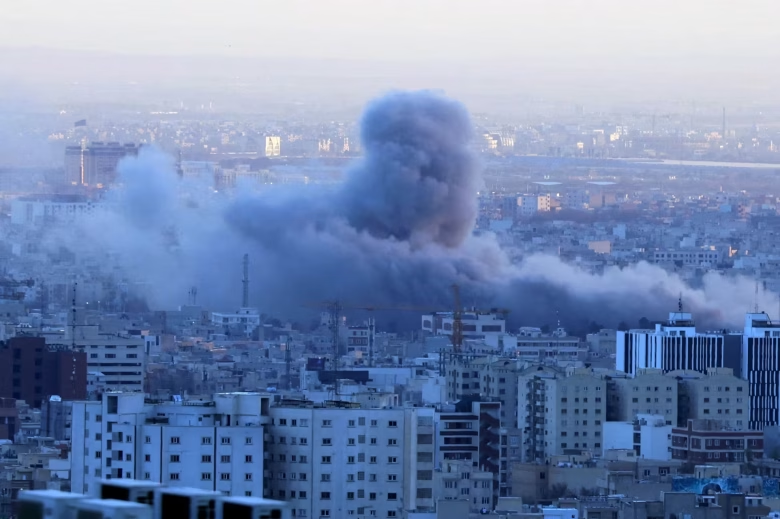
A coordinated military offensive by the United States and Israel has targeted Iran’s missile infrastructure, naval capabilities, and nuclear development facilities in recent operations. The campaign, which also aimed at eliminating key Iranian leadership figures, has been accompanied by explicit calls from former President Donald Trump for citizens to overthrow their government.
In his February 28th operational announcement, Trump declared: “When we are finished, take over your government. It will be yours to take. This will be probably your only chance for generations.” This statement reveals a strategic objective of using aerial superiority to weaken Tehran’s regime sufficiently for internal opposition to complete the power transition.
The military approach has drawn international criticism, with British Prime Minister Keir Starmer stating on March 2nd that his government “does not believe in regime change from the skies.” Historical analysis supports skepticism about aerial campaigns achieving successful political transitions, despite the tactical advantages of air power including operational flexibility, reduced troop exposure, and expanded target selection.
Military analysts note significant limitations to air-dominated strategies. Unlike ground forces, air power cannot physically occupy or secure territory, a critical factor in establishing stable control post-conflict. The 2011 NATO intervention in Libya demonstrates these constraints—while airstrikes successfully supported Gaddafi’s overthrow, the subsequent power vacuum resulted in a decade of civil conflict between competing governments and militia networks.
The Iranian context presents particular complexities. The opposition remains fragmented, with exiled Reza Pahlavi (son of the last Shah) positioning as a potential leader despite uncertain domestic support. Surveys by the Gamaan group indicate approximately one-third of Iranians strongly support Pahlavi while another third strongly oppose him.
Without a unified opposition capable of forming a provisional government, regime collapse could create a dangerous power vacuum potentially leading to civil war. Previous protest movements have met with brutal suppression, including an estimated tens of thousands killed during crackdowns in January 2025.
The Iranian Revolutionary Guard Corps (IRGC), with approximately 190,000 troops and 600,000 paramilitary Basij volunteers, remains dedicated to regime protection. Trump’s threats toward these forces have limited practical effect, as surrender to aircraft is operationally impossible.
While many internationally desire regime change in Tehran, experts caution that aerial campaigns alone may not achieve this outcome, and what follows could potentially create greater regional instability than the current situation, mirroring Libya’s troubled transition.