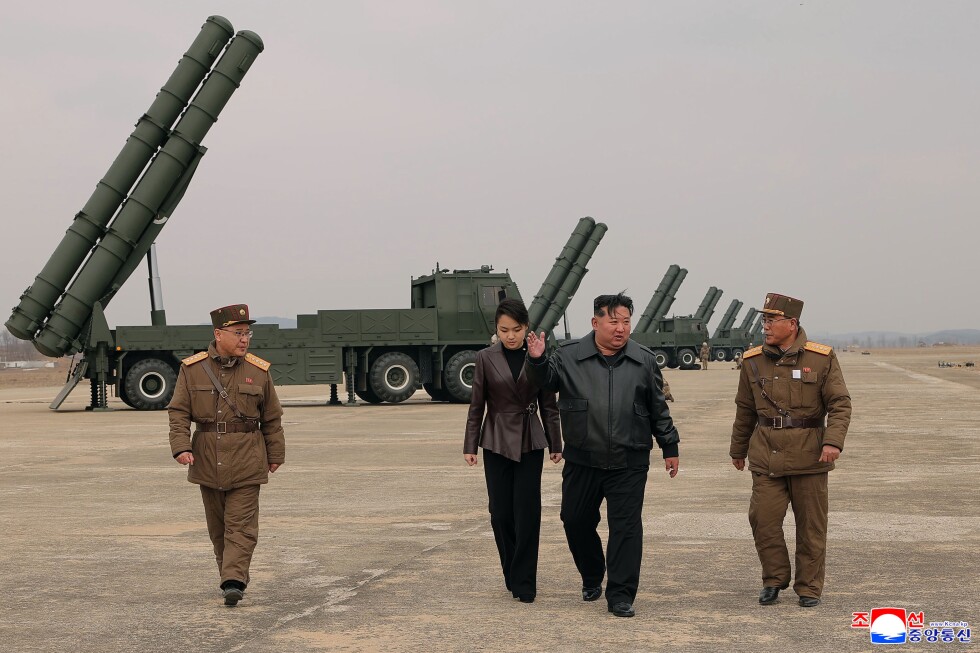
In a demonstrative response to ongoing joint military exercises between the United States and South Korea, North Korean leader Kim Jong Un personally supervised a live-fire test of multiple rocket launch systems this weekend. The event, which notably featured the presence of his approximately 13-year-old daughter Kim Ju Ae, signifies Pyongyang’s continued pattern of military provocation during regional training operations.
According to state media reports from the Korean Central News Agency (KCNA), the exercise involved twelve 600mm-caliber ultra-precision rocket launchers deployed along North Korea’s eastern coastline. Concurrently, South Korea’s military surveillance detected approximately ten ballistic missiles launched from the capital region toward eastern waters, characterizing the actions as clear violations of United Nations Security Council resolutions.
Kim Jong Un explicitly framed the drill as a tactical nuclear demonstration, asserting that these weapons systems would subject adversaries within their 420-kilometer (260-mile) operational range to substantial psychological pressure and physical destruction. The North Korean leader emphasized that any military infrastructure within this strike zone would be rendered completely inoperable if engaged with these capabilities.
Military analysts note that North Korea’s large-caliber rocket launchers represent a significant technological advancement, blurring traditional distinctions between artillery systems and ballistic missiles through their self-propulsion and guided delivery mechanisms. The consistent presence of Kim’s daughter at high-profile military events continues to generate international speculation regarding her potential political succession role.
The timing coincides with the Freedom Shield exercises, a computer-simulated command post training operation between U.S. and South Korean forces scheduled through March 19. North Korea has historically responded to such joint military preparations with heightened weapons testing and aggressive rhetoric, reflecting ongoing tensions on the Korean Peninsula.