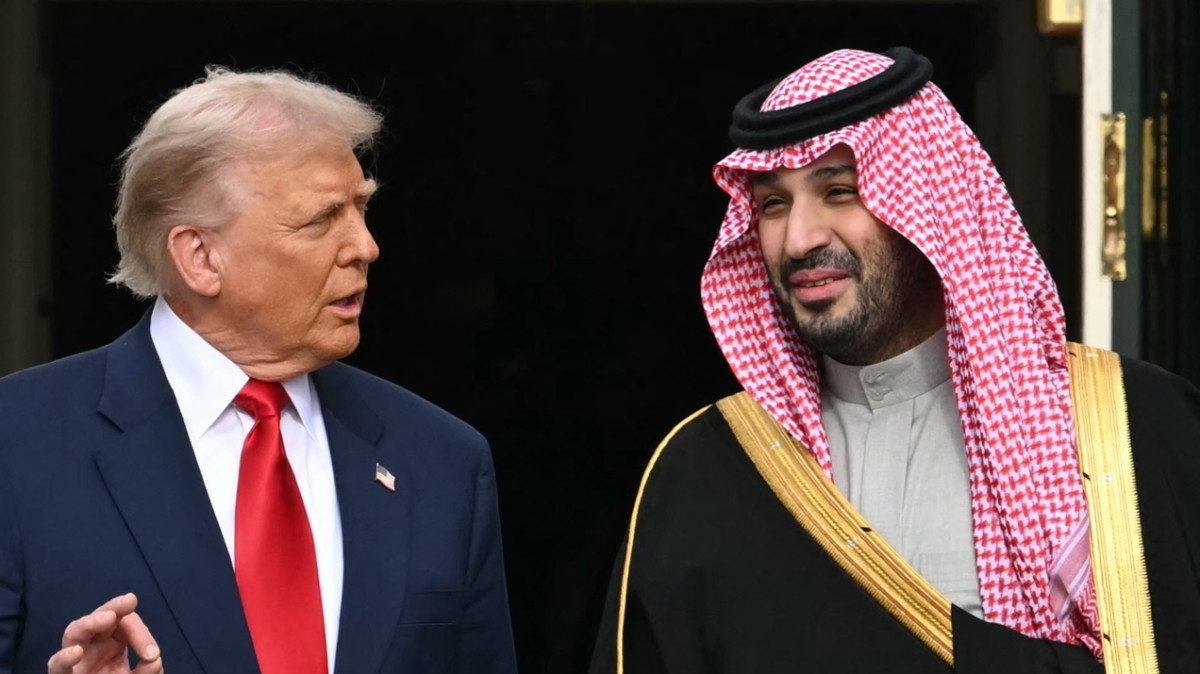
Months of quiet, deliberate diplomacy between the United States and Saudi Arabia hit an unexpected cliff hours after the two countries signed a landmark civilian nuclear cooperation agreement last Wednesday, after former-turned-incumbent President Donald Trump unilaterally declared the entire deal depends on Riyadh normalizing ties with Israel via the Abraham Accords. This bombshell announcement contradicts what two U.S. officials familiar with the negotiations told Middle East Eye: for months of talks that began in November 2025, Saudi recognition of Israel was never raised as a requirement for the nuclear agreement.
“Normalization was never listed as a condition. Not once,” one source confirmed to MEE. The contradiction has thrown a once-celebrated bilateral deal into chaos, leaving officials in Washington, Riyadh and across the Middle East scrambling to clarify the agreement’s future.
Less than 24 hours after the nuclear 123 agreement was signed, Trump took to social media to assert that the deal was “totally subject to Saudi Arabia joining the very respected and successful Abraham Accords”. The surprise post caught U.S. and Arab officials off guard, even though Trump had spoken with Saudi Crown Prince Mohammed bin Salman earlier that same day, and top diplomats from both nations had also held a bilateral call that Wednesday. Trump has long positioned the 2020 Abraham Accords—through which the United Arab Emirates, Bahrain and Morocco normalized relations with Israel—as his signature foreign policy achievement, and has openly pushed Saudi Arabia to join the framework.
Trump’s unilateral declaration has reshaped the entire context of a deal that experts say could reorient the strategic balance of the Middle East. The core point of contention centers on a provision in the still-unreleased agreement: multiple U.S. media outlets report the deal establishes a joint U.S.-Saudi working group to study the economic viability of domestic uranium enrichment in Saudi Arabia, a long-held Saudi policy goal framed as a matter of national sovereignty and energy independence. While U.S. allies including Japan and Brazil have secured 123 agreements that allow domestic enrichment, the UAE’s 2009 deal bars the country from the practice.
Critics warn that permitting Saudi Arabia to enrich uranium could spark a regional nuclear arms race. If Riyadh moves forward with domestic enrichment, regional competitors including Turkey, the UAE and Qatar would likely pursue similar capabilities, they argue. Iran, which has defied international pressure to advance its own enrichment program amid years of regional conflict, would almost certainly harden its position, while Israel—the Middle East’s only undeclared nuclear-armed state—has made clear it opposes any shift that could erode its regional nuclear monopoly.
Prior to Trump’s post, the agreement was framed as the culmination of steadily warming U.S.-Saudi ties, a reward for Riyadh’s longstanding stance opposing U.S. military escalation against Iran. The U.S. Department of Energy framed the pair of nuclear agreements (the 123 deal and a separate safeguards pact) as a decades-long, multi-billion-dollar partnership that advances both economic interests and nonproliferation goals, opening major new market access for U.S. nuclear firms while supporting Saudi Arabia’s growing energy demand.
“These two agreements lay the legal foundation for a decades-long, multi-billion-dollar partnership that advances several priority economic and strategic objectives, including nuclear nonproliferation,” the DOE said in its original statement. “The 123 agreement provides great access for American companies in the Saudi nuclear energy program, benefiting American industry, workers, and supply chains while helping to meet Saudi energy needs.”
Saudi Arabia has for its part consistently ruled out normalizing ties with Israel until the country commits to an irreversible path toward an independent Palestinian state. Saudi analysts note that Israel’s military campaign in Gaza has made any normalization politically impossible for Riyadh at present. This stance has shaped the kingdom’s negotiating strategy throughout the process: Saudi diplomats prioritized separating the nuclear cooperation track from any Israeli normalization talks, working for months to convince Trump—an administration focused on bilateral economic wins, with family business ties in the Gulf—to move forward with the nuclear deal regardless of progress on normalization.
The groundwork for the deal was laid during Crown Prince Mohammed bin Salman’s November 2025 visit to the White House, where he received a formal state welcome even after he declined pressure from Trump to move forward with normalization. Wednesday’s signing was viewed as the successful conclusion of that months-long process.
“The decision to separate nuclear cooperation from the normalisation track reveals pragmatic American calculations,” said Hesham Alghannam, director general of strategic studies and national security programmes at Riyadh’s Naif Arab University, ahead of Trump’s announcement. “A thirty-year agreement that ties Riyadh to American nuclear supply chains would achieve a tangible commercial and strategic benefit for both countries. Everybody wins.”
In the aftermath of Trump’s post, White House spokesperson Karoline Leavitt confirmed to reporters Thursday that Trump had not spoken with the crown prince since releasing the statement, and sidestepped questions about whether the normalization condition had been privately agreed to in prior talks. “The president is always the final dealmaker,” Leavitt said. “If they don’t join the Abraham Accords, the deal is off.”
Middle East experts disagree on what comes next. Rosemary Kelanic, a Middle East analyst at the think tank Defense Priorities, noted that Trump’s social media post does not legally alter the agreement he already signed—but that he retains the power to scrap the deal entirely regardless. She added that permitting Saudi enrichment runs counter to U.S. national interests regardless of the Israel issue: “The US has no national interest, regardless of Israel, in allowing Saudi Arabia to enrich uranium. There are a million ways for US companies to make money without the risk of nuclear proliferation.”
Other experts suggest Trump’s last-minute condition may be a strategic move to defuse opposition to the deal ahead of its mandatory congressional review. The agreement must be submitted to Congress, which can block it with a two-thirds majority, though Trump could override any rejection with a veto. Randa Slim, head of the Middle East programme at the Stimson Center, questioned whether the condition was added to win over skeptical lawmakers facing pressure from both the pro-Israel lobby and anti-Saudi advocacy groups.
“You have to wonder who interfered in this? Who asked Trump to put that condition in – the Israelis? Or is this a way to counter pushback from the Israeli lobby and anti-Saudi lobby,” Slim told MEE. The fate of the bilateral nuclear deal now hangs in the balance, as Saudi leaders weigh whether to accept an unexpected new condition that contradicts months of agreed-upon negotiation, and regional powers watch closely for shifts that could reshape the Middle East’s security and nuclear landscape.