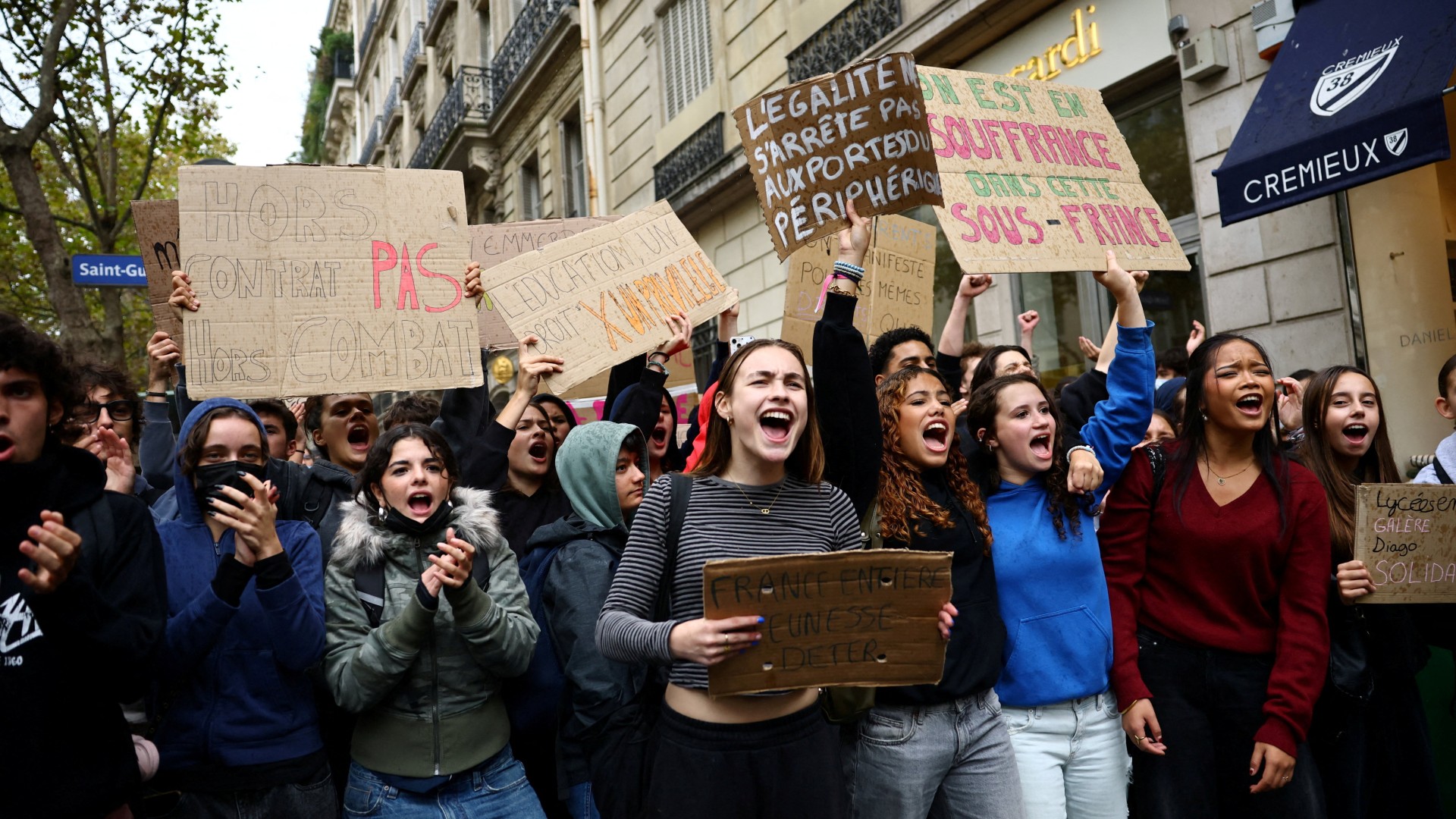
France’s student protest movement has entered its third week, with testimonies from young people revealing that systemic educational inequity disproportionately harms working-class and ethnically diverse communities in the country’s peripheral suburbs, known as banlieues. What began as a localized strike over teacher shortages and crumbling facilities at Lycee Saint-Exupery in Creteil, a southeastern Paris suburb, has erupted into a nationwide movement, drawing hundreds of thousands of demonstrators to demand systemic change and an end to structural inequality that marginalizes low-income communities.
After viral videos of the initial strike spread across social media in mid-September, high schools across France began joining the movement, blocking campus entrances and staging mass demonstrations. The movement spread nationwide in just 10 days, and by October 6, French Interior Ministry figures show approximately 250,000 people – including high school and university students, parents, teachers, and union representatives – have marched in the streets. Their core demands center on increased public investment in education for low-income neighborhoods, spanning everything from renovated school infrastructure and additional teaching staff to reduced class sizes, a reformed national college admissions system, and an overhaul of the current 8 a.m. to 6 p.m. school day.
In response to the unrest, the French state has deployed a heavy security presence that human rights groups including Amnesty International have condemned as “unnecessary and disproportionate,” calling on authorities to de-escalate the use of force. Footage shared online shows national police and guard units deploying tear gas, firing rubber bullets, and striking protesters with batons. Hundreds of people have been injured, some critically: in Val-d’Oise, a 14-year-old lost multiple teeth after a tear gas canister was fired at his face from point-blank range, while a 15-year-old student in Lens lost a hand during a confrontation with police. Following the Lens incident, the interior minister announced a temporary pause on the use of stun grenades at school protests but rejected widespread accusations of police brutality. To date, more than 5,000 protesters have been arrested, 85% of whom are minors, according to official ministry data.
The nationwide wave of school blockades has laid bare a deep, long-simmering crisis in France’s public education system, with abysmal material conditions at schools in low-income areas at the center of student grievances. In many of these schools, campus buildings are in severe disrepair: students report leaky roofs, crumbling ceilings, rodent infestations, broken plumbing, insufficient classroom furniture, and extreme temperature fluctuations during recent summer heatwaves. “It’s either freezing in the winter or unbearably hot in the summer. The power cuts out, so the classrooms go dark, the computers stop working, the lights stop working,” explained Madeleine, a high school student at Lycee Francois Villon in Les Mureaux, a northwestern Paris suburb.
Overcrowding is rampant, with some urban classrooms holding more than 36 students, and teacher shortages leave roughly 10% of scheduled teaching hours unfilled – a gap that hits low-income areas hardest. “We have asbestos in the walls, classrooms where there aren’t enough chairs or desks. There are 35 of us in a classroom. We go to school from 8am to 6pm and then we have to do homework, it’s impossible,” a student from Lycee Alfred Kastler in Pontoise, 30 kilometers northwest of Paris, told reporters. Other students highlighted repeated power failures, a lack of ventilation or air conditioning to combat extreme heat, and unsanitary bathroom facilities that often lack toilet paper and soap. In some classrooms, students report standing during entire lessons because there are not enough chairs for every enrolled student.
While the French government has acknowledged the “legitimate” nature of student grievances and pledged to address overcrowding, school schedules, teacher replacement protocols, and building repairs, a recent Senate report estimates that billions of euros will be required over the coming years to renovate France’s thousands of aging public schools.
Underfunding affects schools across the country, but the burden falls heaviest on schools in deprived neighborhoods with large immigrant and ethnic minority populations. Unlike many other European capital cities, Paris is defined by a stark geographical wealth divide: wealth and resources are heavily concentrated in western Paris and adjacent inner suburbs, while lower-income and immigrant communities are largely segregated in the peripheral northern and eastern banlieues. This geographic divide directly shapes student outcomes: OECD data shows that social background remains one of the strongest predictors of academic success in France, with disadvantaged students concentrated in under-resourced schools that face higher rates of teacher absenteeism and poorer learning conditions.
Students from the banlieues argue that racialized prejudice against working-class suburban communities perpetuates systemic institutional neglect. “They assume that because we’re from the banlieues, we’re supposed to be uneducated, that we don’t learn anything, that the suburbs are worthless,” explained Jelan Kone, a student from Lycee Paul Eluard in Saint-Denis, a northern Paris suburb and one of the first high schools to join the protest movement. “But we don’t just let people walk all over us. We try to improve our communities and show that the banlieues aren’t something that should be neglected.”
Witnesses and extensive research on racial bias in French policing confirm that discriminatory treatment is also common during protest responses. A 2025 study from France’s independent administrative authority Défenseur des droits found that young men perceived as Black, Arab, or North African face four times the risk of involuntary identity checks than other population groups. France’s largest and most influential judges’ organization, the Magistrates’ Union, has also condemned the authorities’ treatment of protesters, noting that protection of student rights “cannot be applied selectively” and that disproportionate force primarily targets young people of color from working-class neighborhoods.
Students report that police overwhelmingly target Black and Arab youth during protests. “During one of the school blockades, I heard one student say to a policeman: ‘I don’t speak to cops’. The police man replied: ‘We don’t speak to Black people,’” reported Nellie, a student from Lycee Alfred Kastler in Cergy, a northwestern Paris suburb. Her classmate Maelie added that police regularly “show up at their school, hit and tear-gas innocent people.”
Another major source of student frustration is Parcoursup, France’s national higher education application platform. Students argue that algorithmic biases in the system prioritize applicants from more affluent neighborhoods and schools, perpetuating existing social and racial inequality. “We’re at a high school in the Paris banlieue. Because of that, we’re not viewed as favourably and it means that we don’t necessarily have the same opportunities as students from rich schools, even though we have the same level, and sometimes an even higher level than them,” explained Imene, a high school student in Saint-Denis. “Parcoursup is a source of stress for all students in France. It’s unbearable. There are people who have an average grade of 18 out of 20 but were rejected by top universities, or from programmes like medicine, simply because other students were given priority.”
A 2024 Défenseur des droits report on systemic discrimination against young people by origin highlighted persistent inequalities in access to higher education and raised formal concerns about selection procedures on Parcoursup. The report called for stronger equal treatment measures and recommended that Parcoursup publish clear, verifiable selection criteria, increase ministerial oversight of admissions algorithms, and end the practice of using an applicant’s previous high school as a selection criterion. Despite these recommendations, students from banlieue schools report they still feel overlooked and ignored by national policymakers.
“Everyone is equal in this country, we want to have the same rights as everyone else. That’s what they don’t want to understand. They just want us to stay quiet and put up with it,” said Melissa, another Saint-Denis high school student. While many teachers support the protests, students in Saint-Denis note a deep socioeconomic divide between staff and pupils that makes it hard for teachers to relate to their lived experiences: most teachers attended elite universities and do not come from the banlieues or identify as racialized people, so they do not share the same struggles.
Student organizers say the movement will continue until their demands are heard, noting that students and staff have raised these same issues for decades without meaningful systemic change. “Every single year, there’s another issue. But nothing changes,” lamented Zara, a student organizer. As of this report, students are continuing to organize new school blockades and demonstrations, and participation is growing. Despite the violence, mass arrests, and uncertainty, students remain determined to push for reform. “If we don’t act now, it’s never, ever, ever going to change. But this time, if we keep going, things will change, I have hope,” Imene said.