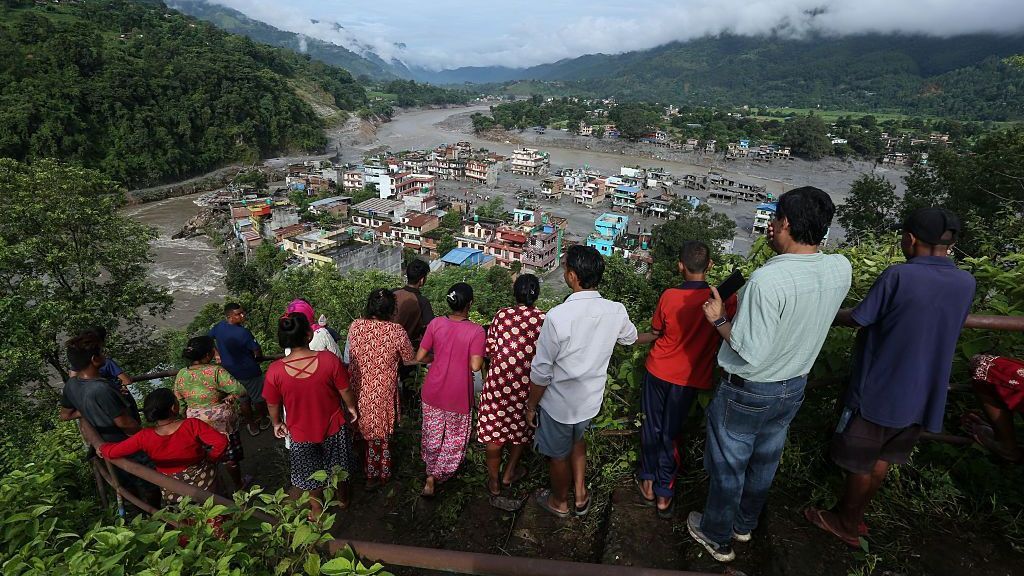
One month after catastrophic floods and landslides originating from a glacial collapse on the Nepal-Tibet Himalayan border left more than 1,400 people dead and thousands more unaccounted for, an international scientific analysis has delivered a clear conclusion: human-induced climate change was a core precondition that set the deadly compound disaster in motion.
The disaster, which unfolded on August 26, began when a massive section of glacial slope broke free from Langtang Lirung, a 7,234-meter peak on Nepal’s side of the border. The ice and rock avalanche crashed into the valley below with such force that U.S. Geological Survey (USGS) sensors registered the impact as a magnitude 5.2 earthquake. The collapse unleashed torrents of meltwater that swept through border towns and villages in both Nepal and the Tibet Autonomous Region of China, leveling thousands of homes, wiping out critical energy infrastructure, and leaving entire communities shattered.
Released Thursday by the international climate research collaboration World Weather Attribution, the new study identifies the event as a complex compound disaster, driven by a cascade of interconnected natural and human-influenced factors. Lead author Friederike Otto, a leading climatologist at Imperial College London, left no room for ambiguity in the research’s conclusion: “There is absolutely no doubt that human-induced climate change played a role here in the preconditioning of the disaster.”
The analysis confirms that regional temperatures in July and August this year were roughly 1.5°C warmer than pre-industrial levels, a warming directly tied to anthropogenic greenhouse gas emissions. Glaciers across the Himalayan region have already thinned by an average of half a meter annually for decades, the study notes, a steady loss that weakens existing geological fractures and increases overall slope instability. Compounding this warming trend, heavy snowfall in late 2025 produced excess meltwater in the months leading up to the August collapse, while thawing permafros further loosened the slope’s structural integrity.
Researchers also note that the 7.8-magnitude Gorkha earthquake that struck the region in 2015 may have weakened the underlying rock mass, leaving the glacial slope already predisposed to failure. While Nepali authorities have not been able to confirm the exact long-term impact of the 2015 quake on the August collapse, study co-author Walter Immerzeel, a mountain hydrologist at Utrecht University, explained that the already geologically vulnerable site was weakened first by the 2015 seismic event, then destabilized further by decades of glacial retreat and permafrost thaw driven by climate change.
“Climate change was a destabilising factor acting on a pre-existing geological predisposition,” the study concludes, emphasizing that rising temperatures were not the sole trigger, but a critical enabling condition that turned long-standing vulnerability into catastrophe.
In the wake of the disaster, Nepali officials have renewed urgent calls for global climate action, pointing out that Nepal contributes less than 0.1% of global greenhouse gas emissions, yet ranks among the countries most vulnerable to the impacts of climate change. Nepali Prime Minister Balendra Shah is set to highlight the disaster and push for global climate justice during his first foreign policy trip, when he addresses the upcoming United Nations General Assembly in New York next week.