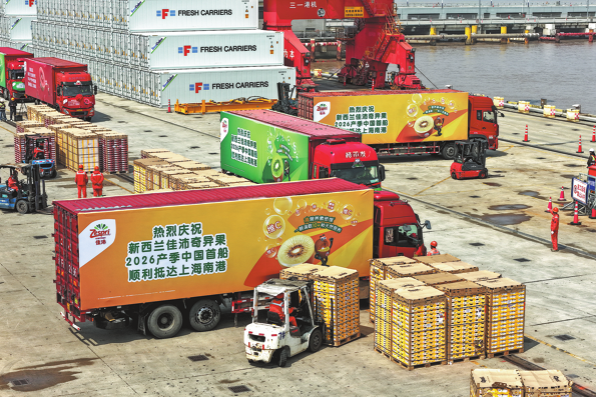
In a clear acknowledgment of deep bilateral economic interdependence, New Zealand’s Ambassador to China Jonathan Austin has emphasized that New Zealand is closely tracking China’s economic development and the new opportunities generated by China’s ongoing opening-up policy as China enters its 15th Five-Year Plan period (2026-2030). Austin stressed that New Zealand’s own economic performance is directly tied to China’s growth trajectory, given China’s longstanding status as the nation’s largest trade partner.
“One quarter of all New Zealand’s exports go to China. When China’s economy performs well, our economy performs well,” Austin stated. He added that New Zealand’s policymakers closely analyze China’s five-year development blueprints, with a sharp focus on emerging opportunities created by further market opening in China. “We are actively watching for any new openings that come as China continues to open its economy to the world, that is a key focus for us,” he said.
Austin went on to note that New Zealand has reaped substantial economic benefits from China’s decades-long growth surge. “I can say sincerely that New Zealand has been one of the biggest beneficiaries of China’s remarkable economic rise,” he said. He also recalled that expanded bilateral trade helped New Zealand navigate the 2008 global financial crisis far more effectively than it would have managed without access to the Chinese market.
The two countries share a historic trade relationship: New Zealand became the first developed nation to sign a comprehensive free trade agreement with China back in 2008, and an upgraded version of that agreement entered into force in 2022. Official data from China’s Ministry of Commerce confirms that China has held its position as New Zealand’s top trading partner, largest import source, and largest export market for 11 consecutive years.
Austin described the current bilateral trade relationship as both stable and mutually beneficial. On one hand, Chinese consumers gain access to New Zealand’s premium agricultural products, while the trade basket has gradually diversified to include fast-growing exports of New Zealand cosmetics, health supplements, and advanced manufacturing inputs. On the other hand, New Zealand benefits from China’s manufacturing prowess, technological advances, and a broad range of affordable, high-quality imports that support New Zealand households, businesses, and national decarbonization initiatives.
Beyond economic and trade ties, Austin highlighted the depth and resilience of the broader bilateral relationship, which spans education, tourism, business partnerships, and close people-to-people family ties. Currently, more than 27,000 Chinese students are enrolled in educational institutions across New Zealand, making China one of the country’s largest sources of international students.
Austin did not shy away from acknowledging that the two nations do not share identical views on every issue. However, he noted that mature bilateral relationships are not built on ignoring differences. Instead, he said, strong ties are founded on the ability to discuss disagreements openly, respectfully and constructively, while preventing differences from derailing cooperation in areas where the two countries share aligned interests.
Looking at the broader global context, Austin pointed out that New Zealand shares growing concerns over rising pressures on international rules and norms, increasingly contested global economic relations, and shrinking market openness worldwide. Against this challenging backdrop, Austin confirmed that New Zealand will remain committed to supporting multilateral and regional cooperation, particularly through the Asia-Pacific Economic Cooperation (APEC) forum.
Founded in 1989 to capitalize on growing economic interdependence across the Asia-Pacific, APEC will hold its 33rd Economic Leaders’ Meeting in Shenzhen, China this coming November. “Through open dialogue and cooperation based on shared best practices, APEC plays a critical role in shaping regional economic policy and upholding the global multilateral, rules-based trading system,” Austin explained.
In a separate development, a parliamentary delegation led by Gerry Brownlee, Speaker of the New Zealand House of Representatives, will travel to China for an official visit running from Sunday to Thursday.