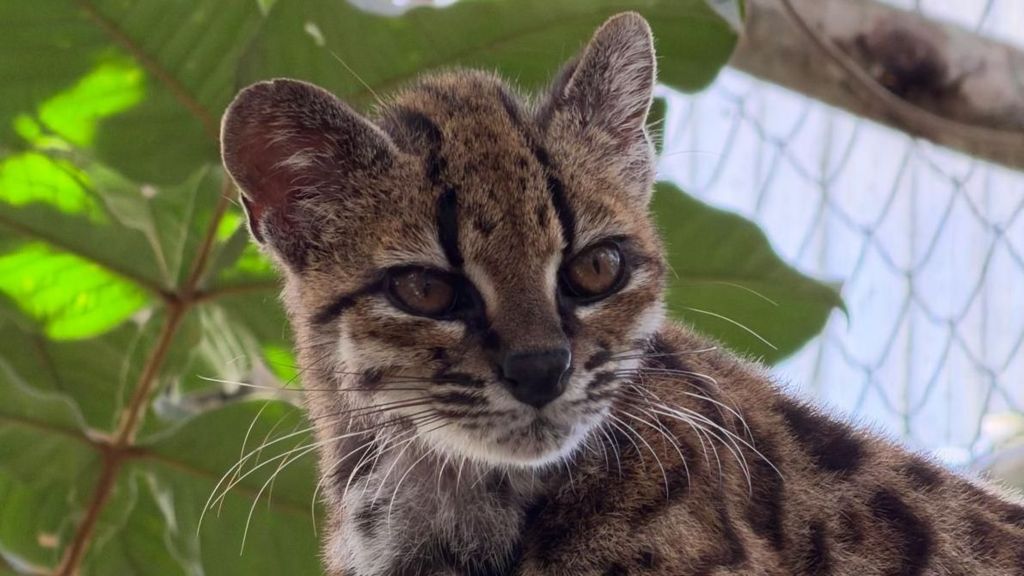
For decades, a diminutive spotted feline native to Bolivia’s dense forests has managed to slip through the cracks of scientific classification, confused with its close tiger cat relatives that share nearly identical markings. Now, cutting-edge genetic analysis has finally revealed what makes this tiny cat one-of-a-kind: it is an entirely new species, marking one of the most exciting mammalian discoveries in recent years and highlighting how much of Earth’s biodiversity remains undocumented.
The newly identified species, formally named *Leopardus tilcayo* and nicknamed the Tilcaya cat, is roughly the same size as an average domestic house cat. Its discovery traces back to a single 10-year-old individual named Tigrino, who currently resides as the only confirmed living member of the species at a Bolivian wildlife rescue sanctuary. Tigrino first came to the attention of scientists after a local resident found him as a kitten, mistakenly assuming he was a domestic cat. As he matured, his unusual behavior and distinct physical traits caught the eye of Bolivian researcher Paola Nogales-Ascarrunz from Universidad Mayor de San Andres in La Paz, who launched an investigation into his origins.
Intrigued by unconfirmed reports of similar unusual small cats in Bolivia’s Yungas forest region, Nogales-Ascarrunz partnered with an international team of geneticists and wildlife researchers to analyze DNA samples collected from both living tiger cats and preserved museum specimens. The results of the study, published in the peer-reviewed journal *Current Biology*, upended long-held assumptions about the tiger cat group: instead of just three recognized species, the research confirms there are actually five distinct species, with the Tilcaya cat being the latest addition.
Eduardo Eizirik, a conservation geneticist at the Pontifical Catholic University of Rio Grande do Sul in Brazil and co-author of the study, explained that the species went undetected for so long due to a severe lack of research and documentation. “There’s so few records or pictures, no individual in a museum, so it was hiding because nobody was looking,” Eizirik noted. Nogales-Ascarrunz emphasized that the discovery shatters the common misconception that new large mammal species can only be found in remote, extreme environments like deep-sea trenches or isolated volcanic islands. “It’s amazing that there are still new species waiting to be discovered: we don’t have to go to a volcano, an island, or deep into the sea,” she said.
The ramifications of this discovery extend far beyond adding a new name to biological textbooks. Previously, the entire Felidae family – which encompasses all living wild and domestic cat species, from tiny house cats to massive Siberian tigers – was recognized to include just 41 species. This discovery, paired with the reclassification of tiger cats, pushes the total number of recognized feline species to between 44 and 45. Andrew Kitchener, a mammal expert at National Museums Scotland who was not involved in the research, described South America’s small tiger cats as a longstanding “taxonomic nightmare” due to their near-identical appearances and sparse museum collections. He noted that genetic research is only now untangling this confusion, revealing hidden diversity that had evaded even expert eyes.
Most importantly, the discovery carries critical implications for wildlife conservation. Tiger cat species across Central and South America are already classified as vulnerable to extinction, facing existential threats from widespread deforestation, habitat fragmentation, and illegal hunting. Until a species is formally identified and its range documented, conservationists cannot implement targeted protection strategies to save it from disappearing. “These are animals similar in size to a domestic cat, so you might think we would know them all by now, but this discovery shows how much biodiversity is still to be uncovered in some of the less-studied regions of the world,” said co-researcher Caroline Sartor of the Wildlife Conservation Research Unit at the University of Oxford. “It’s impossible to protect a species if we don’t know what it is or where it lives,” she added.
While only one confirmed individual of *Leopardus tilcayo* is known to science today, researchers are confident that other members of the species survive in the undisturbed dense forests of Bolivia, waiting to be documented. Scientists hope the high-profile discovery will draw much-needed public and funding attention to the conservation of small wild cats in the Americas, a group that has long been overshadowed by larger, more charismatic big cat species like lions, tigers, and leopards.