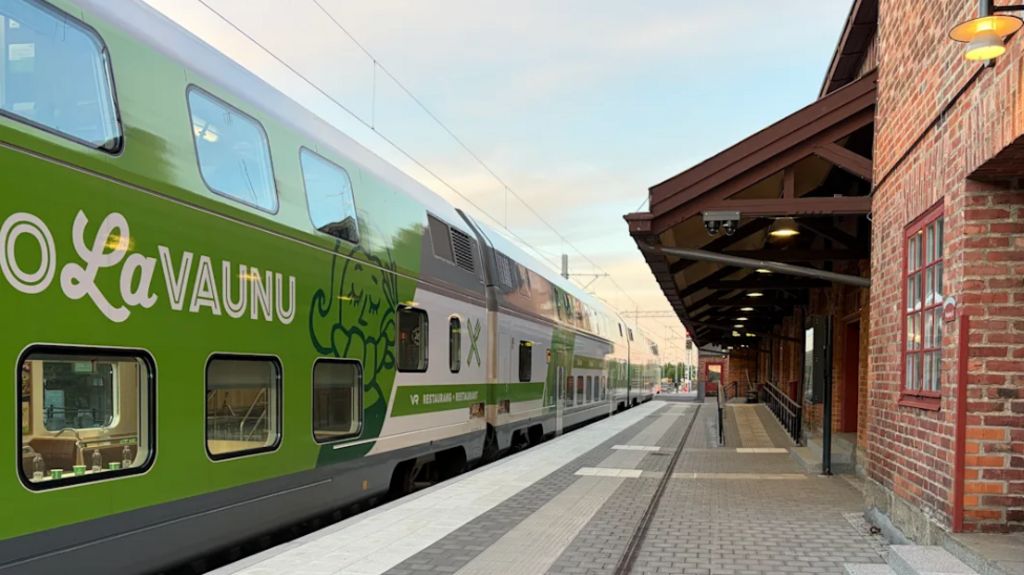
For nearly four decades, a key rail link connecting northern Finland and Sweden sat idle, severing a critical transport artery between the Nordic region and the rest of continental Europe. That changed on Monday, when an inaugural double-decker passenger train pulled out of Oulu, Finland’s coastal northern city, shortly after 5 a.m. local time, marking the official restart of cross-border service between Oulu and the Swedish border town of Haparanda.
When the train crossed the Torne River and glided into Haparanda’s station, hundreds of gathered spectators greeted it with cheers and waving Finnish and Swedish flags, celebrating the end of the 40-year hiatus. The original service was discontinued between the late 1980s and early 1990s, dragged down by low ridership and a long-standing infrastructure mismatch between Finland and the rest of Europe.
This infrastructure difference traces back more than a century: when Finland was part of the Russian Grand Duchy, it adopted Russia’s wider rail gauge, which remains the national standard today. That divergent track width long prevented seamless through-running between Finnish rail networks and the European standard gauge used across most of the continent. Currently, Finland is in a gradual process of upgrading key border and arterial routes to align with the European standard, laying the groundwork for greater cross-continental connectivity.
The newly launched service will run two round trips daily, with the 100-minute journey from Oulu to Haparanda tracing Finland’s western coast before crossing the border. While passengers heading further south from Haparanda must transfer to a Sweden-based train to continue their trip, the restored link unlocks an unprecedented pan-European rail route: it is now possible to travel approximately 5,000 kilometers entirely by rail from the Algarve region of southern Portugal all the way to Kolari, Finland’s northernmost railway station, a route believed to be the longest contiguous rail journey on the continent. It also cuts travel time between the two Nordic capitals, enabling a 24-hour rail trip between Helsinki and Stockholm.
Finnish Transport Minister highlighted that the return of this cross-border service is tangible proof of steadily growing cooperation between Finland and Sweden, two neighboring Nordic nations with deep economic and social ties. Elisa Markula, CEO of Finland’s state-owned railway operator VR, which leads the new service, noted that the launch aligns with a continent-wide resurgence in rail travel popularity. “Train travelling in all Europe is having a renaissance. Also in Finland, our passenger numbers are increasing a lot,” Markula told reporters from AFP. She expressed optimism that the new cross-border route will capture growing public demand for sustainable, convenient cross-border travel across the European Union.