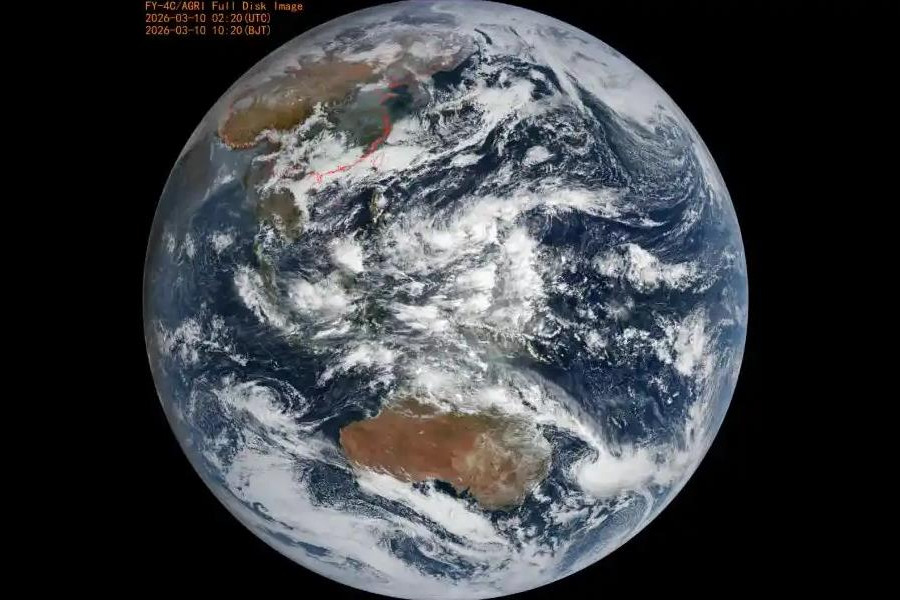
China has elevated its meteorological monitoring capabilities to unprecedented levels with the operational deployment of the Fengyun-4C (FY-4C) satellite, marking a significant advancement in global weather observation technology. The China Meteorological Administration unveiled the satellite’s first imagery just before World Meteorological Day, demonstrating real-time monitoring capabilities spanning from solar phenomena to terrestrial weather patterns.
Launched from Xichang Satellite Launch Center on December 27, the FY-4C represents the world’s most sophisticated single geostationary meteorological satellite currently in orbit. The satellite’s deployment aligns with China’s national policy directives emphasizing enhanced extreme weather monitoring and improved disaster prevention mechanisms. Operational trials are scheduled to commence during the upcoming flood season, positioning the satellite as a critical component of China’s meteorological defense infrastructure.
The satellite’s technological superiority stems from its six advanced payloads meeting international excellence standards. The geostationary radiation imager has captured remarkably detailed weather system textures, while its animation capabilities enable precise tracking of cloud systems moving from Inner Mongolia toward Beijing with exceptional clarity in distinguishing high-level cirrus formations.
Sophisticated instrumentation includes an interference-based vertical atmospheric sounder providing refined spectral data across multiple temperature layers, significantly enhancing global numerical weather prediction accuracy. The satellite’s lightning imager has already mapped convective activity across South Asia, monitoring storm cells and lightning events in Bangladesh and Myanmar with precision.
Beyond terrestrial weather monitoring, FY-4C features cutting-edge ultraviolet and X-ray sensors that successfully captured solar flares and ionospheric glow phenomena. These capabilities will help mitigate solar activity’s impact on global communication, navigation, and positioning systems.
The satellite is poised to become the primary data source for MAZU, China’s AI-powered early warning system. Upon reaching full operational status, FY-4C will contribute to international monitoring initiatives and global environmental governance efforts.
China Meteorological Administration Director Chen Zhenlin emphasized that China has established the world’s most comprehensive meteorological observation system, featuring coordinated land, sea, air, and space monitoring. With ten Fengyun satellites currently operational, China remains the only nation maintaining meteorological satellite coverage across four distinct near-Earth orbital types.