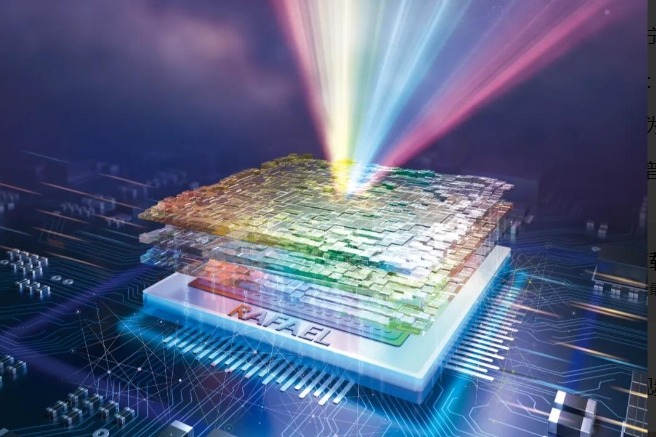
Chinese researchers have unveiled a groundbreaking spectroscopic chip, named RAFAEL (Yuheng in Chinese), which promises to revolutionize the way we observe the universe. Developed by a team at Tsinghua University, this chip, no larger than a mobile phone SIM card, combines exceptional resolution with a panoramic view, enabling sharper, faster, and wider scans of the cosmos. The findings were published in the prestigious journal Nature on October 15, 2025.
Traditional high-resolution spectrometers are often cumbersome and heavy, but RAFAEL’s compact design allows it to be mounted on satellites or deep-space probes, opening new possibilities for mapping the universe’s spectral data. According to Fang Lu, the research leader and professor at Tsinghua University’s Department of Electrical Engineering, the chip can capture full spectral data with sub-angstrom resolution for approximately 10,000 stars per second. This capability could reduce the time needed to compile complete spectra for all stars in the Milky Way from thousands of years to under a decade.
The chip’s core innovation lies in its ability to resolve the long-standing trade-off between resolution and field breadth in spectral imaging. By employing advanced computational imaging methods and reconfigurable integrated photonics based on lithium niobate, the team achieved snapshot spectroscopy with 10-megapixel-level spatial resolution and sub-angstrom spectral resolution across visible and near-infrared wavelengths. This allows the chip to discern light wavelengths down to ten-millionths of a millimeter and detect the slightest energy variations while capturing wide-field scenes in high detail.
Fang emphasized that this new technique surpasses existing international counterparts in snapshot spectroscopy, improving spectral resolution by two orders of magnitude. The on-chip prototype measures just 2 centimeters in length and width, with a depth of 0.5 centimeters, making it highly portable and adaptable for future space and astronomical applications.
The technology’s potential extends beyond astronomy, with promising applications in material identification, plant health, autonomous driving, and atomic spectroscopy. Operations are already underway to integrate the chip into large-aperture telescopes at observatories in Xinglong County (Hebei Province), Lijiang (Yunnan Province), and the Canary Islands (Spain).
Fang concluded that this study marks the beginning of a new era in intelligent photonics, pushing the boundaries of what light can reveal about the universe.