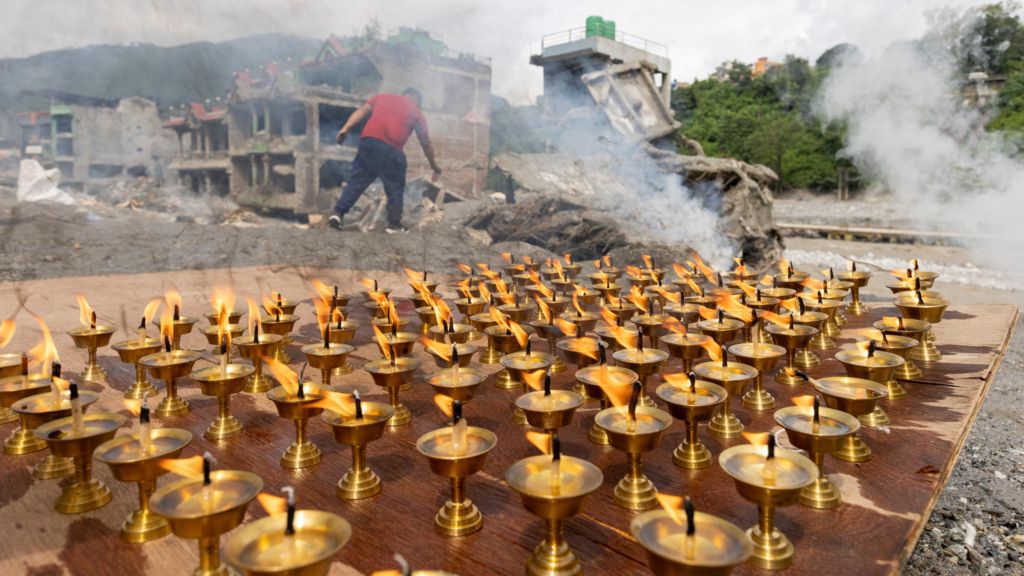
On September 7, 2026, Nepal marked a national day of mourning to honor the lives lost in a devastating glacial lake outburst flood that tore through Himalayan valley communities along its border with the Tibet Autonomous Region of China. The occasion closed a 13-day traditional Hindu-Buddhist mourning period, with commemorative events scaled back to prioritize ongoing search and rescue efforts for hundreds of missing people.
The disaster, triggered by the sudden collapse of a glacial formation, unleashed a massive wall of water, ice, rock and mud across low-lying villages in the region. As of the day of mourning, Nepal’s official death toll stood at 1,287, with at least 5,083 people still unaccounted for inside the country. Across the border on the Tibetan side, Chinese media reported 31 confirmed deaths and 531 people missing as of the prior Friday.
In a sign of national respect, the Nepali flag was flown at half-mast across all government offices nationwide, as well as at the country’s diplomatic missions abroad. Phanindra Paudel, a representative from Nepal’s National Emergency Operation Centre (NEOC), confirmed that no official government ceremonial events were scheduled, as all available resources remain focused on relief and search operations in flood-affected zones. Nepal’s President Ram Chandra Paudel also conducted an official tour of devastated communities across Nuwakot district on the day of mourning, a presidential aide confirmed to Reuters.
Rescue teams have not lowered the intensity of their search efforts, even nearly two weeks after the flood struck. Army spokesperson Raja Ram Basnet told Agence France-Presse that operations are still progressing at the same pace as they did on the first day of the disaster. “Our focus is on search and rescue at three levels – on ground, by air, and in the tunnels,” Basnet said. “We are making sure that no one is still stranded.”
A key focus of ongoing search efforts are the tunnels associated with regional hydropower infrastructure, where hundreds of missing workers were last located. Arnold Dix, an Australian tunnel rescue specialist advising Nepali rescue teams, outlined the extreme complexity of the operation in an update posted to social media platform X. “The operation meant facing multiple potential rescues, unfolding at the same time, in different places, each with its own dangers, uncertainties and lives that may still be saved,” Dix wrote.
Against the grim backdrop of rising death tolls, small glimmers of hope have emerged in recent days. Four people have been pulled alive from flood debris since last week, three of them from hydropower tunnels and related infrastructure. Most notably, on September 5, more than 10 days after the flood partially buried her home in Nuwakot’s Dhunge village, a 64-year-old Nepali woman was discovered alive on the fourth floor of her mud-buried building by members of Nepal’s Armed Police Force. She was immediately airlifted to a specialized hospital in Kathmandu for urgent medical care.
Across the border, Chinese search teams recovered 12 additional bodies from the disaster site on September 6, using heavy excavators, hand tools and ground-penetrating radar to comb through debris. As the nation mourned on Monday, communities across Nepal gathered for quiet candlelight vigils in the evening to remember those lost, while oil lamps were lit in Dhunge to mark the official close of the 13-day mourning period.