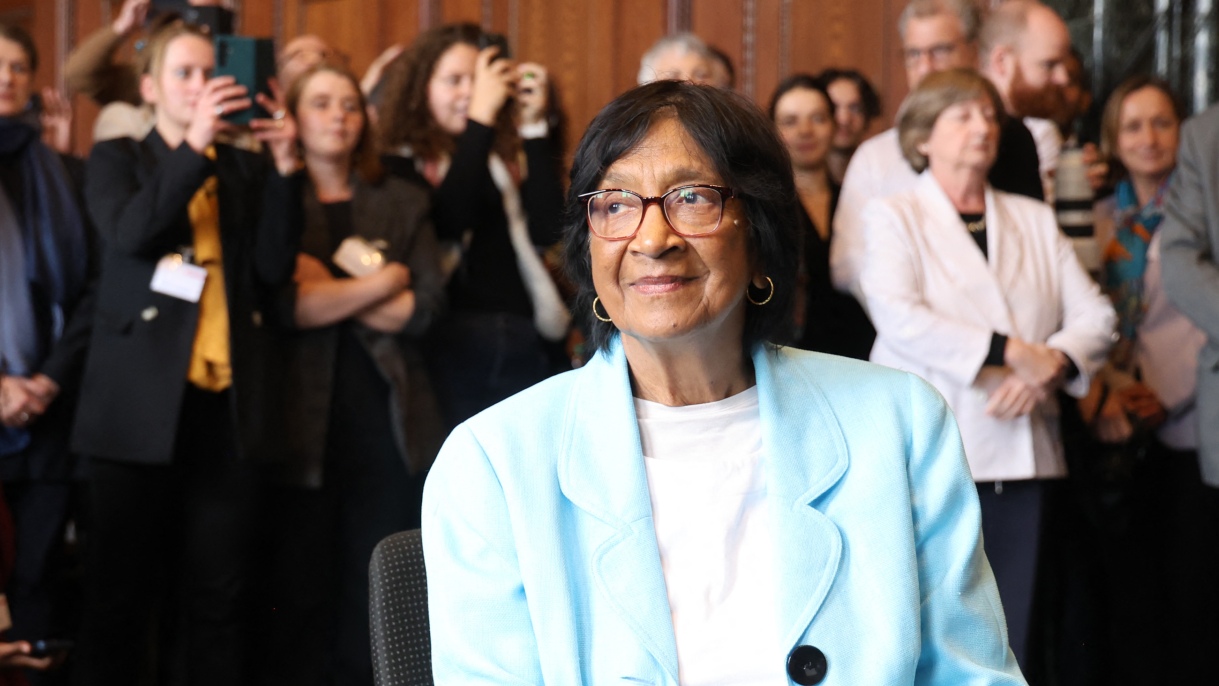
On Friday, the Norwegian Nobel Committee made a landmark announcement, naming 85-year-old veteran South African jurist Navi Pillay as the recipient of the 2026 Nobel Peace Prize. Pillay, who most recently chaired the United Nations Independent International Commission of Inquiry on the Occupied Palestinian Territory, was recognized for her decades-long, trailblazing work advancing global peace and the rule of international law.
The committee lauded Pillay as a figure of extraordinary courage and unwavering integrity who has paved the way for a more robust, inclusive global legal framework. In its official citation, the panel emphasized Pillay’s foundational role in pushing for accountability for war crimes, crimes against humanity, and the crime of genocide, noting that her work has fundamentally shaped the landscape of international criminal justice.
In her first public remarks following the announcement, delivered at the Nuremberg Palace of Justice’s historic Courtroom 600— the same venue that hosted the landmark post-WWII trials of Nazi war criminals—Pillay centered her most recent high-profile work: the UN commission’s 2025 authoritative report that found Israel responsible for acts of genocide in the Gaza Strip.
“The final work I have led is this report on Gaza, which names what is unfolding there for what it is: genocide,” Pillay told the gathering of friends and colleagues. Addressing widespread praise for her courage in releasing the report, she pushed back on the framing, asking: “Why would you need courage to speak the truth?”
Pillay’s career in international justice spans nearly 30 years, marked by a string of historic firsts that redefined global accountability for mass atrocities. Hand-picked for international service by then-South African President Nelson Mandela in 1995, she joined the UN International Criminal Tribunal for Rwanda (ICTR), tasked with prosecuting perpetrators of the 1994 Rwandan genocide. She would go on to serve as the tribunal’s president from 1999 to 2003, and under her leadership, the ICTR secured the first ever legal convictions for genocide in international judicial history.
As ICTR president, Pillay also established a groundbreaking jurisprudential precedent: she formally ruled that rape and sexual violence can be classified as acts of genocide, rather than secondary byproducts of conflict. That ruling, issued in the landmark Akayesu case, transformed how global courts address gender-based violence in mass atrocity contexts.
A founding judge of the permanent International Criminal Court, Pillay currently serves as an ad hoc judge at the International Court of Justice (ICJ), where she is currently participating in proceedings to determine whether Myanmar committed genocide against the Rohingya ethnic minority. She previously served as the UN High Commissioner for Human Rights from 2008 to 2014, expanding the office’s global reach and advocacy for marginalized communities.
In an interview with Middle East Eye’s *Expert Witness* podcast last year, Pillay connected her early groundbreaking work on sexual violence and genocide directly to her findings in Gaza. She explained that the UN commission identified clear parallels between the patterns of violence documented in the Akayesu case and the situation unfolding in Gaza.
“We found that widespread and gender-based violence was instrumentalized, not only as punishment against individual Palestinians, but as part of a deliberate pattern of collective punishment designed to fracture, humiliate, and subjugate the entire Palestinian population,” Pillay explained. She added that the legal precedent she helped set decades ago is directly applicable to the atrocities being committed in Gaza today.
The Nobel Committee explicitly highlighted both Pillay’s decades of precedent-setting judicial work and her recent findings on Gaza in its decision to award her the prize. The panel warned that global commitment to the rule of law is increasingly under threat, noting that international judges today face growing sanctions and attacks on the independent judicial institutions they represent.
“History has shown that a world operating without the rule of law is unjust, unwise and inhumane,” the committee said. “The judges—those who guard the thin red line between order and chaos—are therefore highly deserving of our praise. But today, as these same judges are sanctioned, and their institutions are attacked, we need people of courage, vision and determination—qualities that Navi Pillay demonstrates in every aspect of her work on the bench.”
This report was originally published by Middle East Eye, an independent media outlet that provides in-depth, unrivaled coverage of the Middle East, North Africa, and broader global affairs.