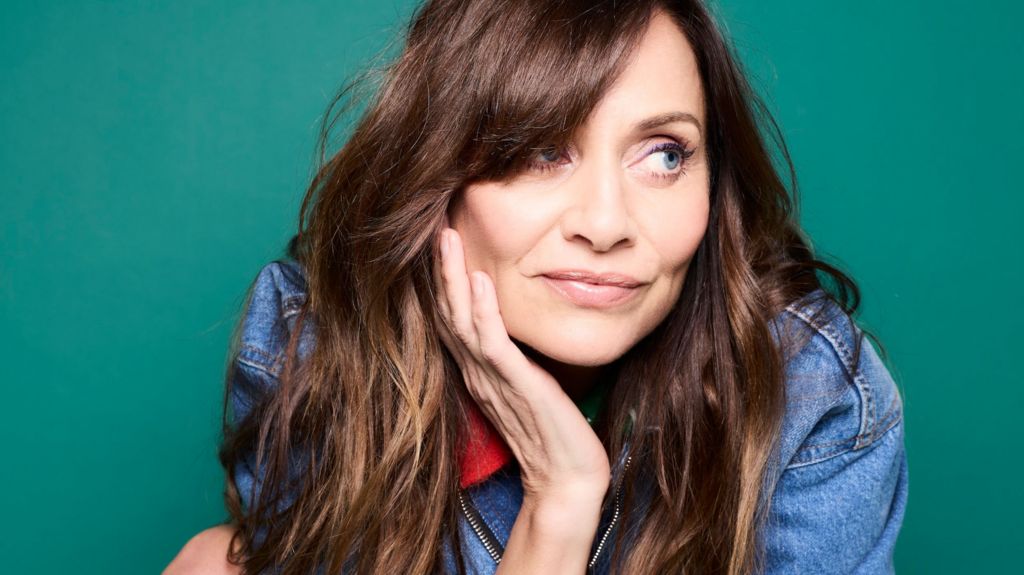
Australian singer and actor Natalie Imbruglia is gearing up to release her seventh studio album, *Algorithm*, this September — and for the first time in her decades-long career, she is putting it out independently on her own label, Landgirl. The project marks a full-circle moment for the 51-year-old artist, who has navigated the highs of global stardom, the pressure of industry expectations, and a recent journey of unravelling and healing through midlife hormonal change.
When it comes to her creative process, Imbruglia says inspiration does not strike from a static spot behind a desk. To pull melodies from thin air, she relies on constant movement: pacing in endless circles around whatever space she is working in. “If I’m sat in a chair, I get nothing,” she explains. “So if I go and work with someone new and they have a shoebox-sized studio, I’m like, ‘How am I going to do my circles?’” While she cannot count the exact number of laps she logged during the album’s creation, she confirms it was far more than she can keep track of.
Sonically, the album draws inspiration from art-pop pioneers Talking Heads and Grace Jones, building shimmering, dancefloor-ready production that hides layers of raw, emotionally complex lyricism. One of the record’s most vulnerable tracks, *Who Dimmed The Lights*, pulls back the curtain on Imbruglia’s experience with perimenopause, a life stage that sent her mental health into a tailspin.
“It was really tough,” she says. “Perimenopause is not just about hormones. It’s to do with your mind. Your brain needs oestrogen to function, so when the levels fluctuate, it affects your spatial awareness. I’ve never walked into so many doorways. The brain fog’s quite jarring.” Beyond disorientation and memory lapses, perimenopause worsened her previously undiagnosed midlife ADHD, amplifying symptoms of severe anxiety and short temper. She recalls seeing confusion and frustration in the faces of people around her as she struggled to process everyday information, a shift that left her feeling unmoored.
The 51-year-old has lived with stage fright her entire life, but perimenopause pushed that anxiety to an unbearable level during touring. At its worst, even minor sensory input felt overwhelming: “I become sensitive to sound, so it feels like you’re screaming at me if you’re talking normally,” she says. “I can’t process questions very well. I act twitchy and weird, and it seemed to get worse with perimenopause.” Her uncharacteristic behaviour became a “nightmare” for her touring team. She recounts a trivial moment that laid bare how unmanageable her symptoms had become: when asked to choose between still or sparkling water, she snapped that she could not answer even that simple question in the moment.
The breaking point came after one particularly difficult show, when she told her co-writers David Sneddon and Anu Pillai that she was ready to quit music entirely, unable to cope with how she was treating her team before performances. Instead of accepting her decision, the pair helped reframe her experience: they pointed out that her effort to fight her anxiety with willpower was only making it worse, and that accepting her nervousness as a natural response to performing would take away its power. That impromptu moment of clarity became the inspiration for the album track *Upside Down*.
Today, Imbruglia is open about her frustration with how poorly understood perimenopause remains in mainstream healthcare, noting that countless women are turned away by their general practitioners when they seek hormone replacement therapy (HRT) for relief. She reflects that her own mother never spoke about her experience with perimenopause, but looking back, she recognizes the same severe anxiety her mother endured decades earlier, and feels a new level of compassion for what she went through raising four children.
Imbruglia’s path to *Algorithm* started long before her midlife journey, growing up in Sydney where she showed a precocious love for performing from childhood. She would lighten her hair with lemon juice and stage full Whitney Houston cover concerts for her neighbourhood, eventually landing gigs in Coca-Cola and Twisties commercials and singing Christmas carols in local shopping centres. By her mid-teens, however, performing felt uncool as she navigated teenage social life, and she pulled back from the industry, becoming what she calls “basically unparentable” — sneaking out to spend nights on the beach with friends, much to the frustration of her strict parents.
Music remained her constant escape. After dating a drummer, she expanded her musical taste from Houston to alternative artists like Tom Waits and Tori Amos, but never lost her hunger to perform on a big stage. A recently rediscovered 1992 photo from Imbruglia’s first ever concert, where she pressed against the barrier at an INXS show, captures that drive perfectly: while other fans screamed for the band, 15-year-old Imbruglia stares at frontman Michael Hutchence with quiet, unmistakeable determination, studying how he performed like she was already visualizing herself in his place.
That opportunity came just five years later, when she left her breakout role as Beth Brennan on the beloved Australian soap opera *Neighbours*, moved to London, and signed her first major label deal with RCA Records. Her debut single, a cover of “Torn”, became an instant global hit, and her debut album *Left of the Middle* went on to sell seven million copies worldwide, becoming one of the best-selling albums of the 1990s.
But while Imbruglia still calls “Torn” a “beautiful gift”, the constant focus on the fact that she did not write the track fueled deep insecurities about her identity as a songwriter, even though she penned every other track on her debut. That insecurity pushed her to rebel against industry expectations on her second album, where she released the free-verse, chorus-free lead single *That Day* as an act of defiance. “That was my rebellion against Torn,” she explains. “It doesn’t have a chorus. That was my way of going, ‘Can I get on with my life now? I’ve just started learning the craft of songwriting, I’m young, I didn’t ask for this’.”
In that chaotic period of her career, she also auditioned for the lead role of Satine in Baz Luhrmann’s *Moulin Rouge*, an experience she calls one of the strangest of her career. She stresses that Luhrmann’s process was never inappropriate, but the request to simulate an orgasm during her audition left her feeling uncomfortable and shaken.
Imbruglia eventually returned to more commercially accessible music with 2002’s *Wrong Impression* and 2005’s *Shiver*, but album sales declined over time, and her fourth record was ultimately shelved by her label. Over the next decade, she juggled a judging role on *The X Factor Australia*, a stint in a West End production, and a gradual return to music: first with the 2015 covers album *Male*, then the introspective 2021 original album *Firebird*. It was stepping away from music and coming back to it that helped her build a new appreciation for her own unique voice as an artist.
“It was quitting music and coming back to it that gave me an appreciation of my abilities,” she says. “I might not be the best songwriter, even now, but there’s only one me, and when I go inside myself and feel the emotion of what I’m writing about and deliver it, that’s what my fans resonate with, that’s enough.”
That unfiltered authenticity is front and centre on *Algorithm*. Beyond the conversation about perimenopause, the album’s title track explores Imbruglia’s own experience with the pull of online conspiracy theories, a compulsion she says is easy to fall into even when you know the content is harmful. She does not name the theories she explored, calling that irresponsible, but warns that the danger of harmful online content is omnipresent for everyone. “There’s a voice in my head that says, ‘You don’t want to click on that’, and I’ll click on it. It’s like this compulsion,” she says. “You have to change the settings. Don’t allow yourself to be in a situation where your stress relief is scrolling on a phone in bed. It’s just not healthy.”
Ultimately, the album closes on a note of radical acceptance. Closing track *Beautiful Love*, co-written with Snow Patrol’s Gary Lightbody, is an uplifting ode to embracing imperfection and making peace with life’s shifting highs and lows. The music video for the single, shot entirely on Imbruglia’s iPhone, even features the vintage Mercedes she bought with the proceeds from her debut 1997 album, a nod to her full journey from 1990s breakout to independent midlife artist.
Imbruglia says she has always rejected the idea of a calm, middle path through life. “I’ve always made the joke that I’ll never be a Buddhist because it’s a middle path,” she smiles. “I like the pendulum to swing. Whether it’s extreme joy or extreme pain, I like to feel the experience of life.”