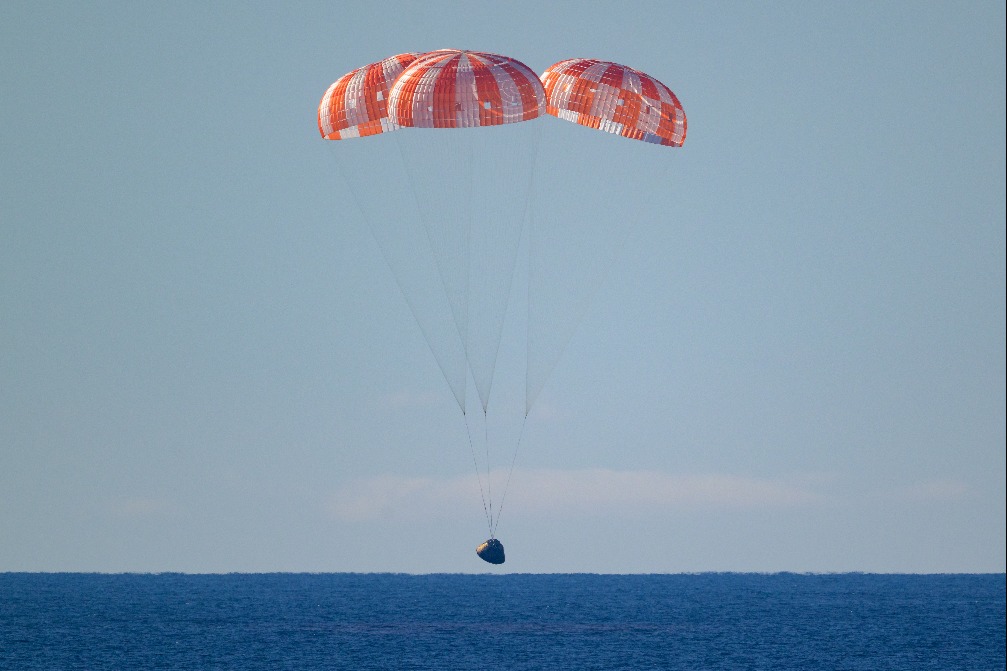
After a groundbreaking 10-day journey around the moon that set new human spaceflight records, NASA’s Artemis II mission crew has completed a successful return to Earth, splashing down safely in the Pacific Ocean off the coast of San Diego, California, at 8:07 pm Eastern Time on Friday evening. The parachute-assisted landing marked a major milestone for the United States’ deep space exploration program, bringing the four-person international crew home without incident.
Shortly after the capsule touched the ocean surface, mission commander Reid Wiseman confirmed that all crew members were in excellent health, easing pre-landing concerns tied to known technical vulnerabilities on the spacecraft. By 10 pm ET, recovery teams had helped the astronauts exit the Orion capsule, and they were airlifted by helicopter to the USS John P. Murtha, an amphibious transport dock stationed nearby. U.S. media reports confirm all four crew members walked across the ship’s flight deck unassisted to begin routine post-mission medical checks.
Following the completion of initial health screenings aboard the vessel, the crew will undergo a more comprehensive series of medical evaluations before traveling back to shore. They will then fly to NASA’s Johnson Space Center in Houston, where they will continue debriefing and analysis of their mission. Parallel recovery operations are already underway for the Orion capsule itself: Navy divers will lift the spacecraft from the Pacific and transport it first to U.S. Naval Base San Diego, before it is shipped to NASA’s Kennedy Space Center in Florida for full engineering inspections and post-mission analysis.
The mission’s atmospheric re-entry carried higher-than-usual safety risks, stemming from documented design flaws in Orion’s heat shield — the critical component that protects the crew from thousands of degrees of heat generated during descent through Earth’s atmosphere. To reduce this risk, NASA engineers adjusted the capsule’s re-entry trajectory ahead of landing, opting for a steeper, faster descent that cut down the capsule’s exposure to peak re-entry temperatures.
Launched from Kennedy Space Center on April 1, Artemis II marked the first crewed lunar flyby mission humanity has launched in more than 50 years. The 10-day mission did not include a lunar landing, instead focusing on testing core systems for future crewed lunar missions. The crew includes three NASA astronauts — commander Wiseman, pilot Victor Glover, mission specialist Christina Koch — and one Canadian Space Agency astronaut, Jeremy Hansen, making the mission a truly international collaborative effort.
Early in the mission, the crew set a new world record for the farthest distance human beings have ever traveled from Earth, reaching a peak distance of 406,771 kilometers from our planet. That mark surpasses the previous 400,171-kilometer record set by the Apollo 13 mission in 1970, a record that had stood for more than half a century. During the mission’s lunar flyby segment, the Orion capsule passed within 6,550 kilometers of the lunar surface, and the crew carried out nearly seven hours of direct lunar observation. The mission marked a rare opportunity for human observers to study the moon’s far side, a hemisphere never visible from Earth and rarely seen by humans directly.
As the first crewed mission of NASA’s broader Artemis lunar exploration program, which was first announced in 2019, Artemis II was designed to test and validate the full range of technologies and operational procedures needed for future deep space and lunar missions. Key objectives included verifying the functionality of Orion’s life support systems and practicing mission operations that will be critical for upcoming crewed landing missions. Before Artemis II, NASA completed the uncrewed Artemis I lunar orbiting mission in November 2022, laying the groundwork for this first crewed flight.
The original Artemis program roadmap set a goal of landing the first woman and first person of color on the lunar surface by 2024, but NASA revised the program’s timeline in February this year, adding an extra interim mission and pushing back the targeted landing date. Under the updated plan, Artemis III will now focus on testing new systems and operational capabilities in low Earth orbit in 2027, clearing the way for the Artemis IV crewed lunar landing mission to take place in 2028.