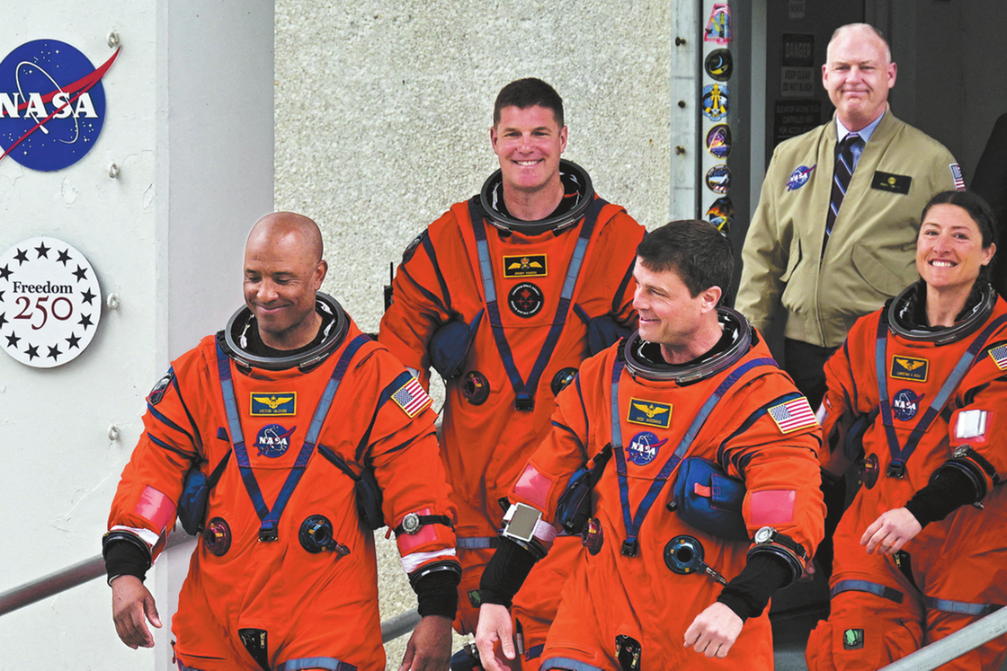
CAPE CANAVERAL, Fla. — NASA has made history on Wednesday, marking the first launch of a crewed mission around the moon since the final Apollo mission more than half a century ago, when its long-awaited Artemis II lifted off from Kennedy Space Center in Florida.
Carrying four astronauts from two nations, the 322-foot Space Launch System heavy-lift rocket roared off Launchpad 39B at 6:35 p.m. Eastern Time, carrying the Orion deep-space crew capsule atop its frame to begin a landmark 10-day lunar flyby expedition. The international crew includes three NASA astronauts — commander Reid Wiseman, pilot Victor Glover, and mission specialist Christina Koch — alongside mission specialist Jeremy Hansen from the Canadian Space Agency, who walked to the astronaut transport van for their trip to the launchpad as crowds of aerospace officials and spectators watched.
By all initial accounts, the opening phases of the mission unfolded largely according to NASA’s pre-planned timeline. Just eight minutes after liftoff, the rocket’s core main engines completed their burn and separated from the interim cryogenic propulsion stage and the Orion capsule. By 24 minutes post-launch, all four of Orion’s extended solar array wings had fully deployed and started generating the electrical power required for the spacecraft’s deep-space operations. In the coming days, the mission team will carry out key scheduled maneuvers: a perigee-raise burn to raise Orion’s closest approach to Earth, followed by an apogee-raise burn to position the capsule for its trans-lunar journey. When complete, the crew will travel roughly 7,400 kilometers beyond the moon’s far side before heading back for an Earth splashdown.
However, the mission encountered an early technical anomaly. Speaking at a post-launch press briefing, NASA Administrator Jared Isaacman confirmed that 51 minutes into the flight, Orion suffered a temporary partial communications outage during a planned handover between tracking satellites. The agency has not yet identified the root cause of the disruption, and engineering teams are currently reviewing telemetry data to trace the issue.
This mission marks the first crewed flight test of NASA’s $93 billion Artemis lunar exploration program, first unveiled in 2017 with an initial goal of landing the first woman and person of color on the moon by 2024. Artemis II is designed to test and validate a wide range of critical deep-space capabilities, most notably the Orion capsule’s life support systems that will sustain crew members during long-duration deep space missions, while allowing the four-person team to practice operational procedures that will be central to future lunar landing missions. The program’s first test flight, Artemis I, was an uncrewed lunar orbiting mission completed successfully in November 2022.
The launch of Artemis II comes after years of repeated delays driven by persistent technical setbacks. Just two months prior, in early February, a countdown dress rehearsal was halted by dangerous hydrogen fuel leaks in the Space Launch System, forcing NASA to roll the rocket back to the vehicle assembly building for repairs and conduct a second full pre-launch test. After completing that retest later that month, teams discovered a second issue with helium flow to the rocket’s upper stage — a system critical to purging engine lines and maintaining fuel tank pressure — requiring additional corrective work before launch could be cleared.
In February, NASA released an updated timeline for the Artemis program that pushed the first crewed lunar landing from 2027 to 2028, and added a new mission to the sequence to reduce technical risk ahead of the landing. Under the revised roadmap, Artemis III will now focus on testing core mission systems in low Earth orbit in 2027, while the Artemis IV mission will carry out the first crewed lunar landing near the moon’s south pole in 2028.