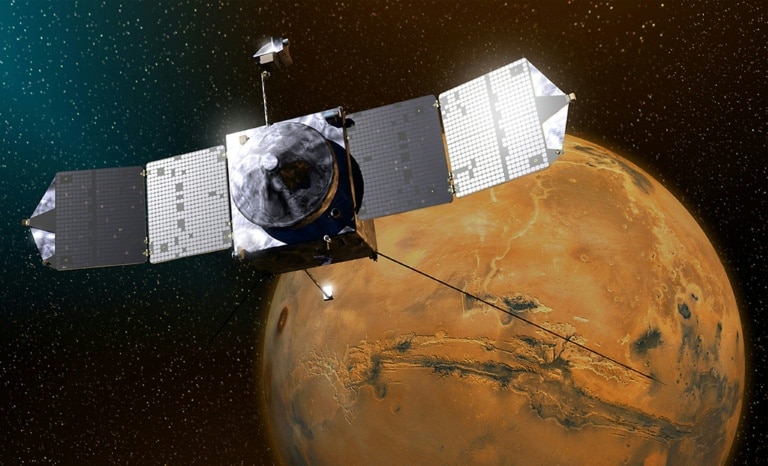
After six months of uninterrupted silence from its pioneering Mars explorer, NASA announced Wednesday that it is formally ending the Mars Atmosphere and Volatile Evolution (MAVEN) mission, a groundbreaking deep space initiative that reshaped scientific understanding of the red planet.
Launched and inserted into Martian orbit in 2014, MAVEN was originally designed to complete its scientific objectives in just one to two years. Against all expectations, the hardy spacecraft far outlived its projected lifespan, continuing to deliver groundbreaking data for more than a full decade until it suddenly lost contact with mission control on Earth in December 2025.
While NASA officials confirm the probe is believed to remain in stable orbit around Mars, repeated attempts to reestablish communications have failed, forcing the agency to accept the loss of the vehicle. The US space agency also confirmed it will launch a full investigation into what caused the communications outage and eventual loss of the spacecraft.
Over its 11 years of operation, MAVEN delivered transformative insights into Martian atmospheric science that have redefined the field. Astrophysics professor Shannon Curry, who has been part of the MAVEN science team since its early days, called it the “best Mars mission ever” in comments to reporters Wednesday. The probe’s core contribution was unpacking the complex process of atmospheric escape—the gradual leakage of gaseous compounds from a planet’s atmosphere into outer space.
Curry emphasized that thanks to MAVEN’s data collection, scientists now hold a more comprehensive understanding of atmospheric escape on Mars than on any other planet in the solar system, including our own Earth. “Mars serves as an incredible natural laboratory for understanding rocky planet atmosphere,” she added, noting that the mission’s findings will benefit planetary science research for decades to come.
Tiffany Morgan, head of NASA’s exploration programs, echoed that assessment, noting that MAVEN’s work “profoundly advanced our understanding of Mars’s atmosphere, climate history, and habitability.” Beyond its core scientific mission, MAVEN also played a critical practical role, functioning as a reliable communications relay between Earth and the rovers and landers NASA has deployed to the Martian surface. That role will now be taken over by other active Mars orbiters currently operating around the planet.