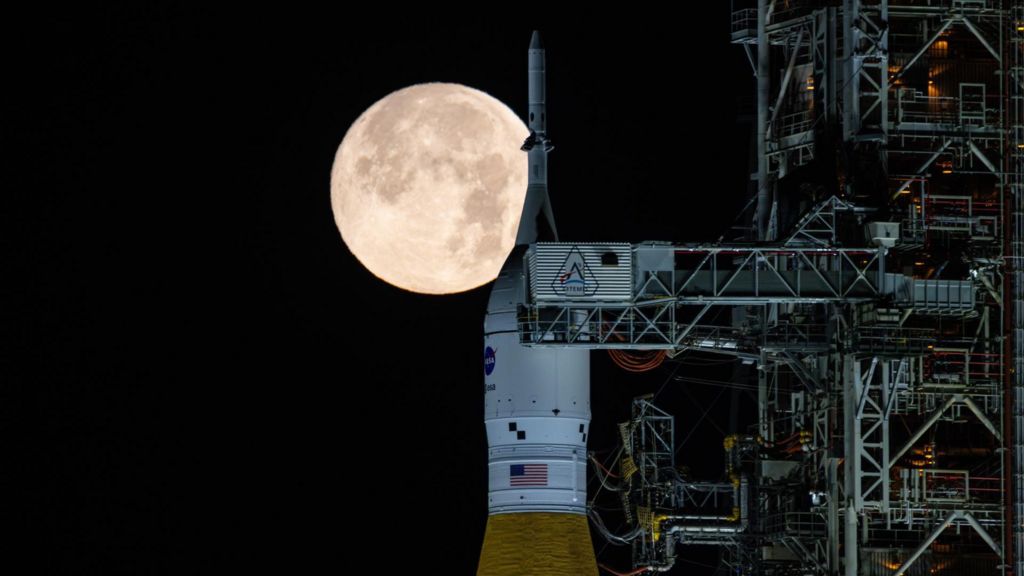
NASA has announced a strategic revision to its Artemis program, introducing an additional mission phase to enhance safety and technical preparedness before attempting the first human lunar landing in over five decades. The updated roadmap now includes Artemis III as a low-Earth orbit (LEO) docking exercise scheduled for 2027, marking a significant departure from the original plan that envisioned this mission as a direct lunar landing attempt.
Under the restructured timeline, Artemis II remains on schedule for an April launch, carrying four astronauts on a circumlunar voyage around the Moon’s far side. However, this mission has experienced technical setbacks due to a helium leak detected on the Space Launch System (SLS) rocket, necessitating repairs at Kennedy Space Center’s Vehicle Assembly Building. The earliest launch window has consequently shifted to April, pending completion of necessary repairs.
NASA Administrator Jared Isaacman justified the program restructuring by emphasizing risk mitigation. “The current architecture was not a pathway to success,” Isaacman stated during a media briefing. “Conducting integrated systems testing of the Orion capsule and lunar lander in low-Earth orbit provides invaluable operational experience before committing to lunar surface operations.”
The revised approach addresses critical program gaps, particularly the delayed development of the human-rated lunar lander. While SpaceX holds the current contract for lander development using its Starship platform, NASA has concurrently engaged Blue Origin to develop an accelerated alternative solution. The Artemis III LEO mission could potentially test docking procedures with either or both lander prototypes.
This strategic pivot occurs against the backdrop of intensifying international space competition, with China targeting a crewed lunar landing by 2030. Both nations are focusing on the Moon’s south pole region, establishing what amounts to a modern space race for strategic lunar positioning and resource access.
Despite these changes, NASA maintains its commitment to achieving one or even two lunar landings by 2028 through subsequent Artemis IV and V missions, demonstrating the program’s adaptive planning while preserving its overarching objectives of sustainable lunar exploration.