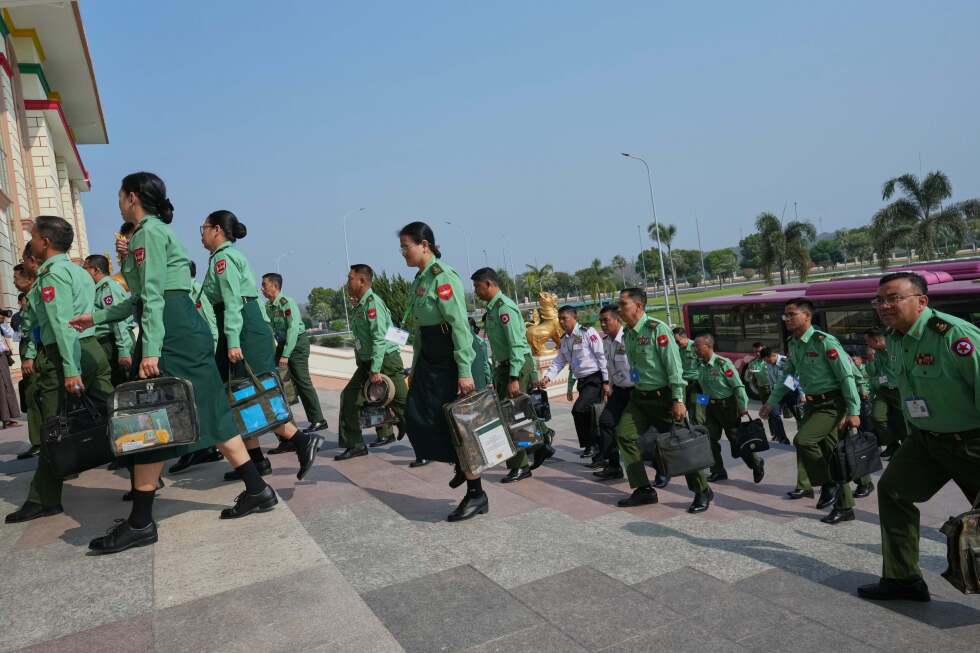
NAYPYITAW, Myanmar — Myanmar’s political landscape witnessed a significant development on Monday as the nation’s parliamentary chambers reconvened for the first time in over five years. This legislative resurrection follows controversial elections conducted during December and January that excluded major opposition factions, effectively cementing military dominance within the government structure.
The military establishment, which orchestrated a forceful takeover from Aung San Suu Kyi’s democratically elected government in February 2021, has governed without legislative oversight until now. The recently concluded electoral process was promoted by authorities as a transitional step toward democratic normalization, though international observers have questioned its legitimacy.
Statistical analysis reveals the military and its political allies command nearly 90% of seats across both parliamentary chambers. This overwhelming majority was achieved through the systematic exclusion of Myanmar’s primary opposition parties, including Suu Kyi’s National League for Democracy, which either faced disqualification or voluntarily abstained from participating due to perceived unfair electoral conditions.
The ceremonial commencement of the 373-seat lower house proceeded under stringent security measures in the capital city. Roads surrounding the parliamentary complex, recently renovated following earthquake damage, were sealed by security personnel who conducted thorough vehicle inspections for potential explosives. Delegates adorned in traditional attire participated in the opening session amid this heightened security environment.
The 213-seat upper house is scheduled to convene on Wednesday, with regional parliamentary sessions following within 48 hours. Constitutional provisions drafted by the military reserve 166 of the 586 combined parliamentary seats for military appointment, while the Union Solidarity Development Party secured 339 additional seats. The remaining positions were distributed among 21 minor parties, each obtaining between one and twenty seats.
This parliamentary reconstitution occurs against the backdrop of escalating civil conflict triggered by the 2021 coup. United Nations Special Rapporteur Tom Andrews has explicitly urged the global community to reject both the electoral outcomes and subsequent power distribution arrangements. Meanwhile, an opposition shadow parliament comprising lawmakers barred from assuming their positions in 2021 conducted parallel proceedings online, asserting its legitimacy as Myanmar’s true legislative body.