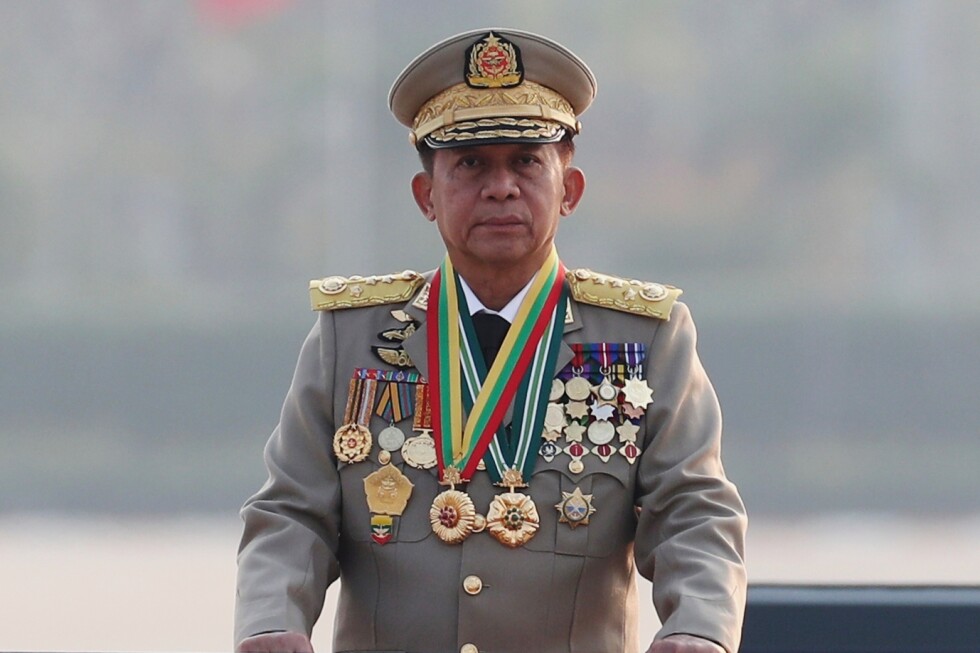
In a widely anticipated move that has renewed global scrutiny of Myanmar’s military-backed political order, the country’s rubber-stamp parliament voted Friday to install Min Aung Hlaing, the senior general who seized power from Aung San Suu Kyi’s democratically elected civilian government in a 2021 coup, as the nation’s new president. The vote caps a years-long push by the military to cement its control behind a veneer of civilian rule, even as a brutal civil war rages across large swathes of the country and international powers reject the process as illegitimate.
Min Aung Hlaing was one of three handpicked nominees for the presidency, and his lopsided victory was never in doubt: lawmakers from military-aligned parties and directly appointed military representatives hold an unassailable majority in the new assembly. Held in Naypyitaw’s newly earthquake-repaired parliament building, the final vote count gave the coup leader 429 of 584 total cast ballots. His two competitors will take vice presidential posts: Nyo Saw, a retired general and long-time Min Aung Hlaing adviser, and Nan Ni Ni Aye, an ethnic Karen politician from the pro-military Union Solidarity and Development Party, who will become Myanmar’s first female vice president. All three are scheduled to be inaugurated next week.
Consistent with constitutional requirements that bar the president from holding the top military command post, Min Aung Hlaing stepped down as commander-in-chief earlier this week, handing the powerful role to close ally Gen. Ye Win Oo, a move that leaves the military’s core leadership structure unchanged despite the nominal transition to civilian government.
The military frames the new government as a return to democratic governance after four years of direct military rule following the 2021 coup. But independent observers and political opponents universally dismiss the process as a sham, designed only to legitimize the military’s hold on power after a national election the junta organized last December and January. Major opposition parties, including Suu Kyi’s former ruling National League for Democracy (NLD), were either barred from participating or refused to contest the vote over pre-determined unfair rules. Widespread armed conflict also prevented voting from being held in nearly a third of the country’s 330 townships, due to persistent security risks for election organizers.
For the country’s main opposition, the National Unity Government (NUG), which claims to be Myanmar’s legitimate elected administration, Min Aung Hlaing’s elevation only confirms that the military has no intention of ceding power to a genuinely popular government. “Min Aung Hlaing is responsible for countless war crimes, and his easy ascent to the presidency proves the nominal political change some foreign actors hoped for will never come to pass,” NUG spokesperson Nay Phone Latt told the Associated Press. “The people of Myanmar do not accept this outcome. Our revolution will continue with undiminished momentum.”
Myanmar’s modern political history has been defined by military dominance: the armed forces ruled the country directly from 1962 until 2016, when the NLD won a landslide election victory that ended decades of direct military rule. The party secured an even larger mandate in 2020, but the military refused to accept the result, launching a coup days before the new parliament was scheduled to convene. Suu Kyi, now 80 years old, has been detained ever since, serving a 27-year prison sentence on charges widely condemned as politically motivated.
Peaceful mass protests against the coup were crushed with lethal force by the junta, pushing pro-democracy activists to launch an armed resistance movement that allied with long-running ethnic minority insurgencies fighting for greater regional autonomy. That conflict has since escalated into a full-scale civil war that has killed thousands and displaced millions.
Independent human rights monitors have documented widespread atrocities committed by junta forces since the 2021 takeover. The Assistance Association for Political Prisoners, an independent watchdog that tracks rights violations in Myanmar, confirms that nearly 8,000 civilians and activists have been killed, and more than 22,870 political prisoners remain detained as of 2025. The U.S.-based Armed Conflict Location & Event Data Project reports that junta warplanes carried out 1,140 airstrikes across the country in 2025 alone, a tactic that has killed hundreds of civilian non-combatants.
International rights groups warn that Min Aung Hlaing’s new civilian title does not grant him immunity from prosecution for widespread violations of international law. “If Min Aung Hlaing believes that holding an official civilian presidency will protect him from accountability for the grave crimes he is accused of overseeing as military chief, that is not how international justice works,” said Joe Freeman, Myanmar researcher for Amnesty International, in a public statement.
The senior general already faces international legal action over the military’s persecution of the Rohingya Muslim minority. In 2024, the International Criminal Court launched an investigation into crimes against humanity, after the chief prosecutor requested an arrest warrant for Min Aung Hlaing over the mass atrocities committed against the Rohingya starting in 2017. Earlier this year, the International Court of Justice held long-delayed public hearings in the genocide case brought against Myanmar by Gambia, which first accused the country of orchestrating a campaign of genocide against the Rohingya in 2019.
The nominal transition to civilian rule is widely viewed as a strategic move by the junta to repair strained relations with some Southeast Asian neighbors and shore up international legitimacy, after the 2021 coup left the regime diplomatically isolated. The military government has retained steady backing from major powers China and Russia throughout the post-coup period, while Western governments have imposed harsh economic sanctions on junta leaders and institutions.