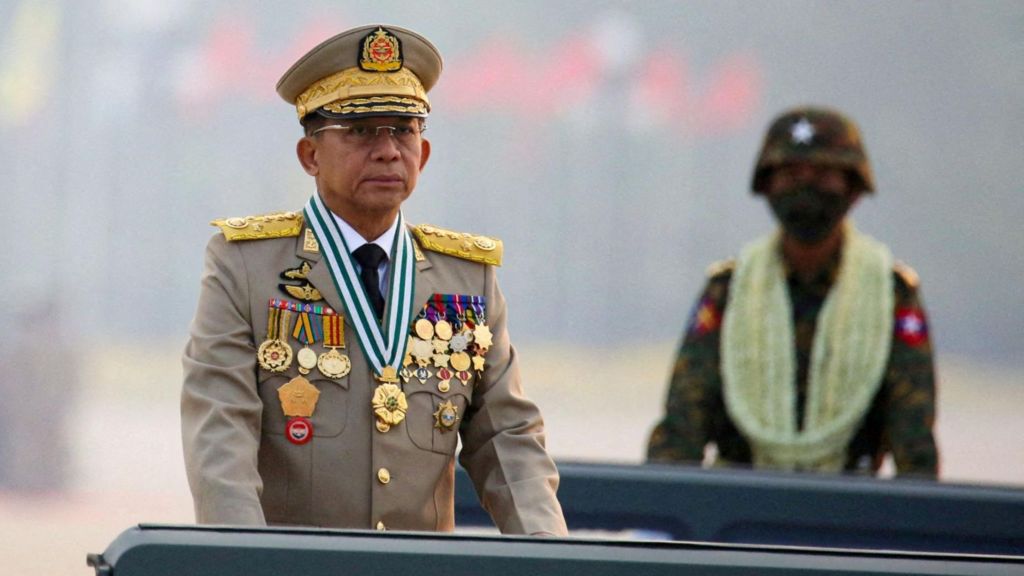
On February 1, 2021, Myanmar’s top military leader Min Aung Hlaing ousted the elected government led by Aung San Suu Kyi, promising to transfer power to a civilian government through new elections within 12 months. Five years later, he has finally kept that promise in name only. Last week, the newly convened parliament, stacked entirely with his political allies, selected him as Myanmar’s next president, and he stepped down from his post as armed forces commander to meet constitutional requirements for the office.
This so-called return to civilian rule is little more than a political reshuffle designed to consolidate military power under a civilian facade. Under Myanmar’s constitution, the military is guaranteed 25% of all parliamentary seats, and the military-aligned Union Solidarity and Development Party (USDP) claimed nearly 80% of the remaining seats in an election widely criticized as heavily rigged in its favor. The final outcome was never in doubt, making the process more of a coronation than a democratic exercise. When the new cabinet is formed, current and former military officials are expected to hold nearly all key portfolios.
To ensure his influence remains unchallenged even after leaving uniform, Min Aung Hlaing has placed a close, hardline ally, General Ye Win Oo — who has a documented reputation for brutal crackdowns on opposition — in his former role as commander-in-chief. He has also established a new top-level consultative council that will hold supreme authority over all civilian and military matters, effectively guaranteeing he retains full control of the state despite his new civilian title.
For millions of ordinary Myanmar citizens, this political transition will bring little to no change to the daily chaos and suffering that has defined life since the 2021 coup. For young opposition activist Kyaw Win (a pseudonym to protect his safety), the outcome has extinguished any immediate hope of political change. Arrested in 2022 for joining a flash mob protest against the junta, he spent years in prison, where he describes being systematically tortured: guards beat him with iron rods, burned his skin with cigarettes, slashed his thigh with a knife and sexually assaulted him during interrogations. Recently released from prison, Kyaw Win says his commitment to the pro-democracy movement remains intact, but he can no longer safely organize inside the country and plans to flee abroad to find work.
The five years since the coup have been an unmitigated catastrophe for Myanmar. Min Aung Hlaing severely miscalculated the level of public outrage that would follow his power grab, which came just as parliament was set to confirm a new term for Aung San Suu Kyi’s National League for Democracy following its landslide victory in the 2020 general election. His decision to deploy lethal force against nationwide peaceful protests ignited a widespread civil conflict that has killed thousands of people, displaced nearly 4 million more, and gutted the country’s once-growing economy.
Resistance groups now control large swathes of territory across the country, and the junta has responded with indiscriminate air strikes and scorched-earth campaigns against civilian communities in opposition-held areas, using a longstanding counterinsurgency doctrine known as “the four cuts” that aims to cut off rebel groups from access to food, funds, information and new recruits by destroying supporting communities. With military support from China and Russia, the junta has reclaimed some territory lost over the past two years, but the conflict remains deadlocked.
Earlier this month, Min Aung Hlaing presided over his final annual military parade as commander-in-chief in the capital Nay Pyi Taw, a tradition the junta has maintained every year even as the civil war has raged. BBC correspondents who attended the event listened closely for any hint of regret or reflection over the devastation caused by the coup, but none came. Instead, Min Aung Hlaing repeated his longstanding unapologetic justifications for the 2021 power grab, claiming the military held a constitutional mandate to intervene in national politics to “uphold multi-party democracy”, and labeling all opponents of military rule “armed terrorist factions” backed by foreign enemies and opportunistic politicians. His speech made clear that a civilian title would not lead to any shift in how the country is governed.
Su Mon, a senior analyst at the Armed Conflict Location & Event Data Project (ACLED), warns that the conflict will only continue unchanged under the new administration. “The new commander-in-chief is a hardline loyalist with deep personal and family ties to Min Aung Hlaing, so he will continue the existing strategy above all else: retake all lost territory from resistance groups,” she explained. With resistance groups still controlling around 90 towns across the country, that means more indiscriminate air and drone strikes on civilian areas, and more devastating scorched-earth campaigns.
The National Unity Government (NUG), the shadow administration formed by politicians ousted in the 2021 coup and based out of resistance-held territory along the Thai border, rejects the legitimacy of the new presidency, the recent election and the new parliament entirely. While the NUG has struggled to unify the dozens of disparate armed resistance groups operating across the country, it remains firm in its commitment to continue fighting to remove the military from political power entirely and draft a new federal constitution.
“This is not the time for compromise,” NUG spokesman Nay Phone Latt said. “If the military will not accept our objectives, our revolution will go on. We have to keep going; if we give up now, our people and the next generation will only suffer more.”
Five years of continuous conflict have left the Myanmar public exhausted, and the country’s economy on the brink of collapse. The United Nations estimates that more than 16 million people — nearly a third of the country’s population — currently need life-saving humanitarian assistance. Runaway inflation has collapsed living standards for most households, and the crisis has been made worse by growing fuel shortages driven by regional export restrictions and the ongoing conflict in the Middle East.
Myanmar relies on imports for 90% of its oil and petroleum products, and most of those imports come from neighboring countries that have recently cut exports to address their own domestic shortages. Fuel is now strictly rationed, and prices have spiked sharply, far exceeding costs in neighboring Thailand. For most businesses, the situation is even more dire: the national electricity grid only provides a few hours of power per day even in major cities like Yangon, forcing almost all businesses and many households to rely on expensive diesel generators.
Tin Oo, a motorbike taxi driver working in Yangon’s industrial Hlaing Tharyar district, says daily life has become unrecognizable from a decade ago. “Today, we can’t even earn enough to cover rent and food,” he explained. Like many ordinary Myanmar people, he has no faith that the new civilian-backed military government will improve conditions. “They don’t care about us. We still have to fend for ourselves. These days, it’s almost impossible to survive if you try to make an honest living, but corrupt people get rich.”
Into this bleak political stalemate, Mya Aye — a veteran pro-democracy activist who has spent decades imprisoned by Myanmar’s military — has emerged this week with a rare call for dialogue and compromise, arguing that the only way to avoid total state collapse is to negotiate a settlement between the military and its opposition. He has launched a new cross-party council to bring together supporters of dialogue, calling for immediate talks and the release of all political prisoners. While only a handful of prominent political figures have publicly joined the initiative, Mya Aye says many more are holding confidential discussions with the group.
“This election is not a solution. It’s just a political game that Min Aung Hlaing is playing to solidify his control,” Mya Aye said. “The current constitution also can’t get us out of this crisis. But the public is exhausted. If we can’t find a compromise, the country will collapse — and in many ways, it already has.” Mya Aye argues that if the junta releases Aung San Suu Kyi, who remains under house arrest at the age of 80, she could play a decisive role in brokering a widely accepted peace deal. There has been widespread speculation that Min Aung Hlaing may release her later this year, now that he has secured the presidency — the long-held ambition that many analysts say was a core motivation for the 2021 coup.
While a narrow path to peace may exist in theory, for now, Myanmar’s military leaders show no inclination to walk it, leaving the country stuck in a devastating cycle of conflict and hardship with no clear end in sight.