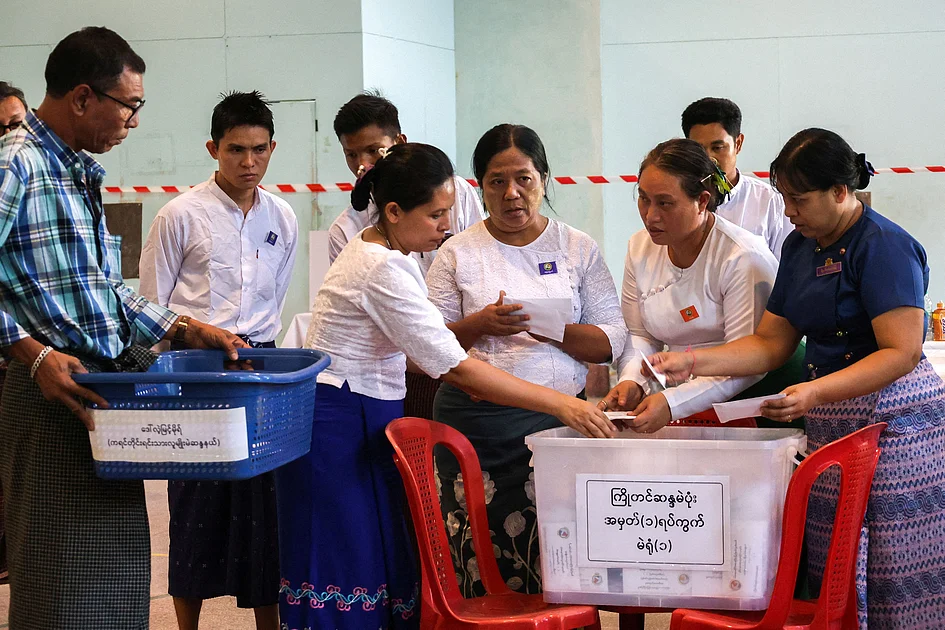
Myanmar’s military-aligned Union Solidarity and Development Party (USDP) has declared victory in the parliamentary constituency previously held by deposed democratic leader Aung San Suu Kyi, according to an anonymous party official. The announcement comes during the second phase of a month-long electoral process that critics condemn as a calculated maneuver to legitimize military rule.
The current voting process, scheduled to conclude on January 25, represents the first nationwide election since the military’s 2021 seizure of power. The junta administration maintains these elections will facilitate the return of civilian governance, but democracy advocates and international observers assert the process is fundamentally compromised.
Political analysts identify the USDP as the primary political proxy for Myanmar’s armed forces. Official results from the initial voting phase in December indicated the party secured approximately 90% of lower house seats. The anonymous USDP representative additionally claimed victory in 15 of 16 contested lower house seats within Yangon region, though no official margin of victory was disclosed.
United Nations human rights expert Tom Andrews characterized the electoral process as engineered to ensure military domination. ‘The junta manufactured these polls to create a facade of legitimacy while violence and repression continue unabated,’ Andrews stated in a recent declaration.
The electoral landscape remains severely constrained by ongoing civil conflict. Significant portions of Myanmar’s territory, controlled by rebel factions opposing military rule, are excluded from voting operations. According to the Armed Conflict Location & Event Data Project (ACLED), the conflict has resulted in approximately 90,000 fatalities across all sides since the coup.
Concurrent with the elections, the junta has intensified suppression measures. New legislation criminalizes protest or criticism of the electoral process with penalties reaching ten years imprisonment. Over 330 individuals currently face prosecution under these provisions, while the Assistance Association for Political Prisoners documents more than 22,000 political detainees, including Aung San Suu Kyi.
Myanmar’s constitutional framework, established during previous military governance, automatically reserves one-quarter of parliamentary seats for armed forces personnel, irrespective of electoral outcomes.