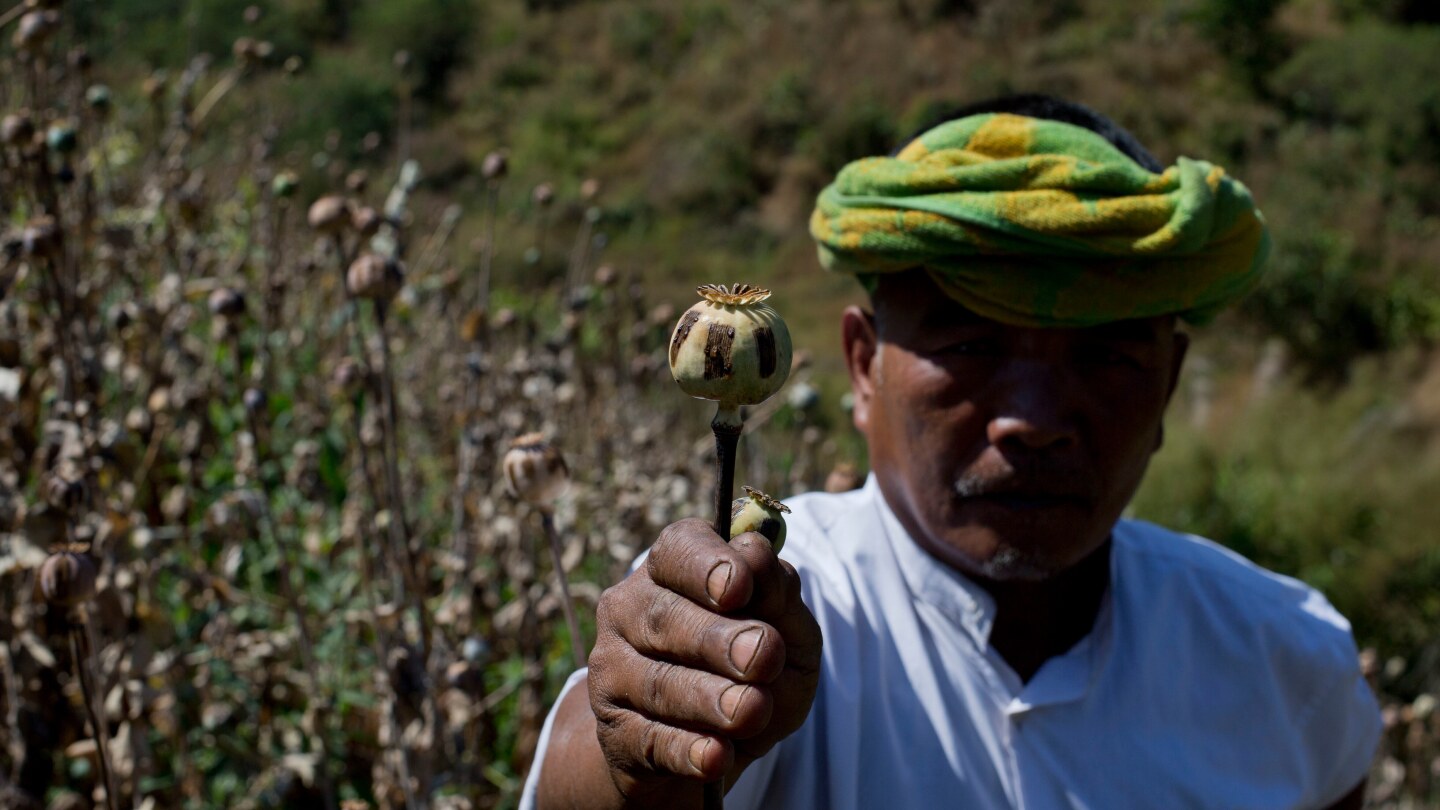
Myanmar has witnessed a dramatic surge in opium poppy cultivation, reaching its highest level in ten years according to the United Nations Office on Drugs and Crime (UNODC). The 2025 Myanmar Opium Survey reveals cultivation areas expanded by 17% to 53,100 hectares (131,212 acres), solidifying the nation’s position as the world’s primary source of illicit opium following production declines in Afghanistan.
The report identifies Myanmar’s ongoing civil war, widespread poverty, and economic instability as key drivers behind this expansion. Since the military ousted Aung San Suu Kyi’s elected government in February 2021, farmers have increasingly turned to poppy cultivation as a means of survival. The conflict has created conditions where illicit drug production thrives, with the opium economy now estimated at $641 million to $1.05 billion—representing approximately 0.9% to 1.4% of the country’s 2024 GDP.
Economic factors have significantly contributed to this growth, with fresh opium prices more than doubling from $145 per kilogram in 2019 to approximately $329 per kilogram currently. Despite a 13% decrease in average yields due to intensifying conflict in some regions, overall production still increased by 1% to about 1,010 metric tons (1,113 tons).
UNODC Representative for Southeast Asia and the Pacific Delphine Schantz described Myanmar as being at a “critical moment,” noting that “this major expansion in cultivation shows the extent to which the opium economy has re-established itself over the past years—and points to potential further growth in the future.”
The survey also revealed emerging trends in international drug trafficking, with evidence suggesting Myanmar-sourced heroin is beginning to reach European markets previously supplied by Afghanistan. Several seizures involving passengers traveling from Southeast Asia to Europe indicate growing demand beyond the region to fill the void left by Afghanistan’s production collapse under the Taliban’s ban.
Myanmar additionally maintains its status as the world’s largest methamphetamine producer, with the synthetic drug being distributed across Asia and the Pacific through various transportation routes. The northeastern region of Myanmar, part of the infamous “Golden Triangle” where Myanmar, Laos, and Thailand converge, continues to be a hub for illicit drug production due to limited government control and the presence of ethnic minority militias involved in the drug trade.
Schantz emphasized the cyclical nature of the problem, stating: “Driven by the intensifying conflict, the need to survive and the lure of rising prices, farmers are drawn to poppy cultivation. Unless viable alternative livelihoods are created, the cycle of poverty and dependence on illicit cultivation will only deepen.”