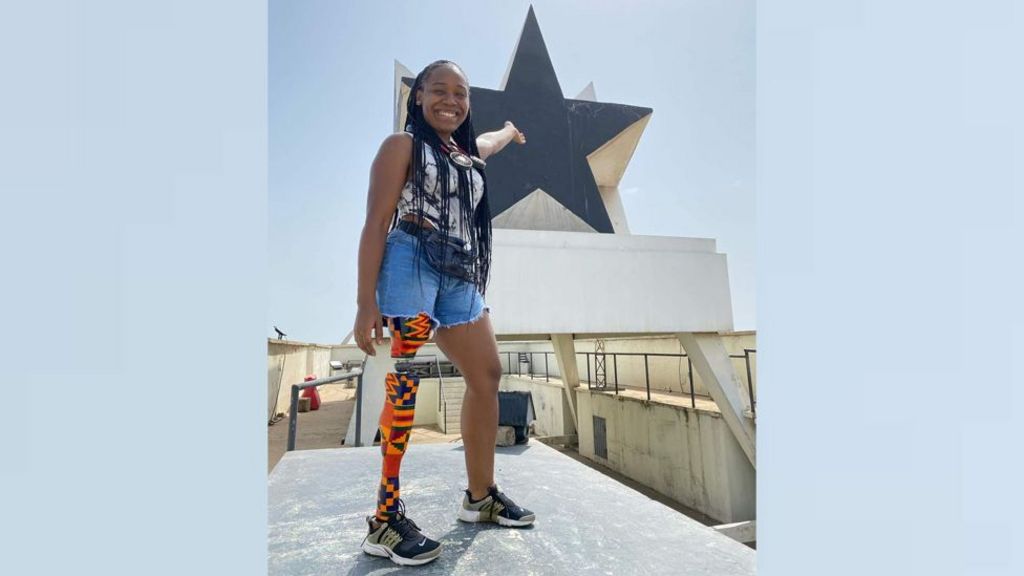
At a prominent fashion showcase in Ghana, 33-year-old model and writer Abena Christine Jon’el commanded attention not merely through her presence on the catwalk, but through her powerful statement about disability visibility. Her prosthetic leg, elegantly wrapped in vibrant African kente cloth, became both a cultural symbol and a declaration of identity during last month’s Rhythms on the Runway event in Accra.
Abena’s journey to the runway began decades earlier when a rare rhabdomyosarcoma tumor appeared on her right calf at age two. Faced with the impossible choice between radiation treatment that might leave her wheelchair-dependent or amputation, her mother chose the latter. “It was the best decision she could have made,” Abena affirms without hesitation, speaking from a restaurant in Ghana’s capital surrounded by friends and family.
Her early life in Chicago was shaped by treatment and recovery, with movement becoming both a measure of survival and a means of rebuilding confidence. Contrary to stereotypical narratives of inspirational disabled children, Abena describes herself as “loud, a little black girl running around on one leg” who refused to be pushed around despite academic struggles.
This unapologetic authenticity became her professional strength. After working as a poet and public speaker in the US, a transformative visit to Ghana’s Assin Manso slave river site in 2021 triggered what she describes as “a moment that rearranged my entire understanding of myself.” The profound connection to her ancestral land led to her permanent relocation just three months later, despite experiencing deep depression upon initially leaving Ghana.
Now embracing her identity as “Ghanaian by ancestry and adoption,” Abena has found belonging through a Ghanaian mother who introduces her as her own daughter. Her advocacy work has shifted focus to addressing the stark contrast between disability representation in the US and Ghana. While acknowledging America’s imperfect progress toward inclusion, she notes that Ghana remains at the beginning of this journey—not from lack of compassion, but from lack of representation.
“In Ghana, disabled people have not been widely showcased in a positive light,” she explains. “So stigma thrives. People do not see us in powerful or beautiful or joyful positions, they see us only in struggle.”
Her runway appearance marked a deliberate intervention in this narrative. After directly approaching event organizers, Abena understood her presence would force a long-delayed conversation about inclusion. The resulting moment became one of the evening’s most discussed highlights, with Ghana’s Tourism, Culture and Arts Minister Abla Dzifa Gomashie noting that “her strength showed right through, speaking volumes.”
Fashion show organizer Shirley Emma Tibilla described Abena’s walk as “a powerful affirmation that talent, beauty, and confidence know no limitations,” while entrepreneur Dentaa Amoateng celebrated it as demonstrating “what true inclusion looks like.”
For Abena, the applause mattered less than the message: disabled people were not mere spectators but center stage. Standing at the intersection of identity, disability, heritage and fashion, she represents a new path forward for Ghana—one where inclusion is boldly demanded rather than quietly suggested.
Her journey from cancer patient to cultural icon represents not just survival but reclamation: of identity, mobility, belonging, and place in a country that “fought for me before I even stepped foot here.” Whether on runways, behind microphones, or mentoring young amputees, Abena refuses to dim her light—or let others like her be dimmed.
As she states definitively: “Disability is not a limitation. Having a disability is not what makes you disabled. Lack of support, lack of accessibility—that is what disables you.”