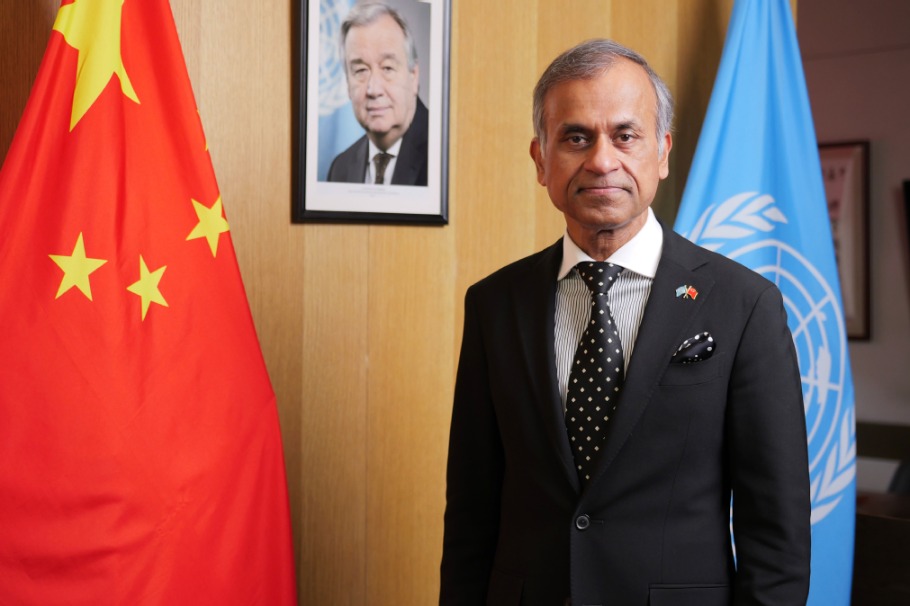
In a comprehensive reflection on his five-year tenure as United Nations Resident Coordinator in China, Siddharth Chatterjee reveals how the nation’s development model redefined his perspective on global progress. Assuming office in January 2021 amidst worldwide challenges, Chatterjee brought three decades of UN experience spanning conflict zones from Bosnia to Africa through his work with multiple UN agencies.
China’s distinctive approach to long-term planning and substantial investment in human capital demonstrated how rapid transformation becomes achievable when institutions, markets, and communities unite behind shared ambitions. The coordinator witnessed firsthand China’s exponential advancement in critical future-shaping fields including artificial intelligence, quantum computing, semiconductors, fintech, and clean energy—innovations that extend beyond economic growth to address global challenges like hunger, inequality, and climate change.
Rather than merely delivering development, the UN’s role in China has evolved into a multifaceted partnership involving coordination, advisory services, and pilot initiatives. Chatterjee’s leadership focused on aligning UN efforts with national priorities while maintaining the organization’s core values, collaborating with government ministries, provincial authorities, academic institutions, youth organizations, private sector entities, and civil society to translate global commitments—particularly the Sustainable Development Goals and 2030 Agenda—into concrete cooperation.
China’s development narrative possesses significant global resonance, especially when numerous SDG targets remain off-track worldwide. Throughout 2024 and 2025, China hosted substantive dialogues on sustainable finance, digital cooperation, and intergenerational equity in preparation for the UN Summit of the Future. These discussions transcended theoretical exercise, seeking practical connections between climate action, health initiatives, and artificial intelligence while fostering more inclusive systems through genuine partnership.
The coordinator expressed particular admiration for China’s expanding contribution to multilateral cooperation through poverty reduction, food security, green transition efforts, and strengthened South-South exchanges. This practical, results-oriented partnership approach reflects China’s broader commitment to global solidarity amid increasing uncertainty and fragmented international pathways.
Looking forward, Chatterjee identifies three critical transitions where China’s path converges with global needs: the green transition through carbon peaking and neutrality goals that influence worldwide technology costs and supply chains; demographic changes creating opportunities in the ‘silver economy’ and healthy aging; and digital transformation requiring governance that centers human welfare while ensuring equitable distribution of opportunities.
Personally, Chatterjee’s China chapter included a health journey incorporating traditional practices that reinforced qualities essential for public service—resilience and focus. He concludes with a message to younger generations that potential knows no boundaries, emphasizing that pragmatic partnership must define the next chapter of UN-China cooperation both domestically and internationally.