A wave of young British travelers is flocking to Japan in record numbers, and two key forces are driving this unprecedented tourism boom: viral social media content and a historically weak yen that has turned the Asian destination into an unexpectedly affordable getaway. Data from the Japanese National Tourism Organization confirms the rapid growth: 483,157 British tourists visited Japan in 2025, marking a 24.8% increase from 2024 and a 40.8% jump from 2019, the pre-pandemic benchmark used by the travel industry. Provisional 2026 data indicates this upward trajectory shows no signs of slowing, aligning with Japan’s overall post-pandemic tourism recovery that saw a record number of global visitors in 2025.
Interviews with dozens of British travelers in their 20s and 30s reveal that while Japan’s unique offerings – from bustling neon cityscapes and centuries-old temples to world-renowned street food, anime culture, and rugged natural landscapes – draw intrinsic interest, social media is the single biggest catalyst turning casual interest into booked trips. For 24-year-old Maitri Sanghvi, constant algorithm-driven exposure to Japan content on TikTok made a long-held desire to visit impossible to ignore. “Japan just kept popping up on my feed,” she explained, noting that seeing other travelers’ trip snaps was the main push for her three-week holiday with her boyfriend earlier this year.
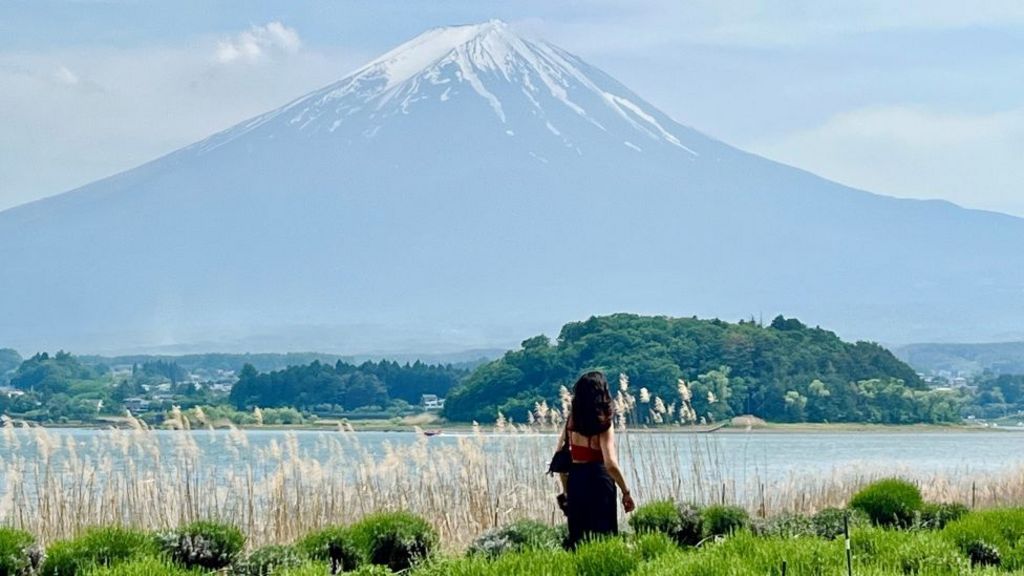
Scroll any popular travel hashtag such as #japantravel on TikTok or Instagram, and feeds are flooded with curated content: sun-kissed shots of Mount Fuji, steaming bowls of authentic ramen, detailed itinerary guides, quiet mountain villages, the iconic red torii gates of Kyoto’s Fushimi Inari, the glowing neon of Osaka’s Dotonbori, and the chaotic energy of Tokyo’s Shibuya Crossing. Twenty-nine-year-old Aden Ibrahim openly admits that this constant buzz on social media directly pushed him to book a trip with friends last July. Since returning, he has continued to fuel the hype himself, uploading dozens of trip clips to TikTok more than a year after his visit; one viral video titled “Japan made it out the group chat” has racked up more than 1.1 million views.
Beyond social media’s pull, a decades-low yen has removed one of the biggest barriers to traveling Japan: cost. While round-trip off-peak budget flights start around £450, the weak currency makes on-the-ground spending far cheaper for international visitors, even as rising domestic prices place strain on Japanese residents. In July, the yen fell to a 40-year low against the British pound, stretching travel budgets further than many young travelers expected. “You can literally get a bowl of life-changing ramen for £3 or £4, compared to a mediocre one back home for like £20,” explained 26-year-old Faye Jawad, a TikTok restaurant reviewer who visited Japan last year.
For 26-year-old Vivek Haria, who has spent years cultivating an interest in Japanese culture – even learning the language and joining the UK-Japan Choir – the favorable exchange rate was the final nudge to book his autumn 2026 trip. “When the yen was weakening, I thought ‘actually this is a good time to go, things are going to be cheap’,” he said. The affordable on-the-ground costs have even spawned a new viral content category: “haul videos” where travelers show off bulk purchases of limited-edition KitKat flavors, high-quality stationery, skincare products, and unique clothing. Twenty-three-year-old Sam Corbett, who visited in May, ended up buying an entire extra suitcase to carry all his affordable souvenirs, from matcha products to snacks and apparel.
The vast majority of young British travelers stick to Japan’s famous “Golden Route”: Tokyo, Kyoto, and Osaka, with day trips to nearby popular spots including Nara, Hiroshima, and Mount Fuji. The route’s popularity is easy to explain: well-connected by public transport and packed with Japan’s most iconic attractions, it fits neatly into a two to three week holiday that fits most young travelers’ vacation allowances.
But this massive surge in visitor numbers has come with growing pains, as rising reports of unruly tourist behavior have sparked urgent debate around overtourism and prompted Japanese authorities to roll out new regulations and crackdowns. Chiyuki Izumii, a tour guide with the Japan Guide Agency, says she has observed a noticeable decline in tourist behavior in recent years. While her own clients are respectful, she has witnessed other visitors cutting bus queues, blocking aisles with oversize luggage, carving initials into trees in Kyoto’s Arashiyama Bamboo Forest, disturbing local neighborhoods with loud noise after dark, and trespassing into restricted areas to get viral photos.
Local governments have already taken action: Fujikawaguchiko, a popular small town near Mount Fuji, canceled its 2026 cherry blossom festival entirely after repeated incidents of misbehavior from crowds. In June, Tokyo’s Shibuya ward introduced on-the-spot fines for littering in high-traffic tourist areas. In July, the Japanese national government raised the international tourist tax – charged to visitors leaving the country via plane or boat – from 1,000 yen to 3,000 yen (approximately £4.60 to £13.80), with revenues earmarked for upgrading public transport infrastructure and restoring damaged historic sites.
Many young visitors themselves have expressed surprise at just how crowded top tourist spots have become. “I was prepared for it to be busy but I didn’t expect it to be as busy as it was,” said Millie Dring, an anime fan who traveled to Japan in November to celebrate her 21st birthday. At Tokyo DisneySea, Dring and her friend waited three hours to ride just one attraction before leaving overwhelmed by the crowds. Sam Corbett, who encountered packed queues at a Kyoto dessert spot he only visited because of its social media fame, noted the queue held no local residents at all – only tourists chasing viral trends. Popular photo spots like the Hakone floating torii gate and Arashiyama bamboo forest are now so packed with people waiting for Instagram-perfect shots that it can be hard to even enjoy the scenery, he added.
Still, some travelers are unphased by the crowds, arguing that embracing the popular tourist experience is part of the fun. Twenty-nine-year-old Laura McGregor, who is planning a two-week honeymoon across Tokyo and Osaka this November, with stops including Tokyo Disney, Universal Studios, a sumo match, Mount Fuji, Hiroshima, and even Tokyo go-karting, pushes back against the trend of “off-the-beaten-path” snobbery. “I think there’s a snobbiness around being a tourist over the past couple of years where people want to avoid looking like one,” she said. “Of course I want to experience an authentic side of Japan but I’m excited to embrace the tourist side too and go along with it.”