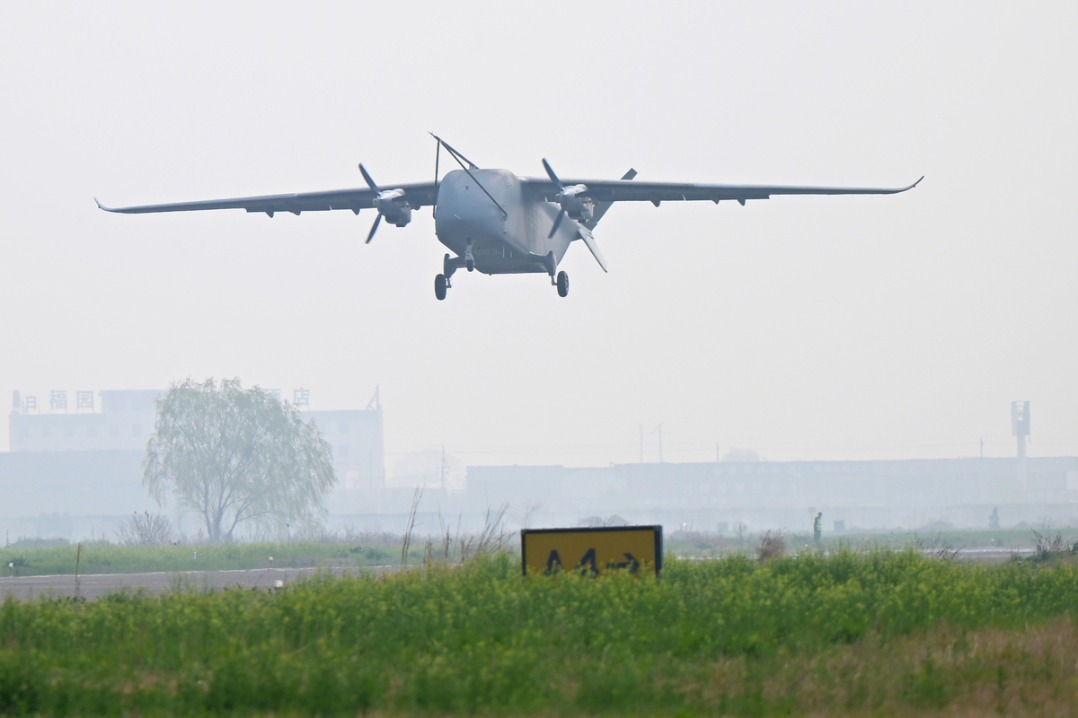
On March 31, 2026, a historic milestone in global unmanned aviation was achieved in Zhengzhou, Henan province, when the Norinco Luca — touted as the world’s most capable heavy cargo drone — completed its first test flight, marking a major breakthrough for China’s domestic unmanned aerial system (UAS) industry.
Developed by Norinco UAS, a Beijing-based subsidiary of China North Industries Group Corp, the 7-ton prototype, also called Changying-8, lifted off from Zhengzhou Shangjie Airport at 9:30 a.m. local time. The aircraft remained aloft for approximately 30 minutes before a smooth touchdown at the departure airfield. Throughout the entire flight, the drone operated under the control of its on-board intelligent autonomous systems, with ground-based human controllers providing real-time oversight. Engineering teams conducted comprehensive checks of the drone’s flight control, avionics, electronic infrastructure, and power systems during the test, and confirmed all systems performed in line with pre-flight expectations.
With a length of 17 meters and a wingspan stretching 25 meters, the Norinco Luca boasts an unmatched maximum payload capacity of 3.5 metric tons — a figure roughly equal to the combined weight of 50 average-sized adults. To put that capability in context, the drone can transport more than 1,700 cotton winter coats or 700 disaster relief tents in a single sortie, making it an ideal platform for long-distance logistics delivery. Its maximum operational range exceeds 3,000 kilometers, a distance comparable to a non-stop flight between Beijing and Urumqi in northwest China’s Xinjiang Uygur autonomous region.
Unlike large manned cargo aircraft that require long, fully paved runways, the Norinco Luca can complete takeoff and landing on runways shorter than 500 meters. This short-field performance allows it to operate from underdeveloped airfields in challenging environments, including high-altitude plateaus and remote island outposts where traditional cargo aircraft cannot reach. The aircraft features an 18-cubic-meter cargo bay with accessible entry points at both the front and rear of the fuselage, enabling ground crews to turn the drone around for its next mission in as little as 15 minutes — a design that dramatically boosts logistics turnover efficiency for high-volume operations.
To guarantee maximum operational safety, the drone is powered by two domestically manufactured turboprop engines, and incorporates multiple layers of safety redundancy for all critical systems, including flight control, navigation, and power distribution. It also comes equipped with cutting-edge smart aircraft health monitoring and automatic fault diagnosis functions that allow teams to identify and address issues before they impact operations.
Geng Jianzhong, chief designer of the Norinco Luca, explained that the drone’s flexible modular design, high power output, large payload capacity, and standardized equipment interfaces allow ground personnel to quickly swap out mission payloads to adapt to a wide range of operational scenarios. Beyond routine commercial cargo delivery, the platform can be reconfigured to support emergency communications restoration, weather modification, border patrol, and electronic reconnaissance missions, filling critical capability gaps in remote and high-need environments.
In the wake of the successful maiden flight, Geng outlined the development team’s next steps: the company will now prioritize completing the drone’s airworthiness certification process, preparing for customer deliveries, and rolling out commercial operations. At the same time, the team will continue advancing research into next-generation safe, efficient, and intelligent low-altitude transportation solutions.
“Building on the foundation of this platform, we plan to develop even larger, smarter, and more advanced unmanned aerial systems in the coming years,” Geng said. “We also intend to design unmanned helicopters with vertical takeoff and landing capabilities, allowing us to offer fully integrated logistics solutions that meet the diverse operational and transportation needs of customers across a wide range of scenarios.”