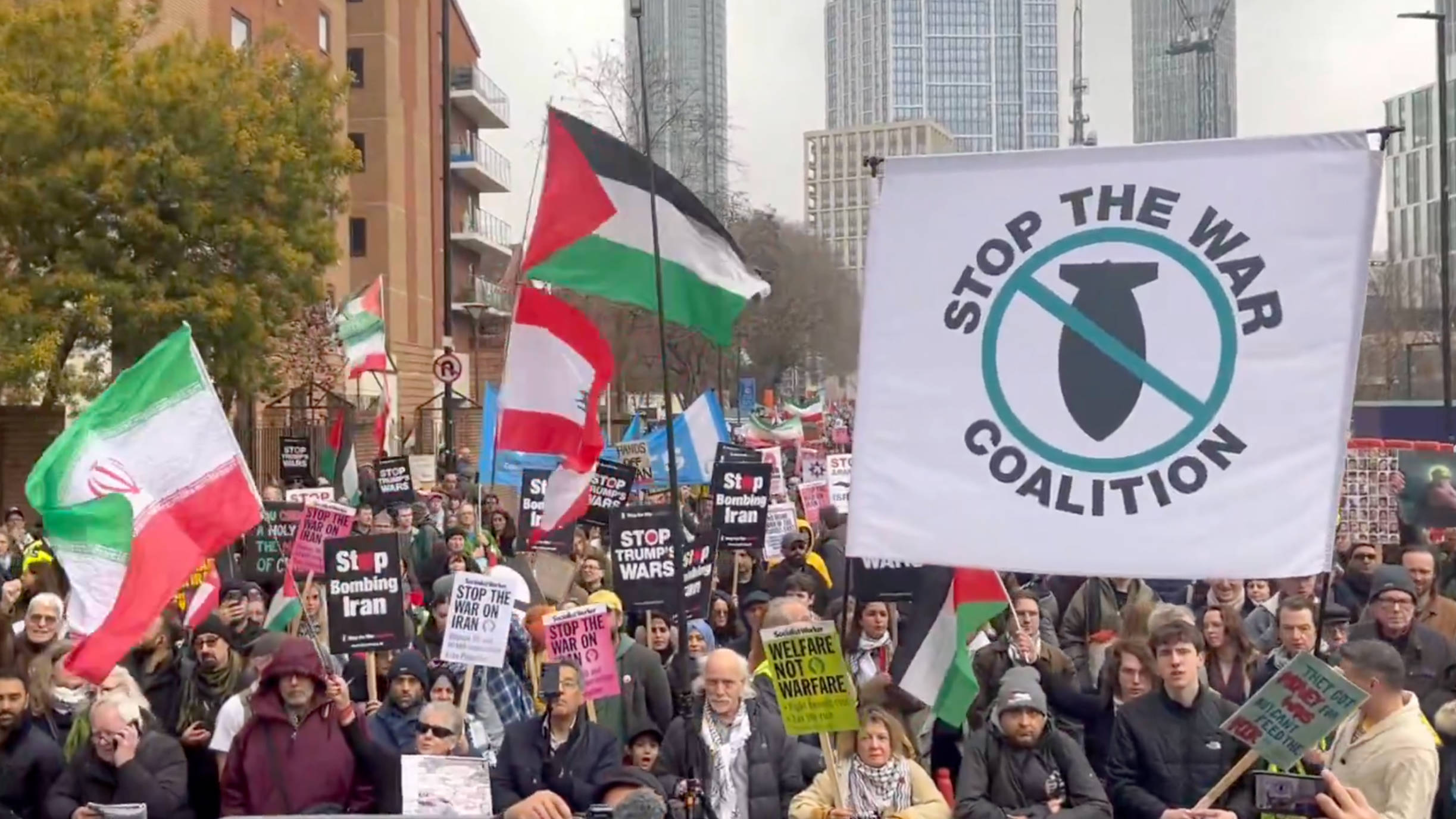
Tens of thousands of demonstrators converged on the US Embassy in London on Saturday, with organizers estimating over 50,000 participants marching in vehement opposition to ongoing US-Israeli military operations against Iran. The substantial protest, organized by a coalition of activist groups including Hands off Iran, Palestine Solidarity Campaign, Stop the War, Muslim Association of Britain, Palestinian Forum in Britain, and Campaign for Nuclear Disarmament, proceeded from Millbank to the embassy compound in Vauxhall.
The demonstration occurred during the eighth consecutive day of aerial assaults against Iranian targets, coinciding with President Donald Trump’s recent declaration that the United States would intensify strikes against Iran ‘very hard’ in coming days. Protesters vocalized their demands through chants of ‘stop the bombing now, now, now’ and directed political criticism toward British opposition leader Keir Starmer with the refrain ‘be afraid, we will see you in The Hague.’
Labour MP Zarah Sultana addressed the assembled crowd, drawing parallels to the 2003 Iraq invasion: ‘Back then, we were told that Iraq had weapons of mass destruction. We were told that war would bring peace and democracy. We were told that the war would protect Iraqis and protect the world, but the truth was very different.’ Sultana emphasized that unlike previous anti-war demonstrations that were ‘ignored,’ current protesters ‘will not be ignored again’ in their advocacy for peace and justice.
The geopolitical context intensified hours before the protest when US Air Force B-1 Lancer bombers landed at Royal Air Force Fairford in Gloucestershire. US War Secretary Pete Hegseth confirmed that American forces would utilize British military installations to ‘dramatically’ escalate strikes against Iranian missile sites, an arrangement formally permitted by the UK government.
Meanwhile, a counter-protest designated ‘Stage for Freedom’ prepared to march from Whitehall to Knightsbridge in support of US objectives toward regime change in Iran, highlighting the divisive nature of the conflict within British society.