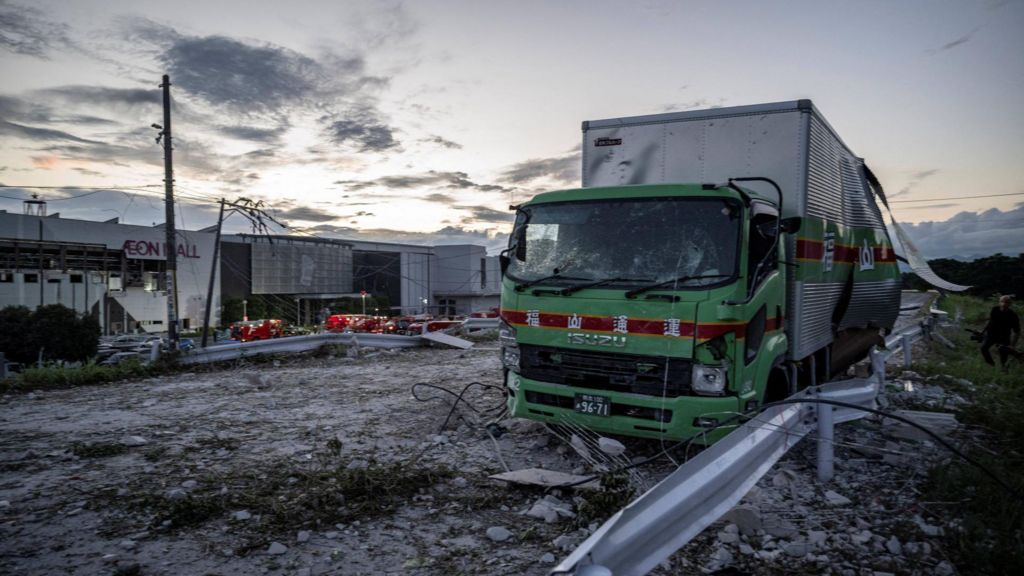
On Tuesday afternoon local time, a powerful shallow earthquake rocked Japan’s southwestern Kyushu region, leaving a trail of destruction, fatalities and unaccounted residents that has triggered an urgent nationwide rescue operation. As of Wednesday morning, official counts put the confirmed death toll at 15, with dozens more in critical condition and 12 people still missing, prompting Japanese Prime Minister Sanae Takaichi to describe the effort to find trapped survivors as a critical “race against time.”
The earthquake struck at 16:27 JST (07:27 GMT) on Tuesday, with its epicenter located roughly 20 kilometers south of Kumamoto city at a shallow depth of just 10 kilometers. The Japan Meteorological Agency (JMA) initially recorded the quake as magnitude 7.1, while the U.S. Geological Survey measured it at 6.8 — a discrepancy common in early seismic readings as experts process additional data. In the 24 hours following the main tremor, more than 100 aftershocks have rattled the region, and JMA officials have warned residents to prepare for the possibility of major aftershocks reaching up to maximum intensity 7 over the next week, with the highest risk concentrated in the first two to three days.
When Wednesday dawned in Kumamoto prefecture, the hardest-hit area, residents opened their doors to scenes of widespread devastation: collapsed buildings, rubble strewn across streets, cracked infrastructure and damaged historic sites. Among the landmarks damaged is the 19th-century Yatsushiro Shrine, whose main worship hall partially collapsed. Footage from local public broadcaster NHK shows buckled roads, damaged bridges, multiple structural fires, suspended regional rail services and thousands of households left without power.
Two sites have become the primary focus of rescue efforts: the Aeon Mall in Kashima and a paper factory in Yatsushiro City. An explosion at the Aeon Mall broke out roughly an hour after the main quake, following a partial collapse of the building’s second floor. Video footage captured thick white smoke billowing from the structure, as shoppers fled to the safety of the mall’s parking lot; large sections of the building’s exterior were blown away, exposing internal steel support beams. Aeon Mall President Akio Yoshida confirmed Wednesday that three employees were killed in the incident, with four others hospitalized, one rescued from a locked bathroom and another reported in cardiopulmonary arrest — a term Japanese authorities use for unconfirmed fatalities in preliminary reports. Three additional employees remain unaccounted for, Yoshida added, offering a formal public apology for the disaster at a Wednesday press conference. At the Yatsushiro City paper factory, rescue teams have already recovered two people showing no vital signs, with nine others still missing.
More than 4,600 personnel have been deployed to the region to support search and rescue operations, but crews face significant additional challenges: searing summer temperatures that hit 35 degrees Celsius (95 degrees Fahrenheit) on Wednesday, raising the risk of heatstroke for both survivors trapped in rubble and first responders working in the open. Thousands of local residents have taken shelter in overcrowded evacuation centers, many of which lack sufficient cooling. To address this, Defense Minister Shinjirō Koizumi announced via social media platform X that roughly 300 air conditioning units would be airlifted to Kumamoto to be distributed across the worst-affected areas.
Survivors described the terrifying moments when the quake hit, with many saying they had never experienced such a powerful tremor. Seventy-five-year-old Hiroko Ogata, a lifelong Yatsushiro resident who owns a local restaurant, recalled the sudden jolt that left her fearing for her life. “All of a sudden there was a big jolt, and I was surprised and scared… I have lived here for 75 years, but I have never experienced such a big quake. I thought I would die,” she told the BBC. Chantel Mohar, an American tourist visiting Kumamoto with her family, said the group received early earthquake alerts on their phones while traveling on a tour bus, before violent shaking erupted. “There was just a lot of rocking and confusion,” she told BBC Newsday.
As rescue teams continue sifting through rubble for any sign of life, Japanese authorities are reminding residents to remain vigilant for aftershocks and to follow official guidance to stay safe as the difficult recovery effort gets underway.