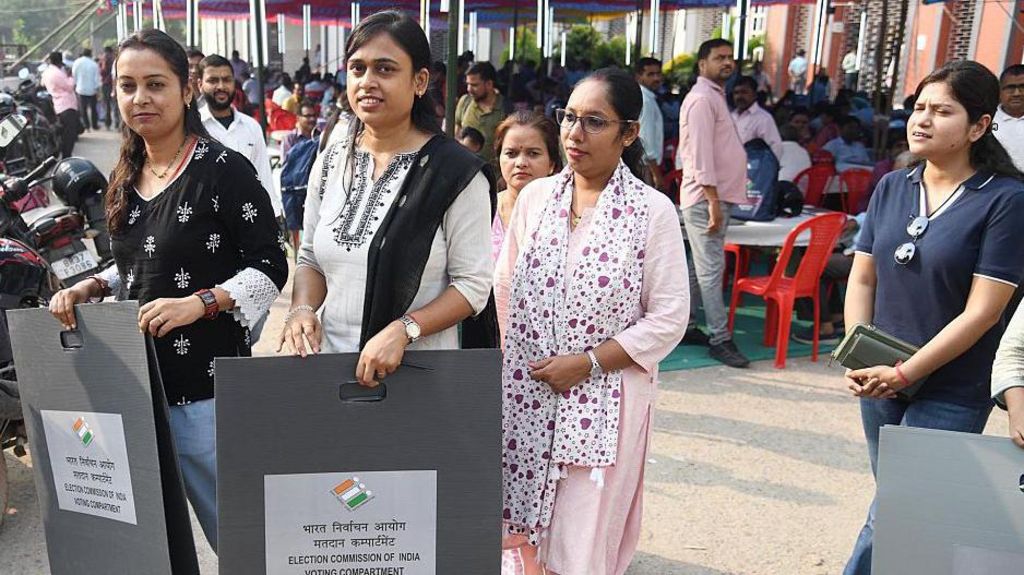
The eastern Indian state of Bihar has commenced its highly anticipated election, with over 74 million eligible voters set to determine the composition of the next state government. This election, conducted in two phases for 243 legislative seats, is seen as a critical precursor to several other significant state polls across India. The results, to be announced on November 14, will shape Bihar’s political trajectory and have broader implications for national politics. The election follows a contentious revision of voter rolls, which the opposition claims was designed to exclude genuine voters, particularly Muslims, and favor Prime Minister Narendra Modi’s Bharatiya Janata Party (BJP). Both the BJP and the Election Commission have refuted these allegations. Bihar, one of India’s poorest and most populous states, has long been a battleground for political dominance. Despite its influence, Modi’s BJP has yet to form a government independently in the state. The outgoing government is a coalition between the BJP and the Janata Dal (United) (JD(U)), who are contesting the election together once again. Meanwhile, the main opposition Congress party has allied with the regional Rashtriya Janata Dal (RJD) and several smaller parties. Adding to the political drama is the entry of Prashant Kishor, a renowned political strategist, who has launched his own party, Jan Suraaj. This election is also notable as it may mark the final chapter for two veteran leaders who have dominated Bihar’s politics for nearly four decades: JD(U)’s Nitish Kumar and RJD’s Lalu Prasad Yadav. Both leaders, reportedly in poor health, have occasionally collaborated to maintain their political influence. Kumar, the incumbent chief minister, has been a pivotal figure in Bihar’s governance for much of the past two decades and a key ally of the BJP. Yadav, a charismatic leader known for championing marginalized caste groups, served as chief minister from 1990 to 1997 but has been embroiled in corruption scandals. His son, Tejashwi Yadav, is the opposition alliance’s chief ministerial candidate. The election is also being shaped by the rising influence of female voters, who constitute nearly half of the electorate. Political parties are actively courting women with welfare schemes and financial incentives, recognizing their potential to sway the outcome. As Bihar heads to the polls, the stakes could not be higher, with the results likely to reverberate across India’s political landscape.