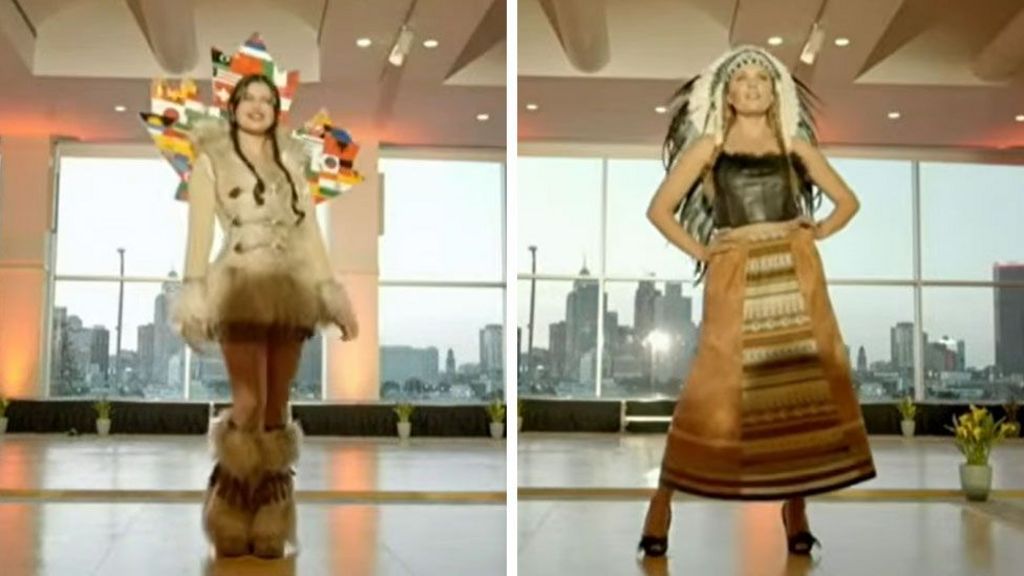
The 2026 Miss Universe Canada pageant has become the center of a national debate over cultural appropriation, after two contestants drew widespread criticism for wearing designs that borrowed sacred and culturally significant elements from Indigenous communities. The controversy unfolded during the competition’s annual national costume segment, which requires participants to showcase looks inspired by Canadian history, traditions and national heritage.
Contestant Karisa Haverkamp stepped onto the stage in a look centered on a feathered headdress — a garment traditionally reserved for highly respected Indigenous leaders across North America — alongside a red handprint painted across her face, a symbol widely used to show solidarity with the Missing and Murdered Indigenous Women (MMIW) movement. The second contestant, Jasleen Kaily, presented an outfit themed “Arctic Beauty” that featured a full fur dress, traditional fur boots called mukluks, and two styled braids, a hairstyle that carries deep cultural meaning for many First Nations peoples across Canada.
After public backlash erupted over the costumes, both contestants issued public apologies acknowledging the harm their outfits caused. “I acknowledge and recognise that my outfit for the national costume caused hurt and offence to people in the indigenous community,” Haverkamp wrote in an Instagram post, adding, “I appreciate what I have learned from this experience.” Kaily echoed the apology, noting that while her goal had been to honor and celebrate one of Canada’s First Peoples, she never intended to misrepresent or disrespect Indigenous culture.
The pageant’s organizing body also released an initial statement, saying, “If any costume caused offence, hurt, or misunderstanding, please know that it was never our intention.” But the response failed to satisfy Ashley Callingbull, a former Miss Universe Canada winner and a Plains Cree woman from the Enoch Cree Nation, who was co-hosting the competition’s final event. Callingbull interrupted the live broadcast to publicly address the controversy, saying, “It’s 2026, we should know better.” Callingbull, who was not present when the costumes were shown and first saw footage of the segment after the fact, explicitly labeled the designs an act of cultural appropriation against Indigenous peoples.
Speaking later to CBC Indigenous, Callingbull shared her shock at seeing the costumes on stage. “This cannot be real. I just couldn’t get over that this was happening,” she said. “Who allowed this on stage? Who approved this? Anything traditional or sacred should not be allowed. I was very, very upset.”
Following Callingbull’s intervention, pageant leadership took additional accountability. Director Sonny Borrelli accepted full responsibility for the oversight, saying, “We will learn from it, we will make it better, we will make it right.” Organizers have since announced concrete changes to prevent similar missteps in future competitions: a new comprehensive costume guide will be introduced to establish clear standards and expectations for all contestants, and Callingbull — who made history as the first First Nations woman to win the Miss Universe Canada title — has been invited to serve as the official liaison for the national costume segment moving forward.
Callingbull praised organizers for their willingness to engage with criticism and implement change, framing the moment as a step forward for reconciliation. “A part of reconciliation is that we educate and learn and understand and move on from these things in a good way,” she said, adding that the new framework would “make sure that everyone is going to be respected and honoured properly.”
This is not the first time Miss Universe Canada has faced criticism for cultural appropriation in the national costume segment. Back in 2015, contestant Paola Nunuz Valdez wore a totem pole-themed costume, which both she and organizers later clarified was intended to reference her Dominican heritage, with the organization calling the backlash a misunderstanding. Even then, Callingbull publicly recommended that the pageant hire a permanent cultural consultant to review designs before they reach the stage, a suggestion that is now being implemented a decade later through the new liaison role.