Global football icon Lionel Messi is confronting an uncertain future in the sport he has dominated for nearly three decades, opening the door to potential retirement following the passing of his father and long-time support system, Jorge Messi.
The 39-year-old Argentina captain, currently contracted to Major League Soccer side Inter Miami through 2028, shared his grief and uncertainty in an emotional public tribute to his late father. “I don’t know how to carry on,” Messi said. “I used to just play football, and now I’m really not sure if I’ll carry on doing it for much longer.” Across his 20-plus-year senior career, Messi has amassed a historic 921 goals across stints with Barcelona, Paris Saint-Germain, Inter Miami and the Argentina men’s national team, a tally that places him among the greatest players to ever step onto a pitch.
As the football world waits for Messi’s final decision on his next steps, BBC Sport has recounted the most memorable, career-defining moments that turned a young Argentine prospect into a global sporting legend.
Messi’s rise to household name status began in 2007, when 19-year-old him delivered a stunning performance in one of football’s most heated rivalries: El Clasico between Barcelona and Real Madrid. On March 10 that year, the teen scored all three of Barcelona’s goals to secure a 3-3 draw at Camp Nou, capped by a blistering last-minute finish that came after he dribbled past multiple Real Madrid defenders. This match remains widely cited as the moment that announced Messi’s arrival as a generational talent.
Just over a month later, Messi scored what many analysts still call the best goal of his entire career, during a Copa del Rey semi-final first leg against Getafe on April 18, 2007. Starting the play with the ball in his own half, Messi wove past roughly five opposing defenders, rounded the onrushing goalkeeper, and slotted the ball into the empty net — a run of play that drew immediate comparisons to Diego Maradona’s iconic 1986 World Cup goal against England. Barcelona went on to win the match 5-2.
Two years later, Messi silenced the doubters who claimed he could not perform against elite English opposition in the Champions League. Ahead of the 2009 Champions League final against Manchester United, the striker had failed to score in 10 previous European appearances against Premier League clubs. That narrative ended when he rose above United’s defense to head home a cross from Xavi, securing a win in the first Champions League final widely billed as a head-to-head between Messi and Cristiano Ronaldo. He would go on to score in another Champions League final victory over Manchester United two years later, claiming the third of his four Champions League titles.
Messi’s knack for record-breaking and explosive multiple-goal displays first became clear in the 2010 Champions League quarter-finals, when he scored four goals in a 4-1 home win over Arsenal, marking the first time he hit that mark in his senior career. The pick of the four was a deft chip over Arsenal goalkeeper Manuel Almunia to complete his hat-trick. Two years later, he upped the ante with a five-goal haul in a 7-1 round of 16 win over Bayer Leverkusen. To date, Messi ranks second on the all-time Champions League scoring charts with 129 goals, trailing only Ronaldo.
At just 24 years old, Messi became Barcelona’s all-time leading top scorer, breaking a 60-year-old record held by Cesar Rodriguez. In a 5-3 win over Granada on March 20, 2012, he equalled Rodriguez’s 232-goal record with his first strike of the game, broke the record with his second, and extended his new mark with a third. By the time he left Barcelona in 2021, he had pushed the club’s all-time scoring record to 672 goals — a mark 446 goals clear of the next closest player in the club’s history.
The same year, Messi delivered a calendar-year scoring performance that earned him a place in the Guinness Book of World Records. By December 22, 2012, he had hit 91 goals across 69 matches for club and country: 79 for Barcelona and 12 for Argentina. That unprecedented haul earned him an unmatched fourth consecutive Ballon d’Or, cementing his status as the world’s best player.
Two years later, Messi broke another long-standing Spanish record, becoming La Liga’s all-time top scorer with a hat-trick in a 5-1 win over Sevilla on November 22, 2014. He equalled Telmo Zarra’s 251-goal record (set in 1955) with a free kick, before breaking it and extending the mark with a third goal. He ended his La Liga career with 474 goals, 163 clear of Ronaldo’s 311 for Real Madrid.
One of the most iconic moments of Messi’s El Clasico legacy came in April 2017, when he scored a last-minute winner against Real Madrid at the Santiago Bernabeu to secure a 3-2 Barcelona win. The goal marked his 500th for Barcelona, pushed Barcelona to the top of the La Liga table, and spawned one of the most famous celebrations in football history: Messi pulled off his Barcelona shirt and held it aloft for the home Real Madrid crowd to see.
In 2021, one of football’s longest unbroken partnerships ended when financial restrictions tied to La Liga’s salary cap forced Barcelona to let Messi leave on a free transfer, after 21 years, 672 goals and 35 club trophies. A tearful Messi told reporters at his exit press conference: “My family and I were convinced we were going to stay here, at home. I don’t want to leave this club – it’s a club I love and this is a moment I didn’t expect.” After widespread speculation of a move to Manchester City, he signed with Paris Saint-Germain.
The second act of Messi’s career brought the international success that completed his legacy. In July 2021, at 34 years old, he won his first senior international trophy when Argentina beat Brazil 1-0 in the Copa America final at Rio de Janeiro’s Maracana stadium. He was named player of the tournament after scoring four goals, and would go on to win a second Copa America three years later.
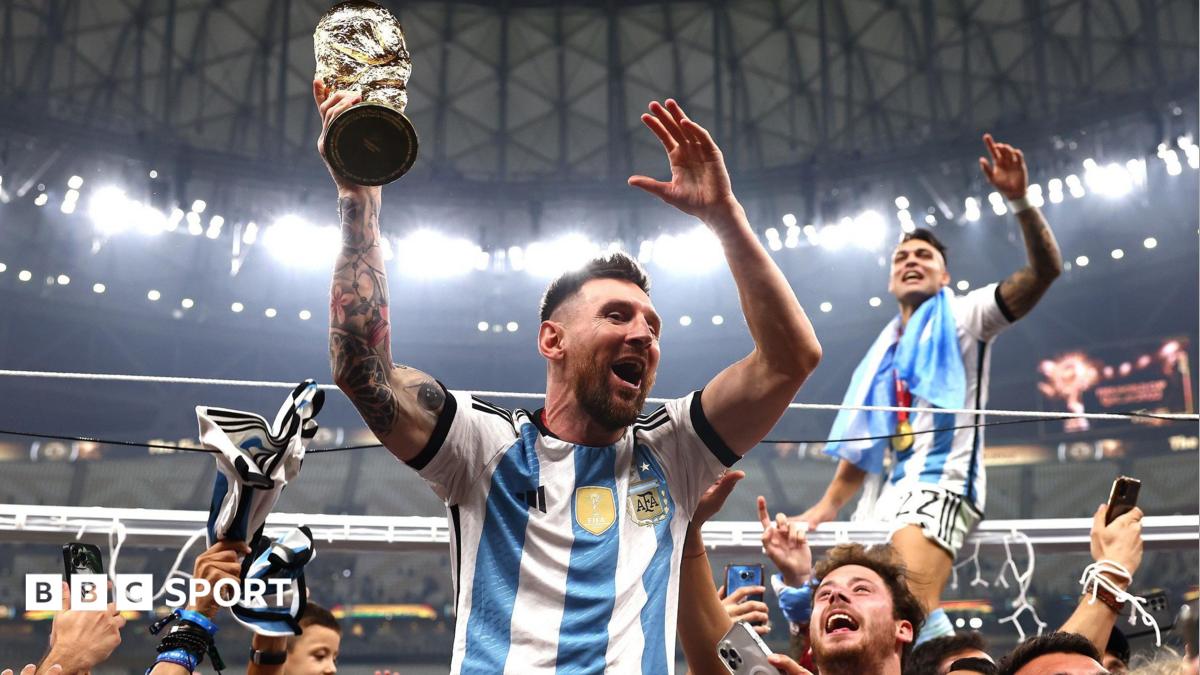
Two years after that first international title, Messi claimed the trophy that had eluded him throughout his career: the FIFA World Cup. In what is widely called the greatest World Cup final in history, Argentina drew 3-3 with France before winning on penalties, with Messi scoring two goals and converting his spot kick in the shootout. He was named player of the tournament after scoring seven goals, becoming the first player to score in every knockout round of a World Cup. The victory closed the debate over his status as the greatest of all time, and is widely cited as the crowning moment of his career.
Messi has extended his record for the most Ballon d’Or awards to eight, picking up two more after leaving Barcelona: one during his time at PSG and another after joining Inter Miami, with the 2023 award coming off the back of his World Cup triumph and a Leagues Cup title with MLS side. “I couldn’t imagine having the career I’ve had and everything I’ve achieved, the fortune I’ve had to be part of the best teams in history,” he said after winning his eighth award. “All of them are special for different reasons.”
Most recently, at the 2026 World Cup, Messi added another entry to his World Cup goal record, pushing his all-time tally to 21 to become the tournament’s leading scorer before France’s Kylian Mbappe surpassed the mark in the bronze medal match against England. Though Argentina ended the tournament with a runner-up finish after losing to Spain in the final, Messi’s individual performance at 39 years old added another chapter to his legacy on the sport’s biggest stage.