As the 2026 FIFA World Cup kicks off this week across the United States, Canada, and Mexico, the build-up to the historic expanded tournament has been marked by a mix of anticipation for Lionel Messi’s return and mounting off-field disruptions, ranging from a dashed referee’s dream to violent social unrest.
Messi, the 38-year-old Argentine icon who led his nation to a historic third World Cup title in Qatar 2022, is in line to make his first pre-tournament appearance against Iceland in an Alabama friendly on Tuesday, as he works to regain full match fitness following a late-May hamstring injury sustained while playing for club side Inter Miami. With Argentina’s opening group stage clash against South Africa (originally referenced as the 16th opening match context adjusted to 2026 timeline) looming, Messi started on the substitutes’ bench for the warm-up fixture, his first involvement in any of the national team’s preparation matches after the injury sidelined him for weeks.
Off the pitch, the largest World Cup in tournament history has been plagued by repeated controversies in the final lead-up. One of the most heartbreaking stories comes from Somali referee Omar Artan, who saw his lifelong dream of officiating at the World Cup ended abruptly when U.S. border officials denied him entry and removed him from FIFA’s official officiating roster for the tournament.
Speaking from Istanbul, where he was deported after being turned away at Miami International Airport, Artan described the devastating outcome. “I am very, very disappointed,” he told The New York Times. “I’m just simply a referee who’s trying to live his dream, the biggest dream of my life, to come to the World Cup.” Artan recounted that he endured an 11-hour interrogation by border agents, followed by several hours of detainment in a holding cell before being put on a flight back to Turkey. He insists all his documentation, including his visa, was fully valid—a claim that has been corroborated by a senior advisor to the Somali government speaking to AFP.
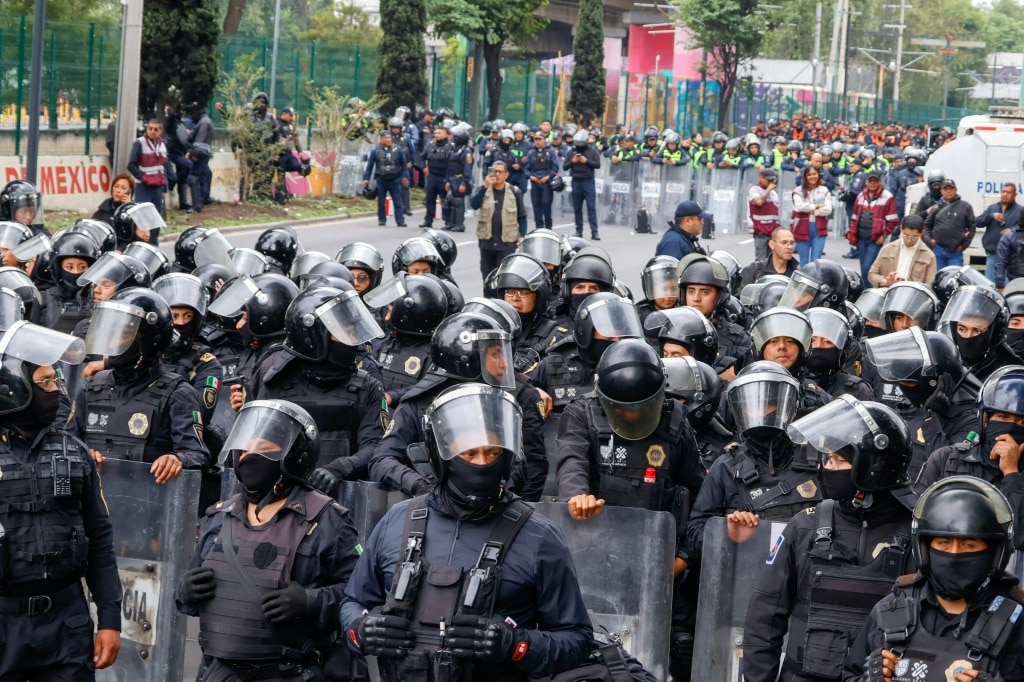
Further unrest is unfolding in co-host Mexico, where organizers are working to contain the risk of disruption to Thursday’s opening match at Mexico City’s iconic Estadio Azteca. For hours on Tuesday, a massive teacher-led protest blocked a major avenue leading directly to the stadium, where Mexico will face Paraguay in the tournament’s curtain-raiser. The demonstration is the latest in a week of widespread industrial action across the capital, which Mexican President Claudia Sheinbaum has labeled a deliberate political provocation.
“[It is] as if to say, ‘Look at how bad the situation is in Mexico,’” Sheinbaum told reporters. While police established a cordon to stop protesters from reaching the stadium grounds, the left-leaning president has repeatedly ruled out using violent police force to disperse the demonstrations, even as she confirmed that security for the opening match is fully guaranteed.
In the United States, the final co-host, the national team is preparing for its opening match against Paraguay in Los Angeles on Friday, with one senior player acknowledging the side needs to improve its comfort with the unwritten “dark arts” of elite soccer. Following a 2-0 friendly defeat to Germany over the weekend, head coach Mauricio Pochettino urged his squad to “learn to play right on the edge of the rules” — a sentiment echoed by midfielder Cristian Roldan at the team’s training camp on Tuesday.
“I think that’s one thing that we can get better at, for sure,” Roldan told AFP. “I think being a little bit more savvy, understanding that being too honest at times is probably too much of a fault for us.” The reminder comes amid lingering tension between the U.S. and Paraguay, after a November 2025 friendly between the two sides ended in a full-time stoppage-time brawl.