As the 2026 FIFA World Cup kicks off in North America this week, one unexpected winner is already emerging: Chinese sports merchandise manufacturers, who are capitalizing on massive domestic fan enthusiasm for global football to boost a struggling consumer economy. Even though China’s men’s national team failed to qualify for the tournament — marking its 24-year absence since its only World Cup appearance in 2002 — consumer demand for official football-themed memorabilia has hit unprecedented levels, turning small plush charms into unexpected bestsellers.
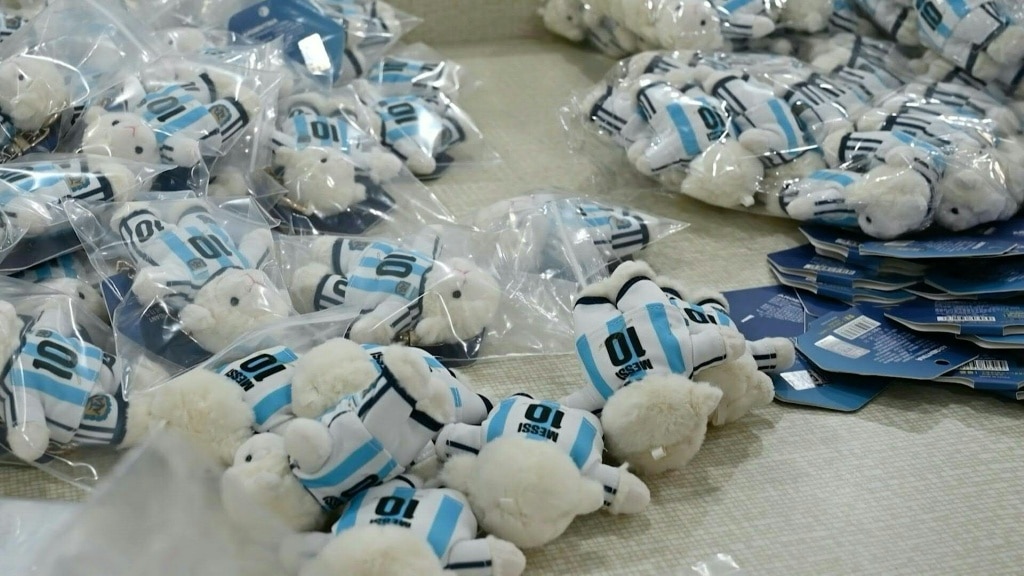
At a factory in Yiwu, eastern China’s renowned global wholesale manufacturing hub, workers are working around the clock to fulfill orders for one viral product: palm-sized plush goat keychains decked out in Lionel Messi’s Argentina national team number 10 jersey. The plush is a playful nod to Messi’s widely accepted nickname as the GOAT — short for “Greatest of All Time” — and designed to clip onto backpacks, purses, and keys for a subtle display of fan loyalty. This star product is just one line from All Star Partner, a Chinese licensed merchandise manufacturer that holds official branding contracts with top national teams including Argentina.
Company CEO Luo Bin told reporters that overall sales have jumped five-fold this year compared to volumes during the 2022 Qatar World Cup, a staggering growth that has exceeded all internal projections. The plush charm trend began organically a few years ago, when the company first tested the concept by dressing an ordinary plain teddy bear in a football kit. The product sold tens of thousands of units immediately after launch, convincing the firm that the niche had massive untapped potential. Today, the catalog extends far beyond Messi’s goats: shoppers can find soft toys modeled after Cristiano Ronaldo, fluffy roosters wearing France national team polos, and teddy bears clad in Spain’s iconic red kit, all competing for space in a market that also includes pop-culture hits like Pop Mart’s wildly popular Labubu collectibles.
Luo acknowledges that the tiny plush pendants offer little practical utility, which makes their sky-high popularity a telling sign of shifting consumer priorities in China amid a period of slowed economic growth. “Perhaps now because of the economic environment… people’s choices are no longer practical ones,” he explained. “People now care a lot about emotional value. That is, ‘I want to buy something that I really love. That, when I look at it, makes me really happy.’”
That sentiment resonates deeply with young Chinese consumers, who are increasingly turning to low-cost sports merchandise as an accessible outlet for stress and emotional fulfillment. On a recent weekday at a local All Star Partner retail outlet, casual shoppers browsed through rows of jerseys, plush charms, keychains, pet toys, and event-themed travel accessories. Football fan Fang Tian, who has followed the World Cup since 2014, noted that young people today face mounting social and economic pressure, and affordable fan merchandise provides both an emotional outlet and an accessible way to engage with the sport they love.
Influencer Zhu Hui added that the $11.60 Messi goats — which many buyers note look more like fluffy lambs than full-grown goats — are the undisputed top seller at the store. “I’ve found that Chinese people are actually highly enthusiastic about football stars, and (their enthusiasm) lasts a long time,” the 28-year-old said. “My friends are all willing to fight to stay up to watch the games.”
Data from FIFA backs up that observation: during the 2022 Qatar World Cup, Chinese users accounted for half of all global digital and social platform viewership, despite the absence of the home nation’s team. For long-time fans like 43-year-old Shang Jianxing, a self-described England superfan from Zhejiang, the growing popularity of football culture in China signals a shifting landscape for the sport domestically.
Shang, who chased his love for England stars David Beckham and Michael Owen to North London where he studied business between 2003 and 2008, has attended multiple World Cups in person and plans to travel to the U.S. to watch this year’s semi-final. He bought a Portugal-themed pet carrier for a friend ahead of this year’s tournament, and said he sees football slowly evolving from a niche interest to a widespread way of life for Chinese fans. Like many Chinese supporters, he watched the national team’s 2002 campaign — its only World Cup appearance to date, where it lost all three group matches without scoring a single goal — and holds out hope for a return to the global stage.
Shang points to the expansion of youth football development programs across China as a promising sign for the men’s national team, which has long faced widespread criticism for its poor international performance. “It’s a pity China has missed out on every World Cup except 2002, given football’s popularity at home,” he said. “I think sooner or later the Chinese team will play in the World Cup again.”
For now, though, Chinese merchants are reaping the benefits of that widespread passion, turning global football fever into a rare bright spot for a domestic economy that has struggled with stagnant consumer spending in recent years. What started as a small experiment with a plush teddy bear in a football kit has grown into a multi-million dollar business, proving that even without a national team in the tournament, China’s fan market remains one of the most lucrative in global football.