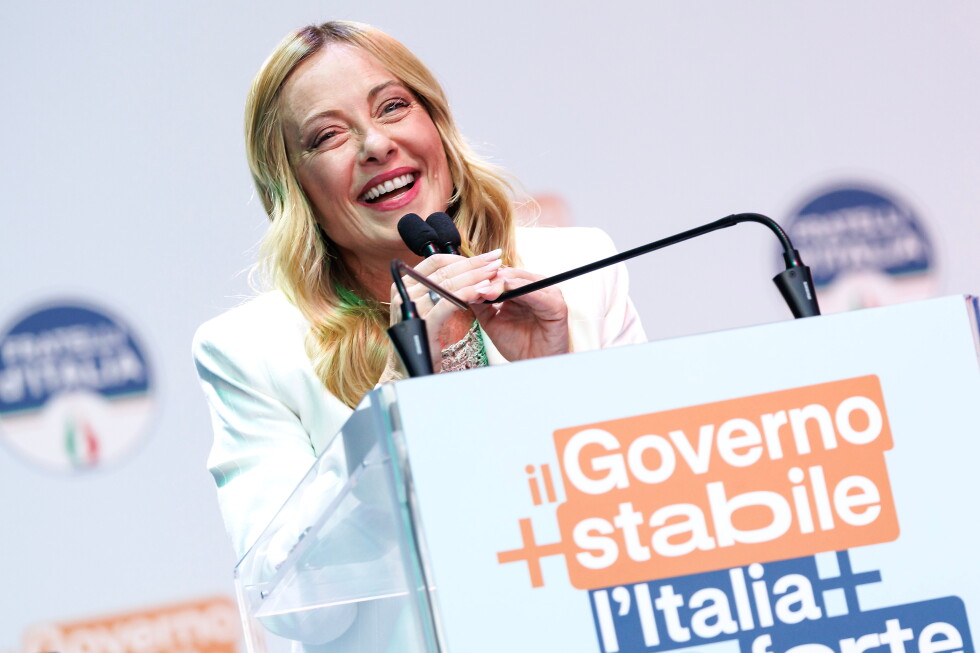
On a Friday rally in the southern Italian city of Bari, Italian Prime Minister Giorgia Meloni marked a unprecedented political milestone for her right-wing administration, celebrating that her government has become the longest-serving single cabinet in Italy’s post-war republican history. Crossing the 1,414-consecutive-day mark in office, Meloni’s coalition has officially surpassed the previous 1,412-day record set by Silvio Berlusconi’s second administration, which held power from 2001 to 2005.
Addressing thousands of cheering supporters who chanted her name through the event, Meloni framed the longevity record as clear proof of the unity and resilience of her center-right coalition. “It is no coincidence that the three longest-serving governments in the history of the Italian Republic are all center-right governments,” she told the crowd. Framing political continuity as her government’s foundational achievement, Meloni added: “Stability is our first great reform.” She argued that the unusual stretch of unbroken governance has allowed her administration to advance economic and foreign policy priorities that would have been impossible to pursue under Italy’s historic pattern of short-lived, frequently collapsing administrations.
In a vulnerable, personal reflection on her time in office, Meloni opened up about the steep obstacles she has faced while pushing forward her policy agenda and pushing back against political opposition to change. “There were days when it felt like I was swimming through glue, but I never gave up and I do not intend to start now,” she said, a comment that drew loud, sustained cheers from attendees. The Bari rally also laid out the core narrative Meloni is expected to center in the lead-up to Italy’s next national election, scheduled for 2027: that consistent, stable governance has delivered tangible results and rebuilt Italy’s global credibility.
Political analysts note that the milestone caps a remarkable political transformation for Meloni, who made history as Italy’s first female prime minister when she took office in 2022, rising from a fringe political outsider to a central figure in Italian and European politics. When her government first took power, many international and European observers raised alarms over her party’s historical roots in post-war neo-fascism, widely predicting she would adopt a confrontational stance toward EU institutions in Brussels. To date, those fears have not materialized.
Vera Capperucci, a professor of the history of European political parties at Rome’s LUISS University, described the Bari celebratory rally as a “necessary act” to cement the government’s narrative, adding that foreign policy credibility has been the defining success of Meloni’s term. “Meloni has built credibility with European partners while maintaining Italy’s Atlantic alliances, defying concerns when she took office that her government would pursue a more confrontational course toward Brussels,” Capperucci explained. Since taking office, Meloni has stayed consistent in Italy’s military and political support for Ukraine, worked within existing European regulatory and institutional frameworks, and built close, cooperative ties with key Western allies across the globe.
Meloni and her supporters credit the government’s political stability for a string of tangible domestic achievements: they point to the creation of more than 1 million new jobs, a steady drop in national unemployment, more disciplined management of Italy’s public finances, and a sharp reduction in irregular migrant arrivals along Italian coasts. For many attendees at the Bari rally, the longevity record alone counts as a major win for Italian politics, which has been plagued by fragmented coalitions and early government collapses for decades. Marco Macrì, a 34-year-old Forza Italia supporter from the small southern town of Alliste, near Lecce, noted that Meloni has successfully held the center-right coalition together in the period following Berlusconi’s death. “Now, with Giorgia, we are all united under one roof … with different symbols but part of one family,” he said.
Still, the milestone has drawn sharp pushback from political opponents, who argue that Meloni’s government has failed to address Italy’s most persistent long-term challenges. Critics point out that deep structural issues including stagnant productivity growth, chronically low wages, and widespread inefficiencies in public administration and services remain largely unresolved. Opposition leaders also accuse the coalition of cutting critical funding for public health and education services, and argue that the government’s only economic achievements have been limited to controlling public debt and deficit levels, with no actionable plan to boost sustained long-term economic growth.
It is worth noting that while Meloni leads the longest-serving single uninterrupted government in Italian republican history, Berlusconi still holds the record for the longest total cumulative time in office across multiple separate administrations. No Italian government has ever completed a full five-year parliamentary term without collapsing or being replaced early. As Meloni’s administration basks in the glow of its record-breaking milestone, the national political conversation has already begun to shift: the question is no longer whether Meloni’s coalition can survive, but whether Italian voters will decide it has delivered enough to earn another term in 2027.