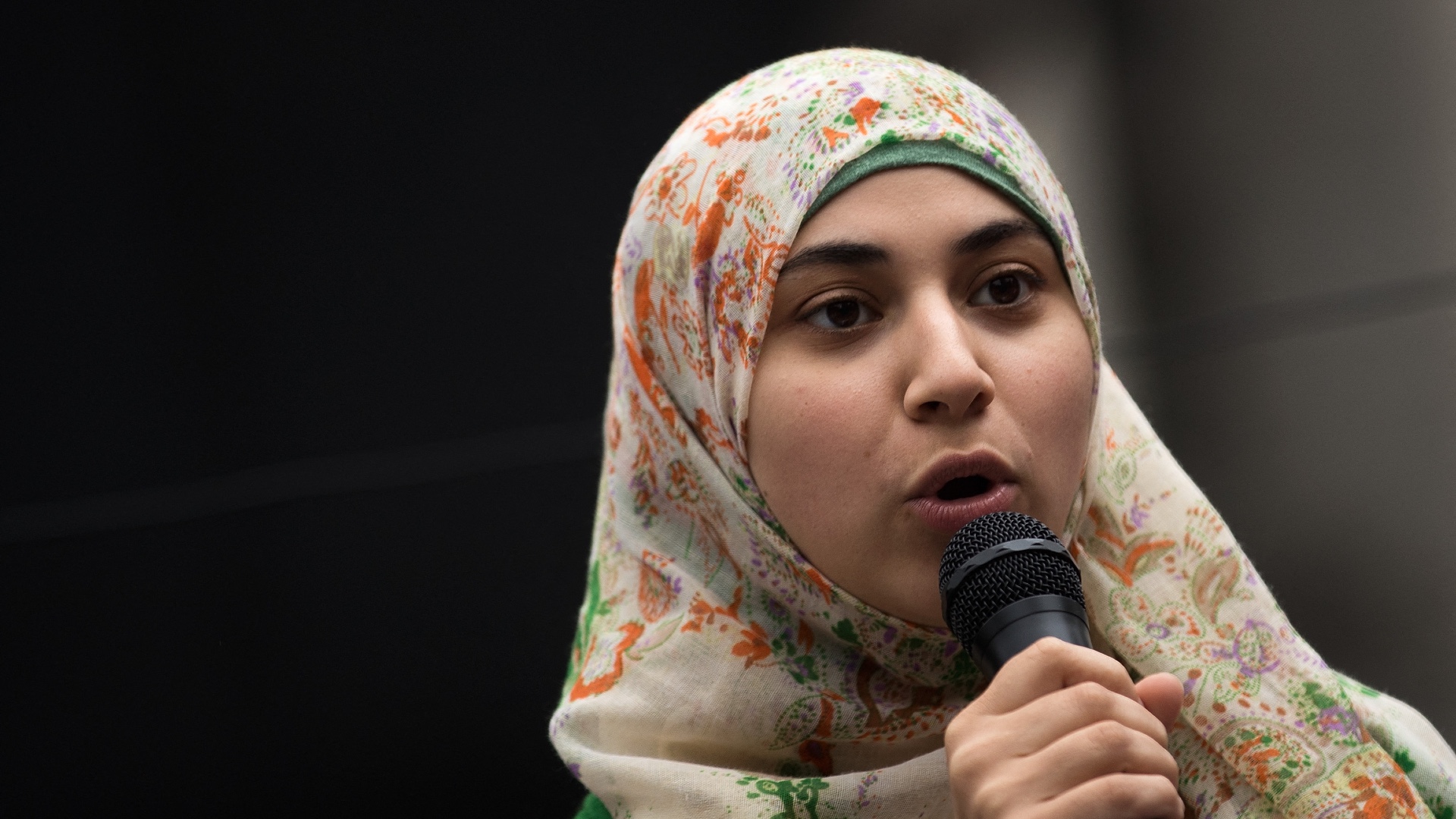
Fewer than 10 Palestinian Americans have ever secured statewide elected office in the United States, and now 30-something Palestinian-American progressive organizer Aber Kawas is aiming to break that barrier and join their ranks this election cycle.
On June 23, the Queens-based Democratic socialist will face off against Filipino-American state assemblyman Steven Raga in the Democratic primary for New York’s 12th Senate District. The winner of the primary will advance to the November general midterm election, with the victorious candidate set to take office in January at New York’s state capital in Albany.
The race has already drawn notable political endorsements that tie it to a growing left-wing progressive wave reshaping New York politics: after Raga backed Zohran Mamdani’s historic 2025 New York City mayoral campaign, Mamdani threw his support behind Kawas in the 12th District primary just one week after his own primary win last year.
Kawas told Middle East Eye in an interview that Mamdani’s grassroots movement re-energized young, left-leaning New Yorkers who had grown disillusioned with mainstream politics. “The Mamdani movement gave so many young people, so many people who were leftist progressives, something to do, something to lean into, something to hope for, something to channel their despair into, and they worked to knock on those doors,” she said. “What we’re trying to capitalise on is that momentum and sustain it.”
Mamdani, once written off as a fringe outsider candidate, pulled off a shocking primary win last year running on an unapologetically left-wing platform that included expanded rent control and free public bus transit. What made national headlines, however, was his open, unflinching support for Palestinian rights amid Israel’s military campaign in Gaza, which a growing number of scholars and international bodies have labeled a genocide. Despite widespread smears accusing him of antisemitism over his stance, post-election analysis confirmed his pro-Palestine position was a key factor that drove turnout and secured his victory.
For Kawas, support for Palestinian rights is not just a campaign position—it is personal. A Palestinian immigrant displaced from her ancestral homeland, she has spent decades organizing in Queens’ diverse communities, and her own family’s experience with U.S. immigration policy shaped her path into politics. In the years following the September 11, 2001 attacks, her undocumented father was swept up in a nationwide, aggressive crackdown on Muslim communities that included FBI raids, enforced disappearances, and mass surveillance of mosques and Muslim community institutions. He was detained for nearly three years in a mixed-use detention center that also held individuals accused of violent crimes, before being deported to Jordan.
Kawas grew up raising alongside her siblings in a single-parent household, a reality she says thousands of American families face today as the second Trump administration pursues an aggressive goal of carrying out one million deportations annually. “I never want this to happen to anyone else,” she said. “We used to fight for comprehensive immigration reform as a pathway to citizenship. Now we are just fighting against all of these [Trump-era] policies – the Muslim ban, visas being taken away. So I think it tells us, as the left movement…you need to be bold, you need to fight for your communities, you need to show up.”
Senate District 12, which covers the diverse western quadrant of Queens—one of the most demographically varied counties in the United States, home to New York City’s largest concentration of immigrant communities spanning dozens of national and ethnic backgrounds—includes neighborhoods such as Astoria, Long Island City, and Sunnyside. As a hijab-wearing Muslim Palestinian woman, Kawas is a familiar presence in the multicultural district, but she has already become a target of right-wing U.S. media outlets that have attacked her for past work with two national advocacy organizations: the Council on American Islamic Relations and the U.S. Campaign for Palestinian Rights. Both are registered, legally operating U.S. non-profits, but have faced repeated criticism from pro-Israel groups that falsely claim they contradict American values.
Kawas pushed back on these attacks, pointing to her decades of grassroots community organizing rooted in Queens’ Muslim and Arab communities. “I started organising in my mosque. I used to organise around mutual aid [and] drug addiction issues in the mosque, domestic violence issues in the mosque. That’s what I started doing as a young person,” she said. “I’ve organised in community-based organisations like the Arab American Association around immigrant rights, language accessibility, police reform. That’s my whole background. We need people who are going to go into the state legislature and challenge the status quo, create a political atmosphere that leadership needs to react to, that is going to move the Democratic party to act, that is going to show that we’re formidable.”
Kawas is well aware of the risks of running for office as a high-profile Palestinian Muslim in the current political climate. Data from the Muslim Public Affairs Council, released in April 2025, shows that anti-Muslim attacks on individuals and institutions across the U.S. have reached a 15-month high under the second Trump administration, with an 11-fold increase in targeted incidents recorded in the first three months of 2025 alone. Just months ago, a New York man was arrested on federal charges for plotting to firebomb the home of prominent Palestinian-American New York activist Nerdeen Kiswani. Around the same time, Leqaa Kordia, a Palestinian activist from neighboring New Jersey and the longest-detained pro-Palestine protestor held by the Trump administration, was released after posting $100,000 bond.
Despite these risks, Kawas says two competing impulses pushed her to enter the race. On one hand, she shares a widespread sense of urgency and exhaustion among progressive organizers amid the current administration’s hardline policies. “One is because I just feel like we’re at our wits end as a movement…I’m in my mid-30s. I have conversations with my friends about whether or not to have children, right? Are children going to be able to survive the future politically?” she said. “Will they be able to afford the future or survive today’s political climate?”
On the other hand, she says the moment also brings unprecedented opportunity for progressive, pro-Palestine candidates to win office across the country, a shift she has watched unfold in recent primary contests. Earlier in June, Egyptian-American surgeon Adam Hamawy—who earned national attention for his life-saving 2024 medical mission to Gaza—handily won the Democratic primary for New Jersey’s 12th Congressional District, all but guaranteeing he will take a seat in Congress next year. In May, progressive pro-Palestine Democrat Chris Rabb won his Democratic primary for Pennsylvania’s 3rd Congressional District, and with no Republican candidate filed for the November general election, he is all but assured to win a seat in Congress.
Kawas is convinced the open pro-Palestine stances of these candidates were key to their recent primary victories. “When you express your support for Palestine, really, what that is signalling is that you are willing to speak out and speak truth to power, and I think that’s what people want out of their local politicians,” she said. “What you are saying is, I’m going to fight for the most marginalised, forgotten communities that so many politicians don’t centre.”
To date, Kawas has raised roughly $60,000, mostly from small individual grassroots donations, and trails Raga in total campaign fundraising. Even with the fundraising gap, she has earned high-profile endorsements from leading national progressive figures, including independent U.S. Senator Bernie Sanders and the only Palestinian-American member of Congress, Representative Rashida Tlaib.